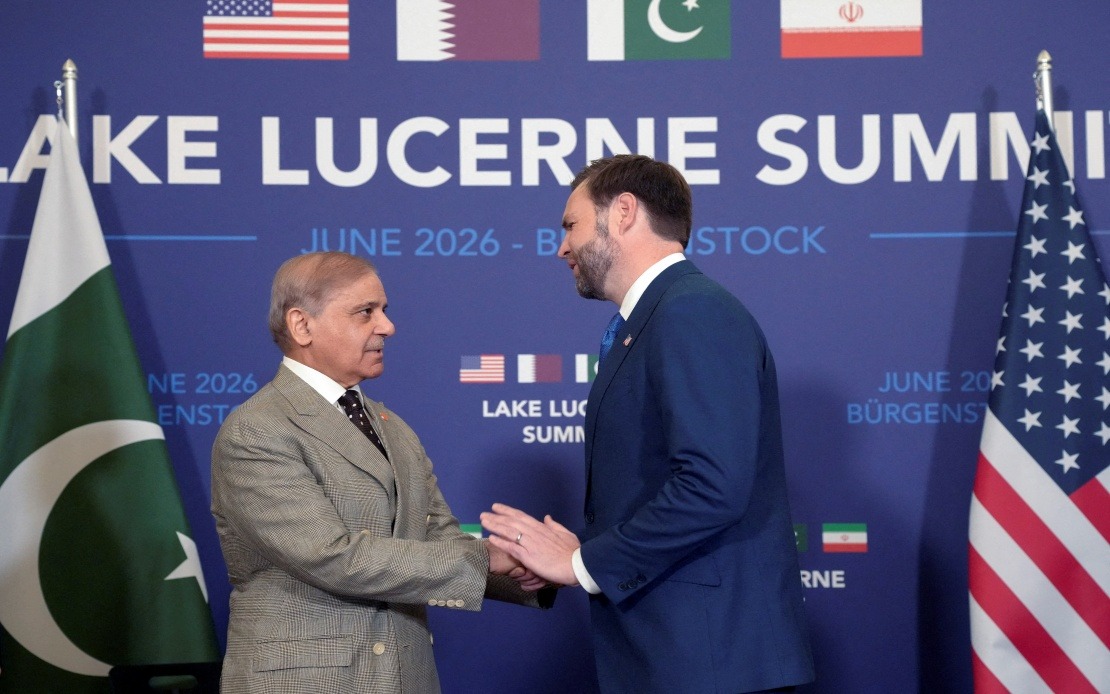
High-level representatives from the United States and Pakistan convened at the Burgenstock resort in Switzerland on Sunday for discussions that underscored the strategic importance of Pakistan's role in regional peace efforts. Vice President JD Vance, alongside special envoys Steve Witkoff and Jared Kushner, met with Pakistan's Prime Minister Shehbaz Sharif and Pakistan Army Chief Field Marshal Asim Munir in what the White House press pool described as an active negotiating session held within the resort premises.
The bilateral meeting took place concurrently with broader technical-level negotiations involving the United States and Iran, with Pakistan and Qatar serving as mediator countries in the discussions. These parallel engagements reflect the complex diplomatic choreography required to address regional security concerns that extend far beyond the immediate participants. The technical negotiations were scheduled to proceed behind closed doors, limiting public information about the substantive discussions but signalling the sensitive nature of the matters under review.
At the heart of these negotiations lies a significant development in US-Iran relations. Just days earlier, on the night of June 17 into June 18, Iran and the United States reached a breakthrough by remotely signing a memorandum designed to end military hostilities that erupted on February 28. This agreement represents a fundamental shift in the trajectory of conflict in the region and carries implications for maritime security, international trade, and broader geopolitical stability that directly affect Southeast Asian interests.
The memorandum establishes concrete timelines for crucial steps toward normalisation. The United States has committed to lifting its naval blockade of Iranian waters, while Iran has agreed to restore shipping operations through the Strait of Hormuz—one of the world's most critical maritime chokepoints through which roughly one-third of globally traded oil passes. For Malaysia and other regional economies dependent on reliable energy supplies and uninterrupted maritime commerce, the restoration of normal shipping through the strait carries substantial economic weight.
Nuclear programme resolution forms another pillar of the agreement. Iran has committed to refrain from acquiring nuclear weapons, with the detailed mechanisms for addressing Iran's nuclear capabilities to be negotiated through a separate agreement to be completed within sixty days. This component of the deal represents what many international observers view as a crucial confidence-building measure, though the specific parameters remain under active discussion. The nuclear element proves particularly significant for Southeast Asian nations concerned about weapons proliferation and its destabilising effects on regional security architecture.
For Iran, the anticipated outcome of successful negotiations would be the lifting of economic sanctions that have constrained its economy and international commerce for years. This potential sanctions relief could reshape trade patterns in Asia, particularly affecting energy markets where Iran possesses substantial reserves that multiple nations seek to access. The possibility of normalised Iranian participation in global trade networks could influence pricing and availability of crude oil and liquefied natural gas affecting Malaysia and neighbouring economies.
Pakistan's presence as both participant and mediator in these discussions reflects its delicate geopolitical position. As a nation sharing borders with Iran and maintaining complex relationships with the United States, Pakistan's diplomatic involvement carries weight in legitimising any eventual agreement and ensuring regional buy-in. The prominence of Pakistan's military leadership in these discussions, represented by Field Marshal Asim Munir, indicates that security and military dimensions remain central to the negotiations.
The involvement of special envoys Witkoff and Kushner alongside Vice President Vance suggests that the United States views these discussions as requiring sustained high-level political engagement rather than purely technical or diplomatic channels. The direct participation of the Vice President underscores Washington's commitment to achieving results and resolving regional tensions that have destabilised the Middle East for months.
For Malaysia and the broader Southeast Asian region, the outcome of these negotiations carries several implications worth monitoring. A successful resolution of US-Iran tensions could reduce military posturing in strategic waterways, lower energy price volatility, and create space for broader regional cooperation on security and economic matters. Conversely, any breakdown in negotiations could escalate tensions, increase military activities affecting shipping, and create uncertainty for energy-dependent economies throughout Asia.
The Burgenstock setting, chosen for its neutrality and discrete diplomatic environment, reflects the sensitivity both parties attach to these discussions. Switzerland's longstanding role as a venue for confidential negotiations has proven instrumental in allowing delegations to engage without intense media scrutiny that might constrain flexibility or create domestic political pressures that could derail progress.
The sixty-day timeline for nuclear negotiations suggests negotiators recognise that achieving comprehensive agreement requires sustained effort but not indefinite delay. This structured approach provides clarity for all parties about expected completion dates while allowing sufficient time for complex technical and political deliberations.
As these discussions proceed in Switzerland, observers throughout Asia will be watching for signs of progress or stalemate. The success or failure of these negotiations will reverberate across maritime trade routes, energy markets, and regional security calculations that directly affect Malaysia and Southeast Asia's strategic and economic interests in coming months.