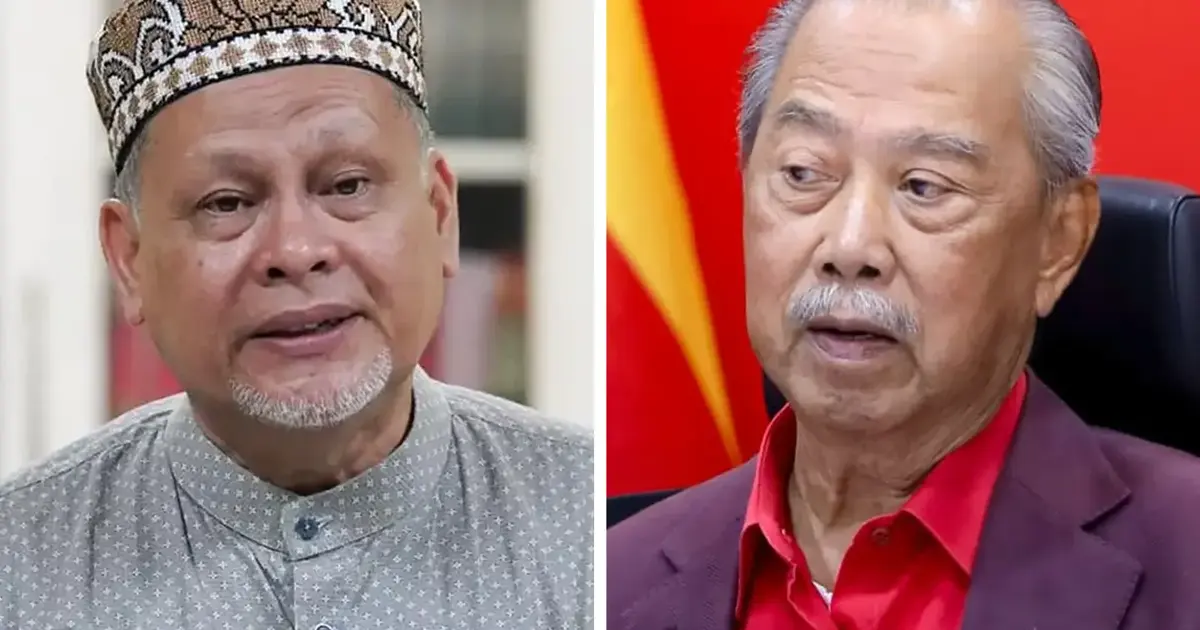
Tension within Malaysia's Perikatan Nasional (PN) coalition has intensified following remarks from Bersatu president Muhyiddin Yassin about his party's electoral prospects, prompting PAS vice-president Amar Abdullah to issue a pointed rebuke suggesting that such competition would be incompatible with continued coalition membership.
Amar Abdullah has characterised Muhyiddin's recent statements as unusual and problematic, particularly given that Bersatu remains nominally aligned with PAS within the PN framework. The escalating friction reveals deepening fissures within an alliance that has been crucial to Malaysia's political landscape since its formation in 2020, and underscores the fragility of coalition arrangements built more on electoral pragmatism than ideological coherence or institutional trust.
The row appears rooted in fundamentally different strategic visions for the two parties' electoral future. Muhyiddin's remarks suggest Bersatu may be contemplating a more independent trajectory, potentially threatening candidates directly against PAS-held constituencies—a move that would effectively transform the parties from allies into competitors. From PAS's perspective, such action while remaining within PN would constitute a betrayal of coalition solidarity, undermining the very logic of maintaining a unified electoral bloc.
For Malaysian political observers, this dispute illustrates the chronic instability afflicting coalition politics in the post-2020 era. Unlike parties that share deep organisational roots or clear ideological platforms, PN has functioned as a convenience mechanism, bringing together disparate elements—Bersatu's Malay nationalism, PAS's Islamic conservatism, and various smaller components—primarily to counterbalance other coalitions. When electoral calculations diverge, such alliances lack the cement to hold together, and positions quickly harden.
Amar Abdullah's implicit ultimatum reflects PAS's considerable leverage within the coalition architecture. As the largest party by parliamentary representation within PN, PAS has become the de facto anchor of the bloc, particularly in rural and semi-urban constituencies where the party commands deep grassroots networks. Muhyiddin, conversely, leads a considerably smaller faction, though Bersatu retains symbolic importance as the party that originally constituted PN's centrepiece. This asymmetry helps explain PAS's confident tone in drawing red lines around acceptable conduct.
The underlying dispute also touches on broader questions about Malaysia's political evolution. Coalition partnerships can stabilise government formation and reduce fragmentation, but they frequently produce tensions when component parties perceive unequal benefit or shifting dynamics. The suggestion that one partner should exit rather than compete internally suggests a winner-take-all mentality that may be counterproductive in a genuinely multi-party system seeking sustainable governance frameworks.
For Bersatu specifically, the position is particularly delicate. Muhyiddin's party has declined substantially in parliamentary representation since 2020, and its electoral relevance increasingly depends on maintaining PN affiliation and benefiting from vote-splitting dynamics that favour regional alliances over national campaigns. Yet remaining indefinitely as the junior partner in a PAS-dominated coalition may corrode party members' morale and long-term viability. This tension between short-term coalition benefits and long-term organisational health afflicts numerous smaller parties across Southeast Asia and explains why coalition politics frequently prove unstable.
Regional implications merit consideration as well. Malaysia's internal coalition fluctuations receive close attention from other Southeast Asian governments seeking to understand how multiparty systems manage coalition formation and maintenance. The instability within PN, combined with ongoing dynamics within the broader political landscape, demonstrates that even ostensibly stable arrangements can fragment rapidly when electoral incentives shift or resource distributions feel inequitable to participating parties.
Amar Abdullah's intervention also signals that PAS is willing to employ public pressure and clear territorial assertions to maintain coalition discipline. Rather than negotiating disputes privately, the explicit statement that Bersatu should exit if pursuing independent electoral strategies represents an escalation in the tone and visibility of coalition tensions. Such public positioning may harden positions on both sides, reducing opportunities for quiet compromise or face-saving arrangements that permit continued cooperation despite underlying disagreements.
The immediate political consequence remains uncertain, but the episode reveals that PN's stability cannot be assumed. Muhyiddin may seek to project confidence in Bersatu's electoral prospects to buoy party morale, or alternatively, he may be testing appetite within PN for greater accommodation of divergent electoral strategies. Either way, PAS's response establishes clear parameters: coalition membership and autonomous electoral competition are presented as fundamentally incompatible, leaving Bersatu with limited middle ground.
Longer term, the dispute underscores Malaysia's ongoing need to develop more robust coalition management mechanisms—formal agreements governing candidate selection, resource distribution, and dispute resolution procedures. Without such frameworks, coalition politics will likely remain punctuated by periodic crises and threats of dissolution, potentially destabilising government formation at critical junctures. For Malaysian political actors and observers, tracking PN's next moves becomes essential to understanding the country's broader electoral trajectory and which blocs may emerge from the next major political realignment.

