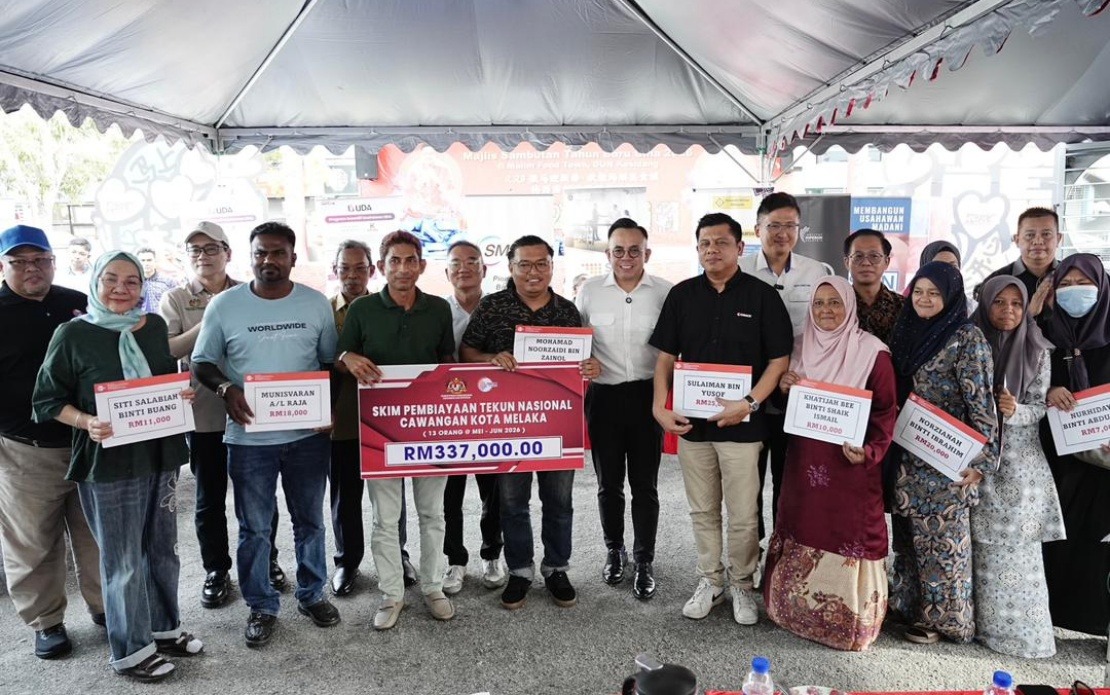
The Ministry of Entrepreneur Development and Cooperatives has channelled nearly RM100 million in financing to more than 4,300 entrepreneurs across Melaka as of the end of May, a move designed to fortify the state's microenterprise and small-to-medium enterprise ecosystem. The deployment reflects sustained governmental backing for business expansion and job creation across the region, underscoring the ministry's pivot towards grassroots economic development in an increasingly competitive regional landscape.
Minister Steven Sim has articulated the ministry's overarching philosophy: financing for entrepreneurs serves as a multiplier effect throughout the broader economy. Capital injections do not simply benefit business proprietors; they cascade through supply chains, create employment, and energise local communities. As funds circulate within the national economy, each dollar deployed generates secondary rounds of spending and investment. This reasoning underpins the ministry's determination to expand the volume of financing reaching entrepreneurs, viewing it as essential infrastructure for sustainable growth.
The announcement arrives during Sim's three-day working visit to Melaka from 19 to 21 June, timed to coincide with the Hebatkan Perniagaan Malaysia Carnival. This engagement strategy reflects a deliberate approach to connect ministry leadership directly with entrepreneurs and traders, allowing officials to monitor implementation of state-level initiatives while gathering ground-level feedback. Such visibility helps the ministry calibrate programmes to address genuine constraints faced by business operators.
At Malim Food Town, the ministry distributed nearly RM1 million in fresh financing to 18 entrepreneurs through TEKUN Nasional and SME Corp Malaysia. These recipients operate across diverse sectors—food and beverages, wholesale, professional services, construction contracting, retail, e-commerce, automotive services, and others—reflecting the heterogeneous composition of Malaysia's MSME base. The breadth of beneficiary sectors suggests the financing machinery is reaching beyond traditional retail into knowledge-based and service-oriented enterprises, a shift that may indicate broader structural changes in how Malaysians are generating livelihoods.
Nationally, the scale of intervention dwarfs the Melaka figure. Through the first five months of 2024, KUSKOP approved RM5 billion in financing that reached approximately 180,000 entrepreneurs nationwide. Extrapolating this trajectory suggests the ministry will substantially exceed its annual target. The PowerUp10K initiative, which aims to channel RM15 billion in financing to MSMEs this year, represents an aggressive expansionary programme that could reshape access to capital for the segment that employs millions of Malaysians and contributes meaningfully to GDP and export competitiveness.
For Malaysian readers, particularly those in Melaka and surrounding states, this financing availability addresses a persistent constraint: most small businesses struggle to secure affordable credit from commercial banks due to collateral requirements and risk premiums. Government-backed financing schemes lower these barriers, enabling entrepreneurs with viable business ideas but limited personal capital to launch or expand operations. This democratisation of credit access is particularly important in a state like Melaka, which has significant populations of traders, hawkers, and small retailers for whom traditional banking relationships remain distant.
The emphasis on diverse sectors and firm sizes reflects recognition that sustainable growth requires support across the entire entrepreneurial spectrum. Food and beverage enterprises, particularly those operating in designated food courts like Malim Food Town, represent visible anchors of informal and semi-formal commercial activity. Construction contracting touches broader infrastructure development. Professional services and e-commerce point toward higher-value-added segments where Malaysians can compete internationally. By financing across these categories, the ministry avoids the trap of picking winners and instead builds a broader-based ecosystem.
Sim's broader commentary on Malaysia's cultural and linguistic diversity as a competitive advantage signals how the ministry frames entrepreneurship within a larger national narrative. By positioning Malaysia as an attractive destination for foreign investment and a springboard for local firms entering regional markets, the minister links MSME financing to internationalisation aspirations. For entrepreneurs in Melaka and beyond, this framing suggests the ministry views local business expansion not as parochial survival but as potential participation in supply chains and markets extending across Southeast Asia and beyond.
The timing of this financing push coincides with economic headwinds across the region. Consumer spending has moderated, businesses face inflationary pressures on inputs, and external demand remains uncertain. In this environment, government financing programmes serve as counter-cyclical support, injecting liquidity when private sector investment has become cautious. Melaka, as a state with substantial tourism and trading heritage, stands to benefit from capital that revitalises food and beverage businesses, retail establishments, and service enterprises that depend on local spending and visitor traffic.
For the broader Southeast Asian context, Malaysia's approach to MSME financing reflects a regional trend toward direct government intervention in credit markets. Thailand, Indonesia, and the Philippines have pursued similar strategies, recognising that MSMEs often lack access to formal finance despite contributing substantially to employment and GDP. The convergence suggests policymakers across the region have concluded that market mechanisms alone leave significant entrepreneurial potential unexploited, and targeted public financing is necessary to unlock growth.
The sustainability of these programmes depends on monitoring loan performance and ensuring that financing reaches genuinely viable enterprises rather than becoming a subsidy mechanism for unsuccessful businesses. The ministry's engagement with entrepreneurs at ground level, as demonstrated during Sim's Melaka visit, provides opportunities to assess which sectors and firm types generate strong repayment patterns. This feedback loop enables continuous programme refinement, shifting capital toward segments with stronger fundamentals.
Looking forward, the trajectory toward RM15 billion in annual MSME financing signals sustained governmental commitment to grassroots economic development. For entrepreneurs in Melaka and throughout Malaysia, this represents a tangible opportunity to access growth capital. Success, however, will ultimately depend on whether recipients use these funds to generate genuine productivity improvements, expand market reach, and create sustainable employment, rather than simply servicing consumption. When businesses convert financing into concrete improvements—better equipment, skilled workers, market access—the multiplier effects Sim describes become reality, benefiting not just business owners but entire communities.
%22%2F%3E%3C%2Fpattern%3E%3C%2Fdefs%3E%3Crect%20width%3D%22100%25%22%20height%3D%22100%25%22%20fill%3D%22url(%23ph3ur6gg)%22%2F%3E%3Crect%20width%3D%22100%25%22%20height%3D%22100%25%22%20fill%3D%22url(%23ph3ur6gp)%22%2F%3E%3Ctext%20x%3D%2250%25%22%20y%3D%2250%25%22%20text-anchor%3D%22middle%22%20dominant-baseline%3D%22central%22%20fill%3D%22rgba(255%2C255%2C255%2C0.95)%22%20font-family%3D%22Georgia%2C%20'Times%20New%20Roman'%2C%20serif%22%20font-weight%3D%22700%22%20font-size%3D%22170%22%20letter-spacing%3D%22-0.02em%22%3EMalaysia%3C%2Ftext%3E%3C%2Fsvg%3E)

%22%2F%3E%3C%2Fpattern%3E%3C%2Fdefs%3E%3Crect%20width%3D%22100%25%22%20height%3D%22100%25%22%20fill%3D%22url(%23ph3wdzeg)%22%2F%3E%3Crect%20width%3D%22100%25%22%20height%3D%22100%25%22%20fill%3D%22url(%23ph3wdzep)%22%2F%3E%3Ctext%20x%3D%2250%25%22%20y%3D%2250%25%22%20text-anchor%3D%22middle%22%20dominant-baseline%3D%22central%22%20fill%3D%22rgba(255%2C255%2C255%2C0.95)%22%20font-family%3D%22Georgia%2C%20'Times%20New%20Roman'%2C%20serif%22%20font-weight%3D%22700%22%20font-size%3D%22136%22%20letter-spacing%3D%22-0.02em%22%3EParliament%3C%2Ftext%3E%3C%2Fsvg%3E)