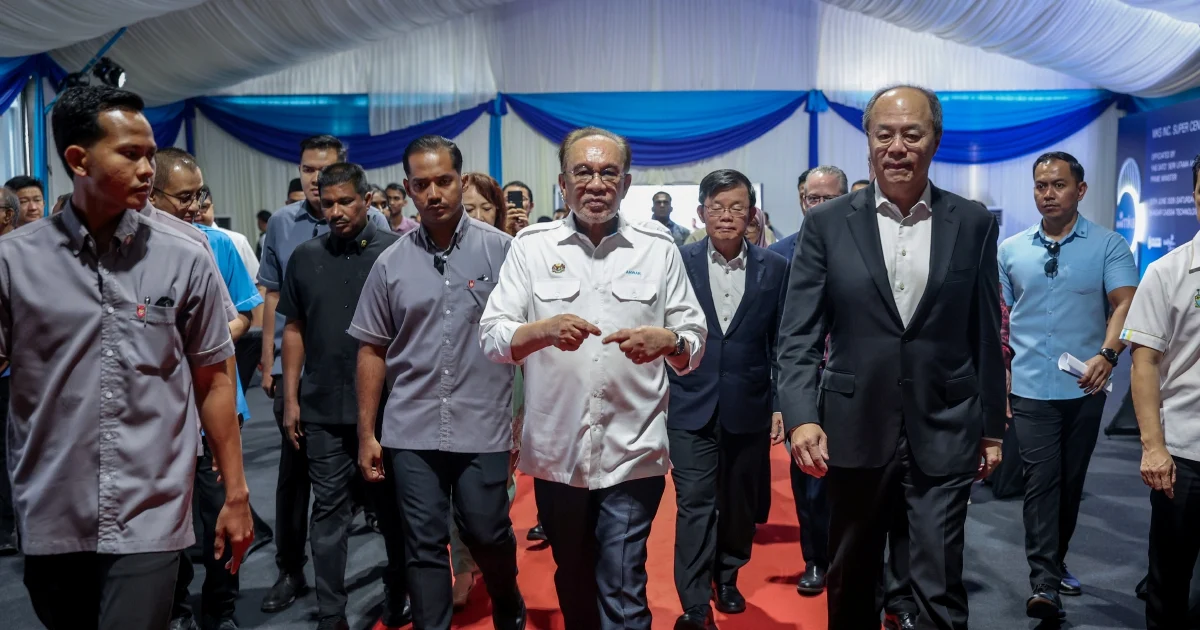
Prime Minister Datuk Seri Anwar Ibrahim has underscored the strategic advantages Malaysia derives from maintaining a position of diplomatic neutrality whilst building engagement corridors with all global powers, arguing this balanced approach is reinforcing foreign investor confidence and underpinning the country's economic trajectory. Speaking in Batu Kawan, Anwar framed the nation's foreign policy orientation as a significant competitive asset in an increasingly multipolar world marked by great-power rivalries and shifting alliances.
The Prime Minister's remarks reflect a deliberate repositioning of Malaysia's international profile following his administration's efforts to reset diplomatic relations across multiple domains. Since taking office, the government has pursued a strategy of avoiding exclusive alignment with any single bloc while expanding pragmatic partnerships across continents. This approach appears designed to reassure international investors that Malaysia will remain a stable, rule-based operating environment regardless of evolving geopolitical fault lines.
Anwar's emphasis on neutrality carries particular resonance for multinational corporations and institutional investors who have historically favoured jurisdictions that maintain stable relationships across different strategic camps. Countries that appear trapped in bilateral tensions or forced to choose sides in major-power competitions often face capital flight or reduced investment appetite, as investors factor in potential sanctions exposure or supply-chain disruption. Malaysia's refusal to align exclusively with any single power bloc presents itself as offering investors relative insulation from such risks.
The economic implications of Malaysia's diplomatic positioning extend beyond investor psychology to tangible commercial considerations. Companies seeking to maintain operations across multiple regions, particularly those with supply chains spanning both Western and non-Western markets, benefit significantly from locating in countries that enjoy good standing with all major trading blocs. Malaysia's traditional positioning as a transnational hub has been reinforced by this neutralist stance, allowing the nation to attract investment flows from sources that might otherwise perceive conflict-of-interest risks.
Anwar's framing also addresses an implicit concern among foreign investors regarding Malaysia's internal political stability and governance trajectory. By emphasising commitment to international engagement and rules-based frameworks, the Prime Minister seeks to signal that Malaysia remains anchored to established norms of international commerce and dispute resolution. This messaging becomes particularly important given Southeast Asia's broader preoccupations with balancing great-power interests whilst preserving regional autonomy—a challenge Malaysia shares acutely with neighbours like Vietnam, Thailand, and Indonesia.
The neutrality narrative further serves Malaysia's specific position within the region's complex architecture. As a member of ASEAN, Malaysia is bound by the bloc's traditional doctrine of non-alignment, yet economic interdependencies with China, partnership obligations toward the United States and Europe, and security arrangements with traditional allies create competing pressures. Anwar's rhetoric suggests his administration is attempting to square this circle by presenting neutrality not as weakness or fence-sitting, but as a source of comparative advantage and stability that investors value.
However, maintaining genuine neutrality amid intensifying great-power competition requires consistent messaging and careful navigation of geopolitical minefields. The attractiveness of Malaysia's position ultimately depends on whether major powers perceive the country as genuinely equidistant or whether they suspect hidden preferences. Recent regional tensions, including maritime disputes and technological competition, test the credibility of any nation's claimed neutrality. Malaysia's ability to preserve investor confidence depends substantially on demonstrating equitable treatment of interests across multiple spheres of influence.
Foreign direct investment responses to Malaysia's diplomatic posture have manifested across multiple sectors, from technology and semiconductor manufacturing to financial services and advanced manufacturing. Investment decisions rarely hinge on foreign policy alone, but Malaysia's reputation as a non-aligned hub with strong institutional frameworks and skilled workforces has proven attractive to companies seeking geographic diversification and reduced geopolitical risk. The Prime Minister's articulation of this positioning appears designed to deepen awareness of this advantage among potential investors.
The economic growth correlations Anwar identified merit examination within Malaysia's broader context. The nation has experienced renewed momentum in foreign investment flows during periods when political leadership has emphasised stability, institutional independence, and measured engagement with all partners. Conversely, periods marked by perceived alignment too heavily with particular powers have sometimes triggered investor hesitation, particularly among multinational firms with global operations requiring carefully balanced geographic exposure.
Malaysia's experience also resonates across Southeast Asia, where several nations confront similar tensions between geopolitical pressures and economic imperatives. The success or failure of Malaysia's neutrality strategy may influence how other regional countries calibrate their own foreign policies and investor communication strategies. If Malaysia demonstrates that principled non-alignment enhances economic performance, neighbouring nations may follow comparable trajectories; conversely, if pressures mount that force explicit choosing of sides, Malaysia's model could prove unstable.
Looking forward, the sustainability of Malaysia's neutrality-based investor confidence depends on three interconnected factors: the credibility of Malaysian institutions in maintaining independence from external pressure, the continued viability of true non-alignment in an era of increasing polarisation, and the administration's ability to translate diplomatic positioning into tangible economic policy that delivers growth and opportunity. Anwar's emphasis on these connections represents not merely rhetorical positioning but reflects strategic calculation about where Malaysia's interests lie in the evolving global order.

