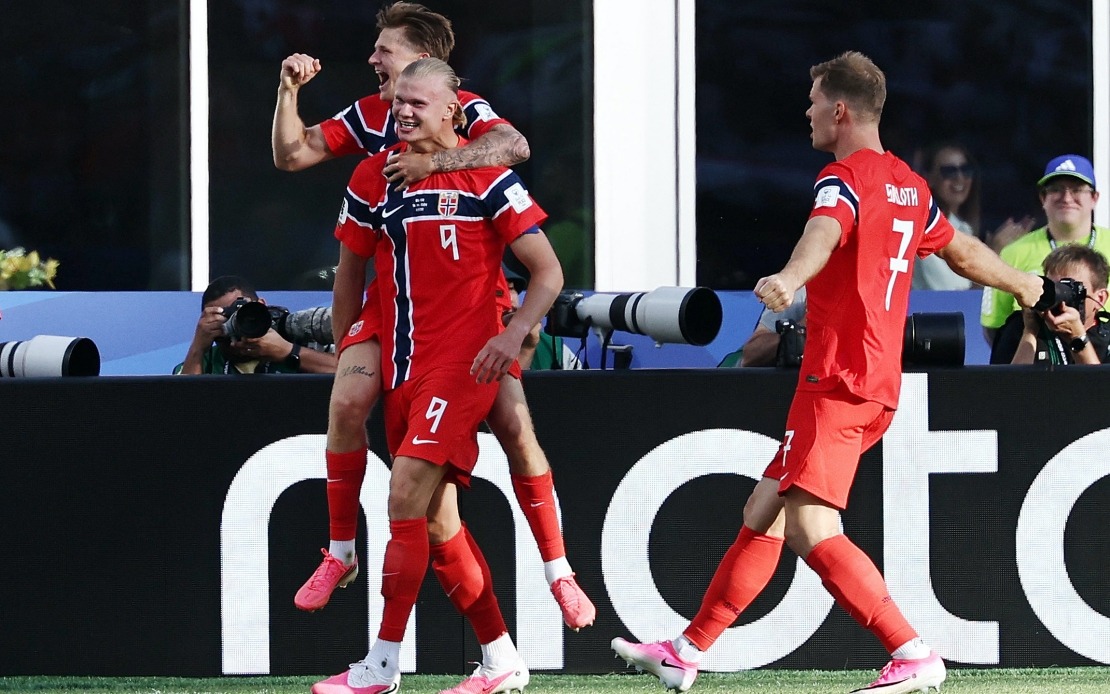
Norway's World Cup campaign carries a powerful narrative dimension, with three current squad members driven by a deeply personal quest to eclipse their fathers' achievement from three decades ago. Erling Haaland, Alexander Sørloth, and Kristian Thorstvedt represent a rare sporting phenomenon: sons determined to complete what their fathers could not when Alf-Inge Haaland, Gøran Sørloth, and Erik Thorstvedt represented Norway at the 1994 World Cup in the United States, only to be eliminated in the opening phase.
Norway's explosive 4-1 triumph over Iraq in their opening fixture has already set a promising tone for their tournament ambitions. This commanding performance provides substantial momentum as the Nordic nation prepares to face Senegal on Monday, a fixture that presents a tangible opportunity to secure knockout stage advancement. The subsequent group encounter against France will complete Norway's preliminary obligations, though the psychological weight of matching or surpassing their predecessors' legacy weighs heavily throughout the squad.
Haaland, already Manchester City's star striker and widely recognized as Norway's most prominent international footballer, has embraced the family connection with characteristic candour. When presented with photographs of his father from the 1994 tournament, the younger Haaland expressed amusement at the striking appearance of the elder Haaland, particularly noting his father's distinctive long hair—a far cry from his modern appearance. This generational contrast encapsulates the passage of time and the opportunity now presenting itself to the current generation of Norwegian talent.
The path that Erling Haaland has pursued mirrors his father's trajectory in unexpected ways. Like Alf-Inge Haaland before him, the younger Haaland has achieved prominence at Manchester City, cementing his status as one of European football's most formidable attacking forces. The parallel between father and son extends beyond mere club allegiance, representing a continuation of excellence in Norwegian football that resonates throughout the nation's sporting consciousness.
Sørloth, now plying his trade at Atletico Madrid, has articulated the profound significance of competing at the same tournament where his father competed a generation earlier. He has characterized the experience as genuinely remarkable, reflecting on how his father has served as his foundational mentor in football. These remarks underscore a reality often overlooked in modern sports discourse: the transmission of knowledge, values, and sporting philosophy from parent to child extends beyond physical inheritance into the realm of tactical understanding and competitive mentality.
Remarking on his earliest World Cup memory, Sørloth recalled witnessing the 2002 tournament contested in Japan and South Korea while on holiday with his family in Denmark. He vividly described the electricity of watching football's greatest spectacle alongside his father, moments that fundamentally shaped his aspiration to reach the tournament stage himself. Such intimate recollections reveal how global sporting events create defining family memories that drive athletes toward replicating or surpassing those formative experiences.
The historical resonance of 1994 remains tangible within Norwegian football consciousness, more than a quarter-century after the fact. That particular World Cup, hosted in the United States, represents both accomplishment and unfulfilled potential for the generation of fathers now watching their sons attempt to progress further. The narrative carries particular weight for a nation where football commands substantial cultural significance and international sporting achievement resonates across society.
Official recognition of this generational moment has permeated the highest echelons of Norwegian society. Hereditary Princess Ingrid Alexandra and Prince Sverre Magnus, the children of Crown Prince Haakon and Crown Princess Mette-Marit, are anticipated to attend Norway's Monday encounter against Senegal in New Jersey. This royal presence underscores how thoroughly the squad's quest has captured the imagination of Norway's establishment and citizenry alike.
The groundswell of support has manifested itself through distinctly Norwegian cultural expressions, particularly the rowing routine drawing on Viking heritage that Norwegian supporters have popularized. This practice has transcended stadium boundaries, with members of Norway's parliament representing all political parties participating in demonstrations of national solidarity on Thursday. Such parliamentary involvement testifies to how thoroughly the team's campaign has united diverse political factions in common cause.
For Malaysian and Southeast Asian observers, the Norwegian narrative presents instructive lessons regarding the importance of youth development pathways and the transmission of sporting excellence across generations. Nations throughout the region increasingly recognize that producing world-class athletes requires not merely contemporary investment but sustained institutional commitment across decades. Norway's approach—evident in how the current generation of talent has benefited from systematic development—offers potential models for regional football federations seeking to elevate their international standing.
The psychological dimension of competing with paternal legacy adds complexity to the pressures Norwegian players already navigate. While some athletes might experience such expectations as constraining, Haaland, Sørloth, and Thorstvedt have publicly framed their fathers' participation as motivational rather than burdensome. This healthy psychological framework—viewing generational continuity as opportunity rather than pressure—potentially explains their squad's strong opening performance.
Looking forward, Norway's progression through the group stage remains uncertain despite their impressive opening. Senegal presents a formidable opponent with its own tournament aspirations, while France ranks among tournament favorites. Nevertheless, the distinctive human interest narrative surrounding Haaland and his contemporaries has already elevated global interest in Norway's campaign beyond typical assessment of their objective capabilities. Win or lose, these three players have already contributed to one of the World Cup's most compelling subplots.