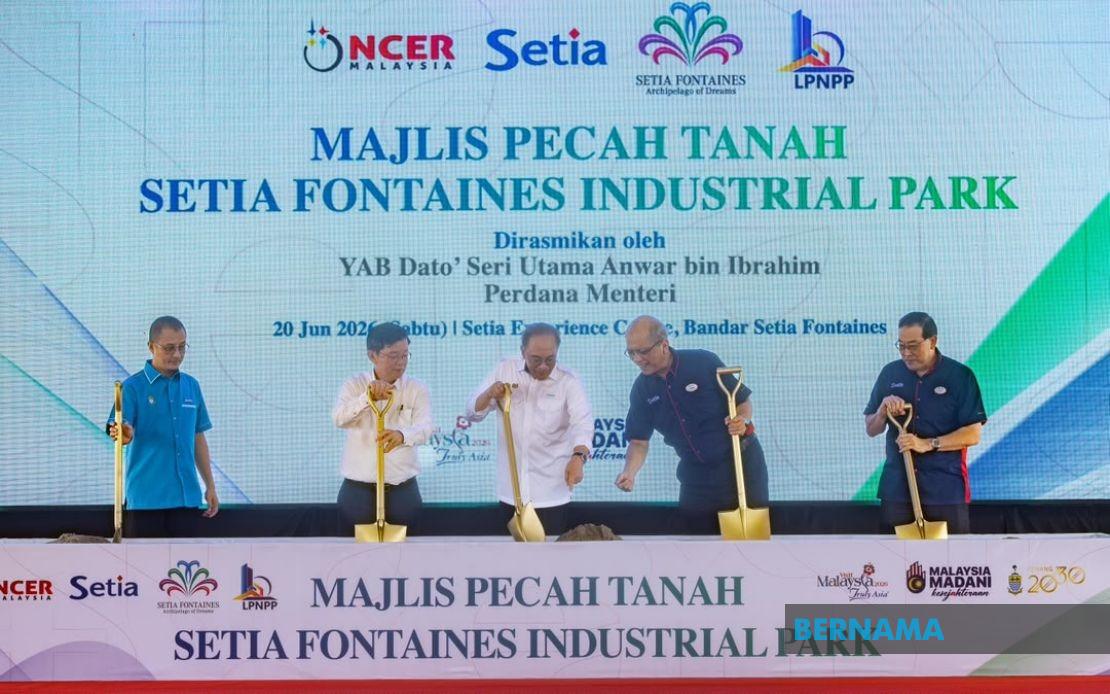
Prime Minister Datuk Seri Anwar Ibrahim has issued a stark warning that rapid economic development and surging investment will only deepen inequality unless government agencies and private sector players actively channel opportunities toward middle and lower-income communities. Speaking at the groundbreaking ceremony for the Setia Fontaines Industrial Park in Bandar Setia Fontaines, Kepala Batas, Anwar emphasised that inclusive growth cannot be an afterthought but must be embedded into the very architecture of major development initiatives.
The Prime Minister's remarks underscore a fundamental tension in Malaysia's development agenda: balancing the pursuit of higher-value economic activities with the need to ensure broad-based prosperity. Anwar articulated this challenge with particular force, suggesting that economic gains concentrated among a narrow segment of society would ultimately undermine social cohesion and constrain pathways out of poverty for disadvantaged communities. His comments reflect growing concern within government that Malaysia's transition toward high-tech manufacturing and advanced sectors risks leaving behind those without access to quality education or capital.
Anwar specifically referenced major institutional investors—Khazanah Nasional Berhad, Permodalan Nasional Berhad, and the Employees Provident Fund—as having particular responsibility to structure their commercial projects with equity considerations in mind. Each time these entities or private companies receive government approval for development, he argued, there must be deliberate mechanisms to create entry points for lower and middle-income Malaysians. Without such provisions, the Prime Minister warned, the wealth gap will widen inexorably while opportunities for ordinary Malaysians contract rather than expand.
This framing represents a significant policy emphasis within the current administration. Rather than treating inclusive growth as a secondary social objective, Anwar positioned it as integral to economic strategy itself. The approach suggests that sustainable development requires not just numerical growth metrics—GDP figures, foreign direct investment inflows, or job creation numbers on paper—but tangible improvements in living standards and economic mobility for average Malaysians. The distinction matters: encouraging statistics divorced from ground-level impact serve neither economic nor political stability in the long term.
The Setia Fontaines Industrial Park exemplifies the type of investment Anwar believes should operate under these principles. Located in Bandar Setia Fontaines, the development represents broader efforts to ensure Seberang Perai experiences economic momentum comparable to that seen on Penang Island and in the state's southern reaches. The industrial park is conceived as a vehicle for generating quality employment as Malaysia shifts away from lower-value, labour-intensive manufacturing toward technology-intensive sectors. This transition is economically desirable but carries acute risks: workers displaced from traditional manufacturing may lack the credentials or skills for emerging opportunities unless deliberate interventions facilitate their transition.
Anwar highlighted the critical role of technical and vocational education and training institutions in closing this skills gap. He stressed that collaboration must deepen among industry players, polytechnics, universities—specifically citing Universiti Sains Malaysia—and other educational providers to ensure curricula and training programmes remain aligned with actual employer needs. This is not merely an administrative coordination challenge but a substantive one: the pace of technological change means that training curricula can become obsolete within months or years. Educational institutions must therefore maintain fluid, bidirectional relationships with employers to anticipate skills demand rather than perpetually chasing it.
The Prime Minister's concern about skills misalignment touches on a persistent Malaysian challenge. The nation frequently experiences simultaneous unemployment among graduates and labour shortages in specific sectors, suggesting a structural mismatch between education supply and economic demand. This disconnect particularly affects lower-income communities whose children may attend under-resourced schools or lack networks providing access to vocational pathways. Breaking this cycle requires that educational institutions not serve as passive repositories of general knowledge but as active partners in workforce development, with explicit connections to employment outcomes.
Anwar's insistence on inclusive development also carries implications for how Malaysia competes regionally and globally. As Southeast Asian nations vie for foreign investment and position themselves within regional value chains, those with broader-based human capital and higher social cohesion typically enjoy competitive advantages over those marked by sharp inequality and limited opportunity mobility. Countries perceived as having entrenched inequalities risk both talent outflows—as skilled individuals seek greener pastures—and social instability that deters long-term investment. Conversely, inclusive growth strategies can reinforce each other: better distributed income supports domestic consumption, creating markets for local enterprises; broader access to education and training deepens the talent pool available to employers; higher mobility and opportunity reduce political tensions.
The industrial park project itself, if executed in line with the Prime Minister's principles, could serve as a proof-of-concept for inclusive development. A facility explicitly designed to create pathways for local workers from diverse income backgrounds, supported by coordinated education and training partnerships, would demonstrate that profitability and equity need not be opposing objectives. However, translating this vision into practice requires sustained commitment from multiple actors—government regulators must enforce standards, private operators must resist cost-cutting pressures that undermine inclusion, and educational institutions must maintain rigorous quality standards while expanding access.
Anwar's emphasis on this issue also reflects political calculation. The government's legitimacy depends partly on demonstrating that its policies deliver tangible improvements for ordinary Malaysians, particularly those in lower-income categories who face the starkest economic pressures. Messages about rapid GDP growth or record foreign investment attract limited enthusiasm if daily costs mount while wages stagnate. By publicly championing inclusive development and holding major investors accountable to equity principles, the Prime Minister positions his administration as attentive to distribution concerns, not merely aggregate growth.
Looking forward, the degree to which Anwar's exhortations translate into structural change remains uncertain. Development approvals can be made subject to equity conditions, but enforcement and monitoring require bureaucratic capacity and political will. Educational institutions can be directed to align curricula more closely with employer needs, but doing so effectively demands resources, faculty flexibility, and sustained dialogue. What is clear is that the Prime Minister has identified inclusive growth not as an optional add-on but as a prerequisite for sustainable development, establishing a benchmark against which future projects will increasingly be measured.

