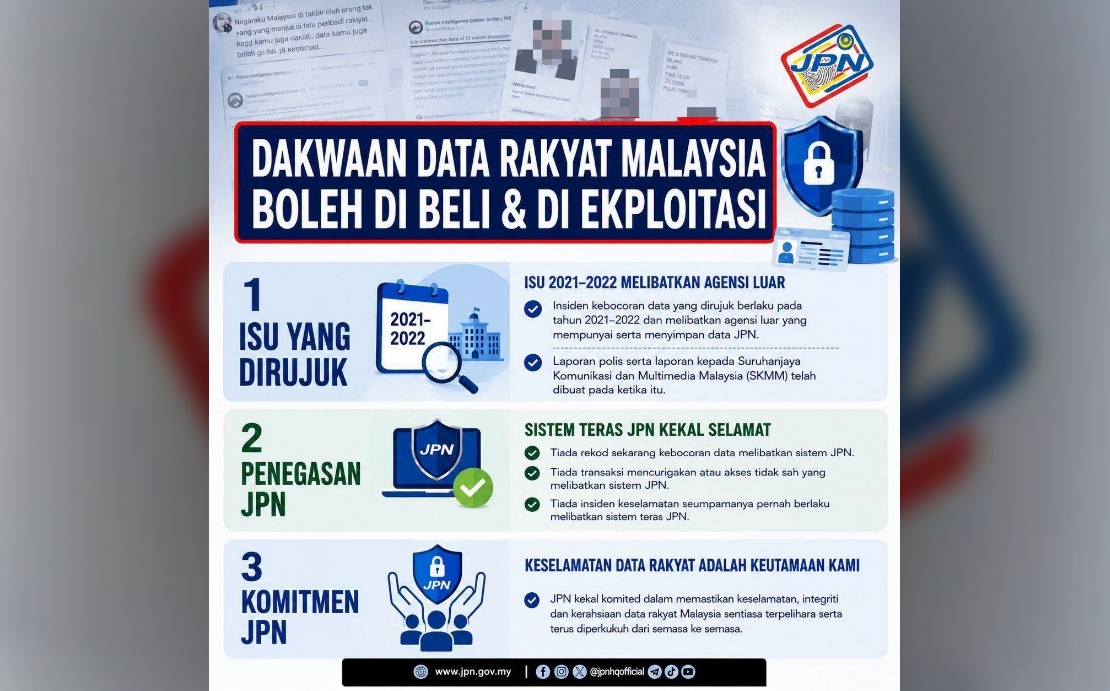
The National Security Council (MKN) moved swiftly this week to dispel concerns about a personal data breach that had gained traction on social media, asserting that the compromised information originates from older cybersecurity incidents predating 2022 rather than contemporary digital systems. Through the National Cyber Security Agency (NACSA), the council emphasized that the data in question was acquired illegally via cyber intrusions targeting multiple systems years ago and is now being circulated online without proper authorisation, a development that underscores persistent vulnerabilities in how historical breach material is exploited for profit or mayhem.
The framing of the incident as a historical matter rather than an active breach represents a crucial distinction for Malaysian citizens concerned about the security of their personal information on government and commercial platforms. However, the mere fact that years-old data continues to circulate and be monetized through illicit channels highlights a troubling reality: once compromised, personal information remains a valuable commodity in the criminal underworld indefinitely. The council's acknowledgment that this material is being redistributed highlights how legacy breaches can resurface, particularly when handled by actors operating across international borders where enforcement becomes far more complicated.
Under Malaysian law, the unauthorized possession, distribution, and sale of unlawfully obtained personal data constitutes a serious criminal offence regardless of where the hosting infrastructure or service operators are located. NACSA has made this position unambiguous: those who provide access to illegally acquired information or profit from its dissemination face prosecution, even if the services offering such access operate from overseas servers beyond immediate Malaysian jurisdiction. This legal principle is essential because cybercriminals frequently exploit jurisdictional loopholes by routing operations through countries with weaker data protection enforcement.
In response to the breach claims, NACSA has partnered with MyNIC and the Personal Data Protection Department to pursue an aggressive take-down strategy. These agencies have engaged international service providers to identify, remove, and block access to the websites facilitating the illegal distribution of compromised data. Simultaneously, the Royal Malaysia Police has launched digital forensic investigations aimed at tracing the identities of those responsible for storing, packaging, and profiting from the stolen information. Such coordinated action demonstrates the government's commitment to following the digital trail wherever it leads.
The council has also issued a public advisory cautioning Malaysians against patronizing services that promise access to unlawfully acquired information. This messaging is directed both at the general population and at organizations that might unknowingly or knowingly utilize such data for competitive advantage or other purposes. Using stolen personal information contributes to the perpetuation of cybercrime and places individuals at legal risk while simultaneously funding criminal networks. Beyond individual moral considerations, widespread consumption of illegally obtained data normalizes the practice and creates economic incentive for further breaches.
The incident arrives amid broader legislative efforts to strengthen Malaysia's cybersecurity framework. The Cyber Crime Bill, slated for parliamentary consideration, introduces significantly expanded definitions of what constitutes a criminal offence in the digital realm. The proposed legislation specifically criminalizes unauthorized access to or modification of computer systems and software without lawful authority, a provision that would broaden the scope of prosecution beyond simply stealing data to include activities such as reconnaissance and system probing. Additionally, the bill defines identity theft as the unlawful use of another person's identity with intent to commit fraud or other crimes, addressing a growing concern as stolen personal data fuels identity-related offences.
Complementing these legislative advances is the Cyber Security Act 2024, which took effect in August of that year. This law establishes mandatory security standards for organizations managing National Critical Information Infrastructure (NCII), encompassing sectors such as energy, water, telecommunications, and finance. Entities designated as NCII operators must implement comprehensive protection measures including formal codes of practice, detailed risk assessments, and regular security audits. The enforcement mechanism creates ongoing accountability and forces organizations to prioritize cyber resilience rather than treating it as a secondary consideration after a breach occurs.
The council also took the opportunity to address public misunderstandings surrounding MyDigital ID, a digital identity platform that has surpassed 16 million registrations since its introduction. A persistent misconception holds that MyDigital ID functions as a centralized data repository storing personal information vulnerable to wholesale theft. In reality, the system operates as an authentication mechanism that verifies user identities by communicating directly with the National Registration Department's authoritative records rather than maintaining shadow copies of personal data. This architecture substantially reduces the attack surface by eliminating the need to store sensitive information on multiple platforms.
The widespread integration of MyDigital ID across government services and private-sector applications spanning telecommunications, banking, and e-commerce has created a unified verification layer that reduces reliance on fragmented identity systems vulnerable to compromise. As more entities adopt MyDigital ID for authentication, the potential for identity theft decreases because fraudsters cannot simply purchase or breach a single database to gain access to multiple services. Instead, they would need to compromise the National Registration Department's own systems, a far more difficult and heavily monitored target.
Looking forward, the council has reaffirmed that cybersecurity remains a central pillar of Malaysia's digital transformation agenda. The government's strategy explicitly prioritizes ensuring that the benefits of digital innovation—from e-commerce to telemedicine to digital government services—are made available to all Malaysians while maintaining robust protections against threats. NACSA, working through MKN, has pledged to remain vigilant and responsive to emerging cybersecurity challenges, whether they stem from foreign state actors, organized criminal syndicates, or individual hackers exploiting vulnerabilities for financial gain.
For Malaysian businesses and individuals, the key takeaway extends beyond the immediate incident. The circulation of pre-2022 breach data demonstrates that cybersecurity is not merely about preventing future intrusions but also about managing the extended lifecycle of compromised information. Individuals and organizations should assume that personal data exposed in any previous breach remains at risk of exploitation indefinitely and take preventive measures such as monitoring financial accounts, using strong authentication, and remaining vigilant for social engineering attempts. As Malaysia's legal and regulatory framework matures, enforcement will become more consequential for both perpetrators and those who knowingly utilize stolen data for commercial advantage.