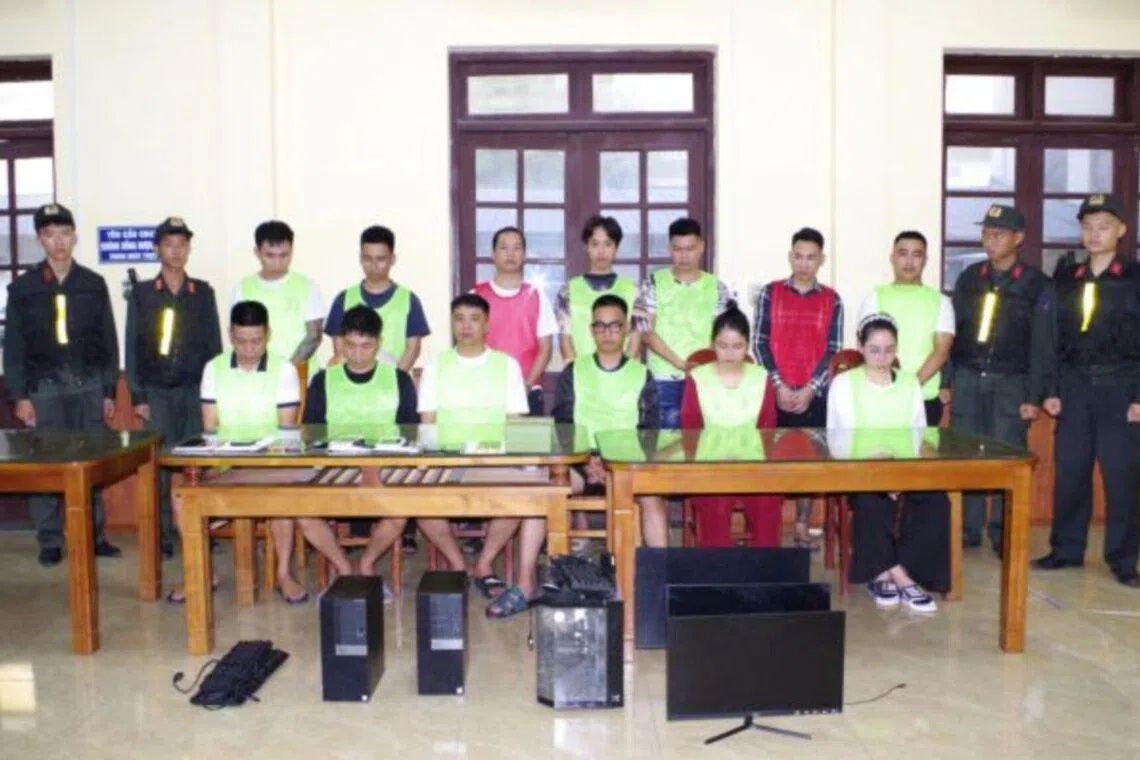
Police in Vietnam's Ninh Binh province have successfully shut down an international online fraud syndicate that operated across borders, with investigations revealing losses exceeding RM39.2 million inflicted upon more than 500 Vietnamese citizens since October 2024. The operation, which involved 12 arrested suspects and two identified ringleaders, represents a significant victory against organised cybercrime in Southeast Asia at a time when cross-border digital scams have become increasingly sophisticated and difficult to track.
Nguyen Van Cuong, aged 28, and Nguyen Van Phuong, aged 34, have been identified as the masterminds behind the enterprise. Police investigation determined that the pair orchestrated the recruitment of numerous Vietnamese nationals, whom they transported to Cambodia to establish and operate their fraud network. The relocation of operatives to a neighbouring country underscores how transnational criminal organisations exploit jurisdictional boundaries and regulatory gaps to evade law enforcement, a pattern increasingly familiar to authorities across Southeast Asia who struggle with the porous nature of regional borders and varying legal frameworks.
The sophistication of the operation lay not merely in its scale but in the multifaceted deception methods deployed by the network. Operatives created counterfeit digital infrastructure, including fake websites and mobile applications designed to mirror government agencies and established commercial entities. This technological dimension enabled them to build false credibility with potential victims, who encountered seemingly legitimate platforms that differed only subtly from authentic ones. Such technical proficiency indicates the group likely included individuals with coding and design capabilities, suggesting the fraud ring operated with considerable organisational depth rather than as a casual criminal enterprise.
The fraudsters employed an extensive arsenal of social engineering tactics that exploited different psychological vulnerabilities. They impersonated authority figures including police officers, prosecutors, judges, bank employees, and tax officials, lending their communications an appearance of legitimacy that compelled victims to comply with financial demands. This dimension of the scheme reveals how perpetrators weaponised the inherent respect citizens hold for government institutions and financial bodies, turning institutional trust itself into a tool of deception. The variety of impersonations also suggests the network tested different personas to identify which proved most effective at extracting funds from victims.
The criminal operation employed multiple scam modalities simultaneously, allowing the network to target diverse demographic groups and exploit different motivation patterns. Fake employment recruitment schemes lured individuals seeking additional income, while investment fraud capitalised on the aspiration for financial growth, particularly through cryptocurrencies and securities—sectors where technological complexity obscures fraudulent activity from non-specialist victims. Romance scams exploited emotional vulnerability, a tactic of proven effectiveness that remains depressingly lucrative for criminal networks. Account hijacking, wherein fraudsters gained control of legitimate social media profiles, then leveraged existing networks of trust to solicit loans, represented perhaps the most insidious variant, as victims often involved their own family members and acquaintances as unwitting conduits of deception.
One particularly elaborate scheme demonstrates the calculated sophistication of the operation. Members posed as military officers and contacted commercial establishments with ostensibly legitimate orders for substantial quantities of goods. They then requested that shop owners and business operators purchase additional inventory on their behalf, requesting payment or deposits be transferred to accounts controlled by the fraudsters. This scheme cleverly exploited not merely individual psychology but institutional procurement processes, presenting itself as ordinary commercial activity that fell within normal business parameters. The ability to execute such schemes successfully suggests operational discipline and the development of detailed playbooks that instructors could teach to new recruits in the Cambodia-based operation.
Investigative authorities recovered substantial physical evidence during simultaneous raids on the network's facilities. Cash, vehicles, mobile phones, computers, identity documents, jewellery, and extensive documentary records pertaining to the operation were seized, providing investigators with material evidence of the crimes and records that will likely implicate additional participants. The diversity and volume of seized items suggests the network operated with sufficient financial resources to maintain a physical infrastructure, purchase equipment, and accumulate assets—a level of capitalisation indicating either high prior success or backing from more established criminal organisations.
Police have charged six suspects with fraudulent appropriation of property and placed them in temporary detention, while procedural measures against the remaining six suspects continue as investigations expand. The two-tier response reflects standard Vietnamese legal procedure whilst maintaining investigative momentum. Authorities have indicated that identification and apprehension of additional suspects remains ongoing, suggesting the twelve arrested individuals represented only the operational layer rather than the complete network structure. Such findings typically prompt broader investigations into financial flows, communication records, and recruitment channels that may reveal upstream involvement.
Asset seizure and freezing operations are proceeding concurrently with criminal prosecution, authorities announced. These parallel measures serve the dual purposes of preventing further dissipation of illicit proceeds whilst simultaneously building stronger cases for prosecution. Recovery efforts face inherent difficulties given the cross-border nature of the operation and the likelihood that significant portions of defrauded funds have already been transferred through multiple financial jurisdictions, a common challenge for Southeast Asian law enforcement agencies addressing transnational crime. The coordination required to recover assets across Vietnam and Cambodia demands institutional cooperation frameworks that remain imperfect in the region.
This case illuminates broader cybercrime trends affecting Southeast Asia, where geographic proximity to established digital infrastructure, relatively lower operational costs than in developed economies, and varying regulatory enforcement capabilities combine to create an attractive environment for organised fraud networks. The relocation of operatives to Cambodia specifically indicates deliberate selection of jurisdictions perceived as offering operational advantages, whether through weaker law enforcement capacity, more permissive regulatory environments, or established criminal infrastructure. Vietnamese authorities' success in dismantling this network provides cautionary evidence that regional cooperation and sustained investigation can disrupt even sophisticated operations, yet the ease with which such networks form suggests the underlying conditions enabling cybercrime remain largely unaddressed.

