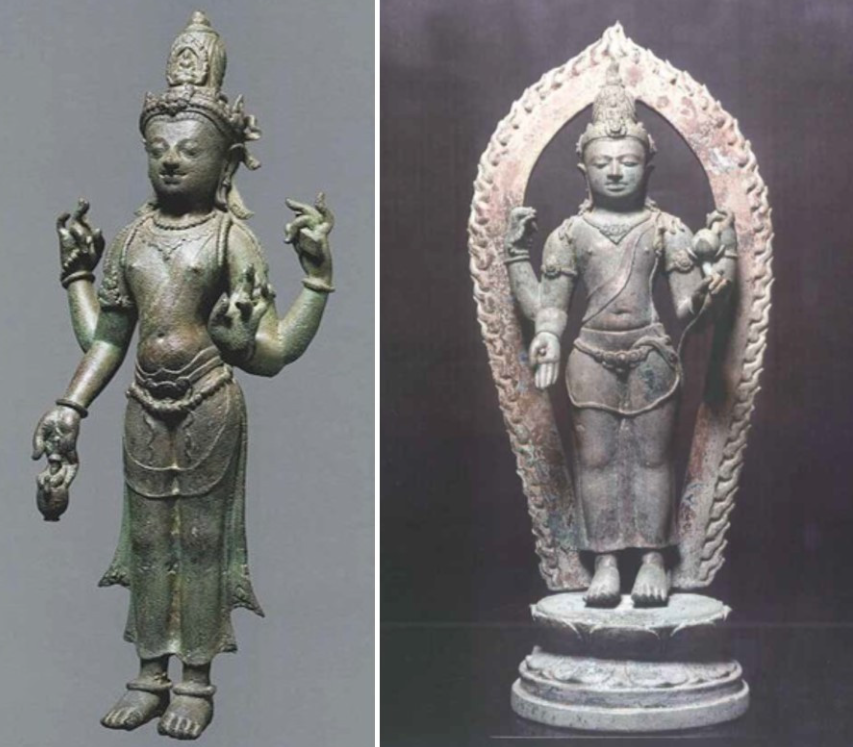
The United States has formally returned two eighth-century bronze Buddhist statues to Indonesia, marking another significant victory in the international campaign against cultural heritage theft. The repatriation ceremony, held at the Indonesian Consulate in New York, underscores the commitment of American law enforcement to dismantle networks that profit from the systematic looting of Southeast Asian antiquities. These sculptures represent far more than artistic treasures; they embody the cultural identity of Indonesia and the broader region, and their recovery demonstrates that stolen heritage can find its way home even after decades in private collections.
The two statues depict Avalokiteshvara, the four-armed bodhisattva venerated across Buddhist traditions for embodying compassion and mercy. Archaeological evidence indicates these pieces were removed from Indonesian sites several decades ago, though the precise locations remain undetermined. The sculptures subsequently entered a shadowy international black market before being acquired by the notorious British antiquities dealer Douglas Latchford, who operated primarily from Bangkok and built a career spanning more than four decades as a leading trafficker of Southeast Asian heritage.
Latchford's role in the antiquities underworld cannot be overstated. For years, he cultivated a reputation as a preeminent collector and dealer of Khmer and broader Southeast Asian art, operating within elite circles of wealthy private buyers and major museums. This veneer of legitimacy enabled him to move looted objects through legitimate channels, obscuring their illicit origins. Between 2003 and 2007, Latchford sold the Indonesian statues along with numerous other artifacts to an American collector, deliberately withholding information about their origins and fabricating provenance documentation to facilitate their entry into the legal art market.
The scheme unravelled in 2019 when prosecutors from the Southern District of New York indicted Latchford for orchestrating a decades-long trafficking operation involving looted Cambodian and Southeast Asian antiquities. The indictment represented the culmination of years of investigation into one of the world's most significant illicit art networks. However, Latchford died in 2020 before facing trial, allowing him to escape justice but not before his legacy became permanently tarnished. Yet his death did not end accountability; two years later, a US-based collector who had purchased pieces from Latchford voluntarily surrendered 34 Cambodian and Southeast Asian antiquities, including the Indonesian bronze statues, demonstrating the power of legal and moral pressure to encourage repatriation.
US Attorney Jay Clayton, speaking at the repatriation ceremony, emphasized the broader significance of the recovery. Clayton stated that the occasion celebrated the restoration of Indonesia's cultural patrimony to its rightful owners and reaffirmed American law enforcement's determination to prosecute antiquities trafficking networks. The prosecutor highlighted the critical partnership between federal prosecutors and the Department of Homeland Security Investigations in identifying and recovering stolen cultural property, while also acknowledging the moral responsibility of private collectors to cooperate with authorities when they discover they possess looted artifacts.
The case of Douglas Latchford illuminates the mechanics of high-level antiquities trafficking that affects Southeast Asia disproportionately. For decades, Cambodia and Indonesia have suffered systematic looting, with thieves targeting temples, archaeological sites, and museums. Latchford exploited demand from wealthy international collectors and institutions willing to purchase objects without rigorous provenance verification. His death in 2020 prompted his daughter to negotiate the return of his collection, valued at more than $50 million, to Cambodia, setting in motion a cascade of recoveries as museums and collectors across the United States, Europe, and Australia repatriated related artifacts.
Indonesia's experience with antiquities trafficking extends beyond the Latchford network. In 2024, US authorities returned three Indonesian artifacts previously valued at approximately 6.5 billion rupiah, representing a separate trafficking operation. Those objects—a Majapahit stone relief, a seated bronze Buddha statue, and a standing bronze Vishnu figure—had been trafficked by Indian-American dealer Subhash Kapoor and American dealer Nancy Wiener through the Manhattan-based Art of the Past gallery. That investigation, conducted jointly by the Manhattan District Attorney's Office and the Department of Homeland Security, ultimately recovered more than 2,500 antiquities allegedly trafficked by Kapoor's network, with an estimated combined value exceeding $143 million.
The recovery of these artifacts reflects the sophisticated investigative capabilities now deployed against international cultural property crime. Modern forensic analysis, digital tracking of provenance, and international cooperation have made it increasingly difficult for traffickers to operate with impunity. Yet the scale of ongoing looting remains alarming. These high-profile cases, while representing significant victories, constitute only a fraction of the total Southeast Asian cultural heritage believed to be in unauthorized foreign possession. Estimates suggest that thousands of artifacts remain unaccounted for, held in private collections or institutional storage facilities worldwide.
For Indonesia and Southeast Asia more broadly, successful repatriations carry profound meaning beyond the material return of objects. Each recovery reinforces the principle that nations possess inalienable rights to their cultural heritage and that international law increasingly protects these rights. The statues of Avalokiteshvara will eventually return to Indonesia where they can inform public understanding of Buddhist artistic traditions and the region's rich archaeological past. Their journey through the black market and back home also serves as a cautionary tale about the vulnerability of cultural sites to organized looting and the importance of stronger protection measures at source locations.
The repatriation also highlights the critical role played by individual collectors willing to cooperate with authorities. The American collector who voluntarily surrendered the Latchford pieces demonstrated ethical responsibility by recognizing that purchasing provenance from traffickers, however unknowingly, perpetuates harmful systems. This precedent encourages other collectors and institutions holding potentially looted Southeast Asian artifacts to undertake rigorous provenance reviews and cooperate with law enforcement rather than remaining silent. Such voluntary returns, complemented by legal proceedings, create multiple pathways for recovery that benefit source nations seeking to rebuild their heritage collections.
Looking forward, the cases of Latchford and Kapoor underscore the need for continued vigilance and international cooperation. Southeast Asian nations, working with law enforcement partners in the United States and elsewhere, must maintain pressure on trafficking networks while strengthening domestic archaeological site protection. Museums and auction houses bear responsibility for implementing rigorous provenance vetting standards, rejecting objects with questionable histories regardless of their commercial value. Educational initiatives highlighting the connections between antiquities trafficking and broader organized crime may also help shift cultural attitudes among wealthy collectors toward a more ethically informed purchasing practices.

