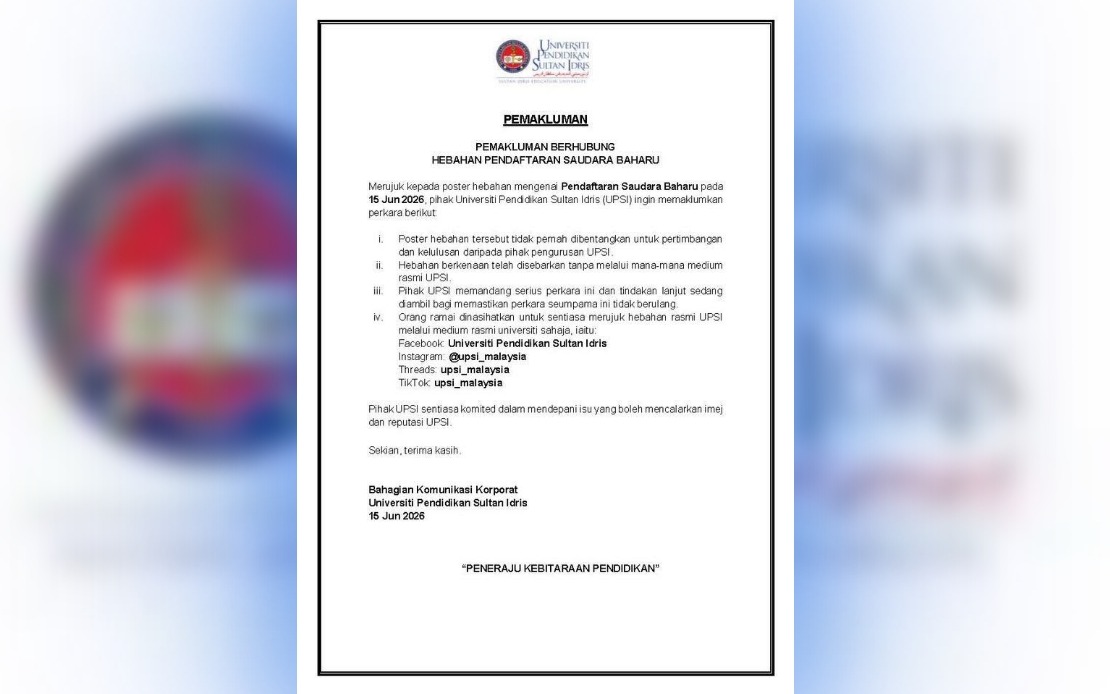
Universiti Pendidikan Sultan Idris (UPSI) has firmly denied any institutional involvement in a poster promoting registration of 'saudara baharu' (newly converted Muslims) that circulated widely across social media platforms in mid-June, clarifying that the material was distributed without authorisation or use of the university's official communication channels.
The university issued a statement through its social media accounts addressing the contentious poster dated June 15, emphasising that no such proposal had been formally presented to UPSI's administration for deliberation or formal approval before becoming public. The institution stressed that the document's circulation bypassed all standard institutional protocols and did not emanate from any recognised university communications medium, underscoring the disconnect between the poster's messaging and UPSI's actual operations and values.
This development reflects growing concerns across Malaysian institutions about unauthorised communications attributed to them, particularly those touching on sensitive religious and social matters. The speed and breadth with which the poster gained traction on social platforms highlighted how misinformation or materials misrepresented as official institutional statements can rapidly reach large audiences, potentially damaging an organisation's credibility before clarification becomes possible. UPSI's swift public response appears designed to preempt further confusion and reassert organisational control over its messaging.
The university signalled its determination to address the reputational implications of the incident, announcing that corrective measures would be implemented to prevent similar unauthorised attributions in future. UPSI's management made clear that any content falsely linked to the institution—particularly material potentially controversial or divisive in nature—constitutes a serious matter warranting formal investigation and preventive action. This stance aligns with institutional best practices among Malaysian universities, where maintaining public trust requires vigilant oversight of institutional communications and swift rectification when breaches occur.
For Malaysian readers, the incident underscores a broader institutional vulnerability in an age of rapid social media propagation. Universities, government agencies, and corporate entities increasingly find themselves targets for misinformation campaigns or fraudulent use of their names and credibility. The ease with which false or unauthorised content can be attributed to recognised institutions poses real challenges to those institutions' reputations and public perception. What might once have taken weeks to spread through traditional media channels can now achieve massive circulation within hours through social platforms, limiting the window for institutional response.
The poster's content relating to conversion registration touched on a culturally and religiously sensitive topic in Malaysia, where Islam holds constitutional significance and conversion processes are regulated through formal Islamic administrative channels. Any unauthorised messaging appearing to represent official policy on such matters could create confusion about legitimate religious procedures, potentially misleading individuals about proper registration channels and requirements. This dimension likely heightened UPSI's concern about the poster's circulation and the necessity for clear public disavowal.
UPSI's invocation of the principle that citizens should rely exclusively on official institutional channels for authentic information reflects a prudent information governance approach. In an environment where social media enables rapid, unverified content distribution, distinguishing between genuine institutional communications and unauthorised or falsified attributions requires active institutional effort and public education. Universities have particular responsibility here, given their roles as trusted knowledge institutions and their influence on student and staff populations who may be less critical of material appearing to come from their own institutions.
The incident also raises questions about how institutional communications can be better protected against unauthorised use or impersonation. UPSI's statement implicitly signals that investigations are underway to determine the source and method of distribution of the unauthorised poster. Whether the material originated from within the institution, was created externally and falsely attributed, or emerged through compromise of institutional communication systems remains to be established. Such investigations typically examine digital footprints, access logs, and other technical evidence to identify responsibility and intent.
Institutional responses of this type serve multiple functions simultaneously. They protect the institution's reputation by creating clear public record of disavowal and non-involvement. They signal to stakeholders—students, staff, partners, and the broader public—that the institution takes such matters seriously and will take action to prevent recurrence. They also establish a framework for institutional accountability, making clear that if internal actors were responsible, consequences would follow. This combination of transparency, accountability, and forward-looking prevention helps rebuild confidence when institutional communications have been compromised or misused.
The incident contributes to ongoing conversations in Malaysia about information authenticity and institutional credibility in digital environments. As higher education institutions and government agencies increasingly conduct business and communication through digital platforms, the technical and procedural safeguards protecting institutional identity and communications become critical infrastructure for maintaining public trust. For Malaysian institutions seeking to protect their reputations while serving their missions effectively, the UPSI case provides a useful illustration of both the speed with which problems can emerge and the importance of swift, clear institutional response.

