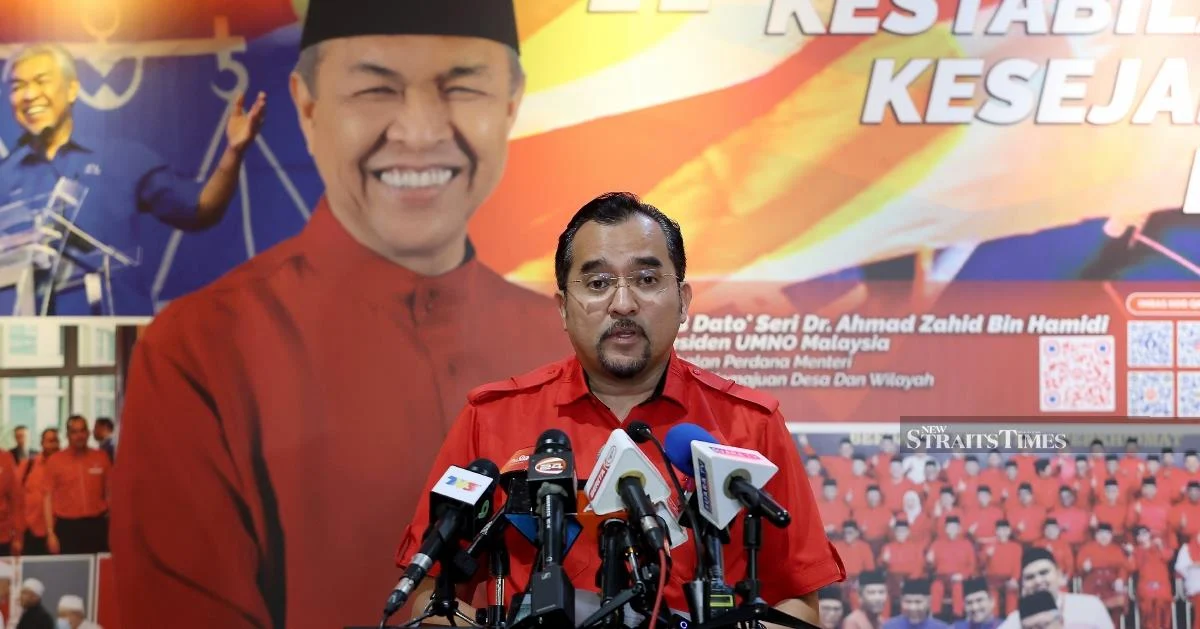
Umno's approach to the impending state elections in Johor and Negri Sembilan will prioritise substantive policy discussions over character assassination and mudslinging, according to party secretary-general Datuk Dr Asyraf Wajdi Dusuki. The commitment signals an attempt by Malaysia's dominant political party to maintain a more dignified and issues-driven electoral contest, even as the political landscape continues to fragment and competition intensifies across the country.
The move reflects a broader positioning strategy by Umno as it navigates an increasingly fractious domestic political environment. With multiple coalition partners and rival Malay-based parties competing for electoral advantage, the party appears to be betting that articulating clear policy platforms will resonate more effectively with voters than attacking opponents. This stands in contrast to the often acrimonious tone that has characterised Malaysian electoral cycles in recent years, where personal attacks and character questioning have frequently dominated campaign narratives across various parties.
For Johor, Malaysia's second-largest state and a traditional Umno stronghold, the strategic positioning carries significant weight. The state has long served as a political bellwether, and maintaining campaign decorum could help consolidate Umno's support base among middle-class and rural voters who may be fatigued by adversarial politics. Negri Sembilan, with its more compact electorate, presents different dynamics but equally important considerations for a party seeking to strengthen its credentials as a responsible governing force.
The emphasis on policy platforms represents Datuk Dr Asyraf Wajdi Dusuki's acknowledgment that voters increasingly demand substantive answers on economic management, education, healthcare delivery, and infrastructure development. By pledging to focus on tangible offerings rather than attacking rivals, Umno is attempting to shift the conversation toward areas where it can leverage its decades of governing experience in these states. This approach could prove particularly advantageous in constituencies where voters possess higher education levels and demonstrate greater sensitivity to governance issues.
However, the commitment to clean campaigning also reflects underlying tensions within Malaysia's political ecosystem. As coalition politics becomes more complex, with Umno operating within different frameworks in different states, maintaining consistent messaging around policies becomes a practical necessity. Mudslinging campaigns are difficult to control when multiple parties and factions are involved, and coordinating a unified attack strategy across geographically dispersed organisations can create liabilities that sophisticated voters may exploit.
The timing of this announcement carries implications for rival parties and potential coalition partners. By staking out the moral high ground early, Umno is attempting to establish expectations that may constrain opponents' ability to conduct aggressive personal campaigns without facing accusations of hypocrisy or dirtiness. This preemptive positioning is a recognisable tactic in contemporary Malaysian politics, where controlling the narrative around campaign conduct has become increasingly important for electoral success.
For Malaysian voters, particularly those in Johor and Negri Sembilan, the commitment suggests that campaign season will potentially offer greater substantive engagement with policy proposals. Whether this translates into practice remains to be seen, given the historical record of campaign pledges in Malaysian elections. Nevertheless, the statement from a senior party official carries weight and establishes baseline expectations against which Umno's actual campaign conduct will be measured by media observers and political analysts.
The regional dimension should not be overlooked. Both states have significant economic importance for Malaysia's overall development trajectory. Johor, with its position as a gateway to Singapore and critical role in the Southern Economic Growth Corridor, requires coherent policy dialogue about trade, logistics, and regional integration. Negri Sembilan's role in the broader Klang Valley metropolitan region means that state-level decisions carry implications for the nation's economic hub. A campaign focused on substantive policy debates could potentially elevate public discourse around these crucial issues.
From Umno's perspective, this positioning also serves a defensive function. The party has faced criticism from various quarters regarding governance records and transparency issues. By emphasizing policy platforms and public benefit, Umno is attempting to reframe the electoral conversation around future-oriented questions rather than historical grievances or institutional accountability matters that may carry negative connotations.
The credibility of such commitments ultimately depends on implementation. Malaysian voters have grown increasingly sceptical of pre-election pledges, having witnessed numerous instances where campaign promises diverge significantly from post-election realities. Media scrutiny of whether Umno actually adheres to this policy-focused approach will be intense, with any deviation toward personal attacks likely to be amplified and weaponised by opposition parties and observers critical of Umno's record.
Looking forward, the Johor and Negri Sembilan campaigns will serve as important indicators of broader trends in Malaysian electoral politics. Whether substantive policy debates can genuinely dominate the campaign narrative, or whether traditional patterns of personal attack and character questioning reassert themselves as voting day approaches, remains an open question. For political observers and citizens concerned about the health of Malaysia's democratic discourse, the ensuing weeks will provide valuable evidence about whether the nation's political culture is genuinely evolving toward more constructive electoral engagement.

