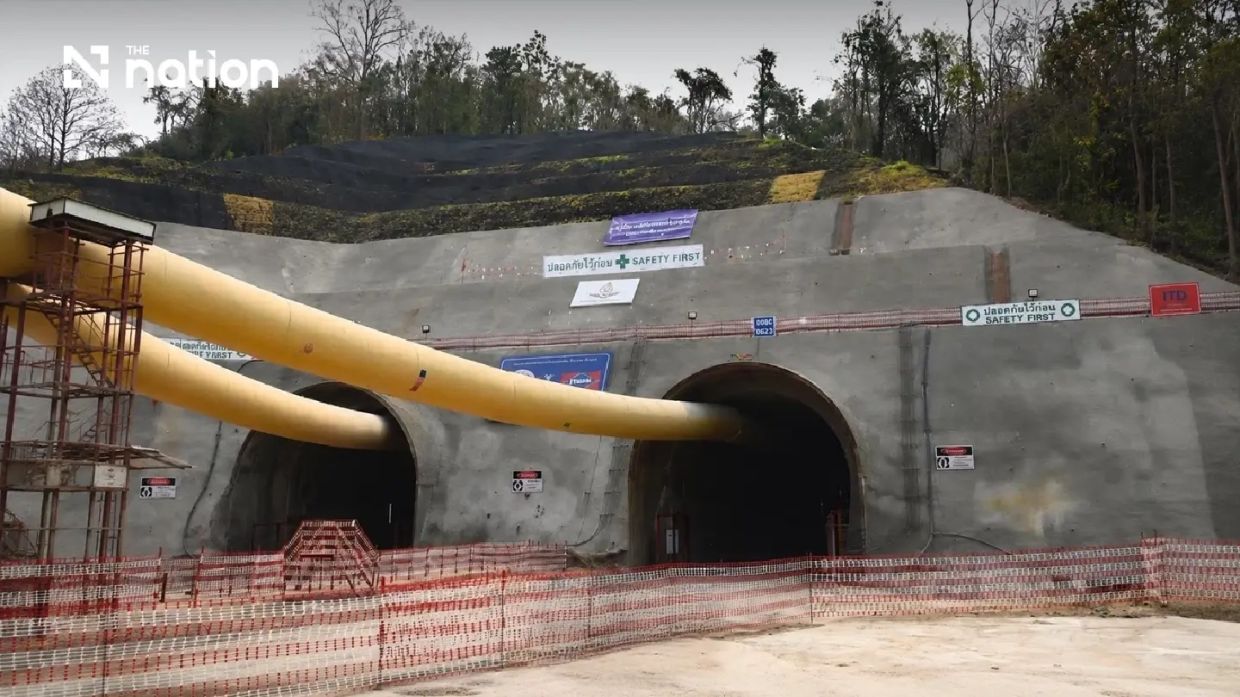
A tragic workplace accident at Thailand's ambitious railway expansion project claimed two lives and left seven workers hospitalized after a catastrophic scaffolding failure Saturday evening at the Doi Luang tunnel in Chiang Rai province. The incident, which occurred inside the 3.4-kilometre tunnel being constructed as part of the State Railway of Thailand's Den Chai-Chiang Rai-Chiang Khong railway corridor, has raised renewed concerns about safety standards on major infrastructure megaprojects across Southeast Asia's construction sector.
According to Deputy Transport Minister Siripong Angkasakulkiat, authorities received initial reports of the collapse at 8:35 pm on Saturday. Preliminary investigations suggest the accident occurred when rocks dislodged from the tunnel wall and struck workers who were engaged in installing waterproofing systems. However, officials cautioned that the precise sequence of events was still under examination, with earlier accounts referencing potential issues in the shotcrete application area. This discrepancy underscores the complexity of incident reconstruction in underground construction environments, where multiple concurrent operations and changing geological conditions can create unpredictable hazards.
The human toll reflects the serious nature of the accident. Three workers suffered critical injuries requiring intensive medical intervention, while four sustained minor wounds. All casualties were transported to medical facilities for treatment. Such incidents are particularly devastating for construction workforces in the region, where many labourers come from economically disadvantaged backgrounds and lack comprehensive insurance or occupational safety training. The loss of income from fatal and serious injuries ripples through entire communities dependent on remittances from construction workers.
The Doi Luang tunnel represents a critical component of Thailand's evolving transportation infrastructure. Situated in Chiang Saen district of Chiang Rai, the bore-through tunnel is fully excavated and currently in the finishing stages. This section falls under Contract 3 of the Chiang Rai-Chiang Khong corridor development, a massive THB19.385 billion undertaking that encompasses approximately 87 kilometres of both grade-level and elevated railway tracks. Beyond the track infrastructure, the contract scope includes three major stations, three minor halts, comprehensive signalling and telecommunications systems, and auxiliary railway facilities that will enhance regional connectivity.
The project is being executed by the CKST-DC3 Joint Venture, a multinational consortium bringing together CH. Karnchang Public Company Limited, a leading Thai construction firm; Sino-Thai Engineering & Construction Public Company Limited, reflecting China's growing infrastructure investment across Southeast Asia; and Chiangmai Construction Co., Ltd., a regional player. This tripartite arrangement, while potentially bringing diverse expertise, also introduces complex coordination challenges that can sometimes complicate safety oversight and incident response protocols.
Responding swiftly to the emergency, the State Railway of Thailand's Special Projects and Construction Department dispatched inspectors to the accident site. Deputy Minister Siripong reported that the project's dedicated safety division had assumed operational control of the tunnel area, cordoning it off from further work activities and implementing comprehensive monitoring protocols. This immediate lockdown prevented secondary incidents and preserved the accident scene for thorough forensic investigation, essential for understanding precisely what mechanical or geological failures precipitated the collapse.
The investigation into the incident's root causes remains actively ongoing, with authorities emphasizing that preliminary assessments differ from confirmed findings. Whether the failure stemmed from inadequate scaffolding design specifications, substandard installation procedures, unexpected geological conditions, or worker error remains to be conclusively determined. Such determinations carry significance beyond assigning responsibility; they inform systemic corrections that can prevent similar accidents at other construction sites throughout Thailand and the broader region.
For Malaysia and other Southeast Asian nations pursuing similar high-speed rail and railway modernization programs, this incident offers sobering lessons about the occupational risks inherent in major underground construction. Projects like Malaysia's own rail infrastructure expansions employ comparable techniques and often contract with similar multinational consortiums. The Chiang Rai tunnel tragedy underscores the critical importance of rigorous safety audits, regular equipment inspections, worker training programs, and hazard identification systems in tunnel construction, particularly during specialized operations like waterproofing application where multiple hazards converge.
The Den Chai-Chiang Rai-Chiang Khong railway line, once completed, will enhance regional trade and tourism connectivity across northern Thailand and into neighbouring Laos, potentially opening new economic corridors for Southeast Asian commerce. However, project delays and safety incidents can jeopardize both timelines and investor confidence in regional infrastructure development. Thailand's government has invested heavily in this railway as part of broader Belt and Road Initiative frameworks aimed at integrating transport networks across Asia. The Chiang Rai accident serves as a reminder that infrastructure progress cannot come at the cost of worker safety, and that robust occupational health systems must accompany ambitious development ambitions.
Official statements from the ministry emphasized that the accident area has been secured and conditions stabilized, though no timeline has been provided for resuming tunnel finishing work. The comprehensive investigation will likely take weeks or months to complete, potentially extending project schedules already complex due to logistical and geological considerations. For the region's workforce and the construction industry broadly, the incident reinforces the necessity for continuous safety vigilance, worker empowerment to raise concerns without retaliation, and genuine accountability when standards are breached. The families of the deceased workers deserve not merely compensation, but assurance that systemic improvements will prevent comparable tragedies from claiming further lives on Thailand's infrastructure projects.

%22%2F%3E%3C%2Fpattern%3E%3C%2Fdefs%3E%3Crect%20width%3D%22100%25%22%20height%3D%22100%25%22%20fill%3D%22url(%23ph3orzkg)%22%2F%3E%3Crect%20width%3D%22100%25%22%20height%3D%22100%25%22%20fill%3D%22url(%23ph3orzkp)%22%2F%3E%3Ctext%20x%3D%2250%25%22%20y%3D%2250%25%22%20text-anchor%3D%22middle%22%20dominant-baseline%3D%22central%22%20fill%3D%22rgba(255%2C255%2C255%2C0.95)%22%20font-family%3D%22Georgia%2C%20'Times%20New%20Roman'%2C%20serif%22%20font-weight%3D%22700%22%20font-size%3D%22320%22%20letter-spacing%3D%22-0.02em%22%3E300%3C%2Ftext%3E%3C%2Fsvg%3E)