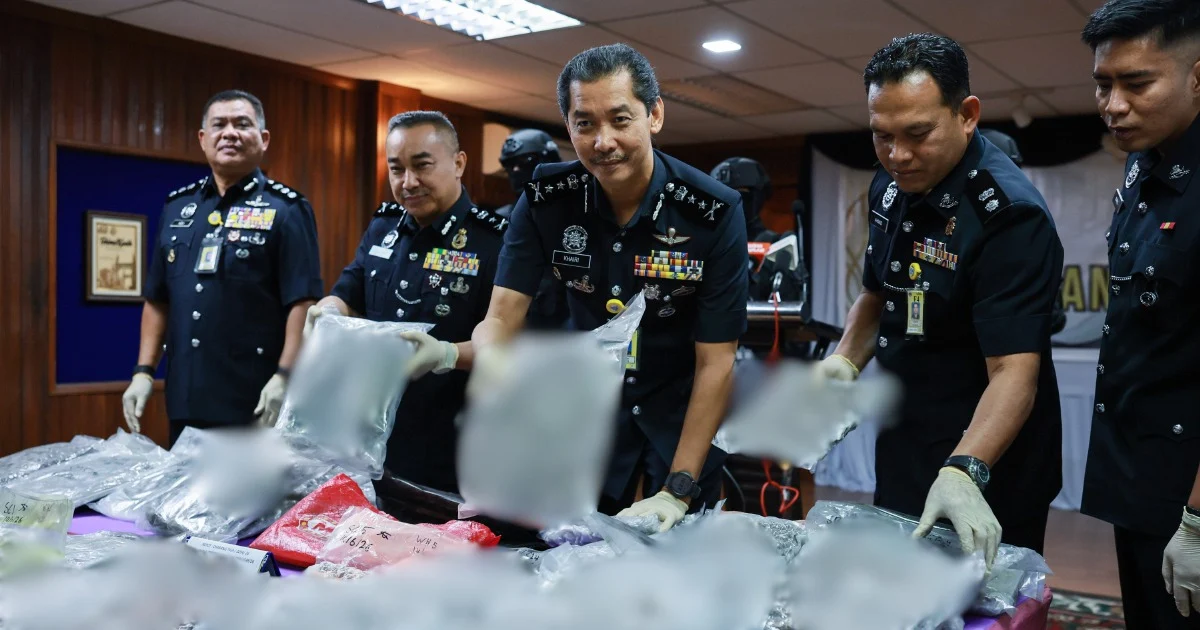
Law enforcement authorities in Terengganu have arrested two brothers in connection with a significant drug trafficking operation centred on a residential property in Kampung Duyong Besar, Kuala Terengganu. The siblings were detained following a police raid that uncovered illicit narcotics with an estimated street value of RM1.76 million, marking one of the larger drug seizures in the state in recent months.
The investigation leading to the arrests reveals a concerning trend of criminals converting domestic residences into clandestine storage facilities for controlled substances. According to police sources, the brothers' house in Kampung Duyong Besar served as a warehouse from which narcotics were distributed across the region. The use of family homes as distribution hubs represents a shift in drug trafficking tactics, as operators seek to avoid detection by avoiding purpose-built facilities that attract surveillance.
The RM1.76 million valuation places this seizure among significant regional drug enforcement successes, highlighting ongoing challenges facing Malaysian law enforcement in combating organised drug networks. The quantity and variety of substances recovered will be subject to laboratory analysis to determine precise drug classifications and weights, which will inform the severity of charges against the accused.
Terengganu, like many East Coast states, has struggled with drug trafficking due to its strategic geographic position and established smuggling routes. The state's ports and relatively porous land borders with Kelantan and Pahang create vulnerabilities that organised syndicates exploit. This latest operation demonstrates that authorities remain focused on dismantling supply chains, though the persistence of such operations suggests ongoing operational challenges.
The involvement of family members in drug trafficking operations presents particular investigative and prosecution complexities. When relatives are implicated together, law enforcement must carefully untangle their individual roles and degrees of culpability. The distinction between storage operators, distributors, and those coerced or blackmailed into participation becomes crucial for securing appropriate convictions and sentencing outcomes.
The arrests follow what is likely an extended surveillance operation. Police typically require substantial evidence gathering before executing raids targeting residential premises, particularly when multiple suspects are involved. Coordination between Terengganu Police's Narcotics Investigation Unit and other state-level enforcement bodies would have been essential to ensure the operation's success and prevent suspects from fleeing the jurisdiction.
For residents of Kampung Duyong Besar and surrounding communities, the discovery may prompt renewed concerns about their neighbourhood's safety and the presence of criminal activity in seemingly ordinary residential areas. Many drug storage operations deliberately maintain low profiles, avoiding the visible signs that might draw attention from neighbours or patrol officers. This invisibility makes neighbourhood-level reporting crucial for law enforcement early warning systems.
The case reflects broader Malaysian drug enforcement priorities. The National Narcotics Bureau and state police commands continue emphasising supply-side disruption, recognising that dismantling distribution networks requires sustained pressure on trafficking operations. The RM1.76 million seizure removes a substantial quantity of drugs from circulation, though law enforcement acknowledges this represents a fraction of the total narcotics flowing through Malaysian markets.
Legal proceedings against the brothers will unfold under Malaysia's strict drug trafficking legislation. Possession of such substantial quantities typically attracts trafficking charges carrying mandatory minimum sentences. The defence may seek to establish degrees of complicity or coercion, though courts generally apply stringent evidentiary standards when evaluating such claims in trafficking cases.
The investigation's outcomes may provide investigators with intelligence regarding broader supply networks and upstream sources. Information extracted during interrogations, combined with evidence from the residence, often yields leads toward larger trafficking organisations. Whether this operation represents an autonomous cell or part of a more complex supply chain will influence the investigation's trajectory and potentially lead to additional arrests.
Terengganu Police's successful execution of this operation demonstrates ongoing enforcement capabilities despite resource constraints that challenge many Malaysian state police forces. The recovery of such a substantial drug quantity and the apprehension of the suspected operators represent tangible progress in addressing the state's narcotics challenges, though law enforcement officials would caution that single operations, however successful, constitute one component of a long-term enforcement strategy requiring sustained commitment and resources.
The arrests underscore the reality that drug trafficking networks remain embedded in Malaysian communities, operating through networks of family, friendship and commercial relationships. Disrupting these networks requires intelligence gathering, community cooperation, and follow-up investigations that extend beyond initial arrests, with long-term success depending on maintaining enforcement pressure even as attention shifts to newly emerging threats.

