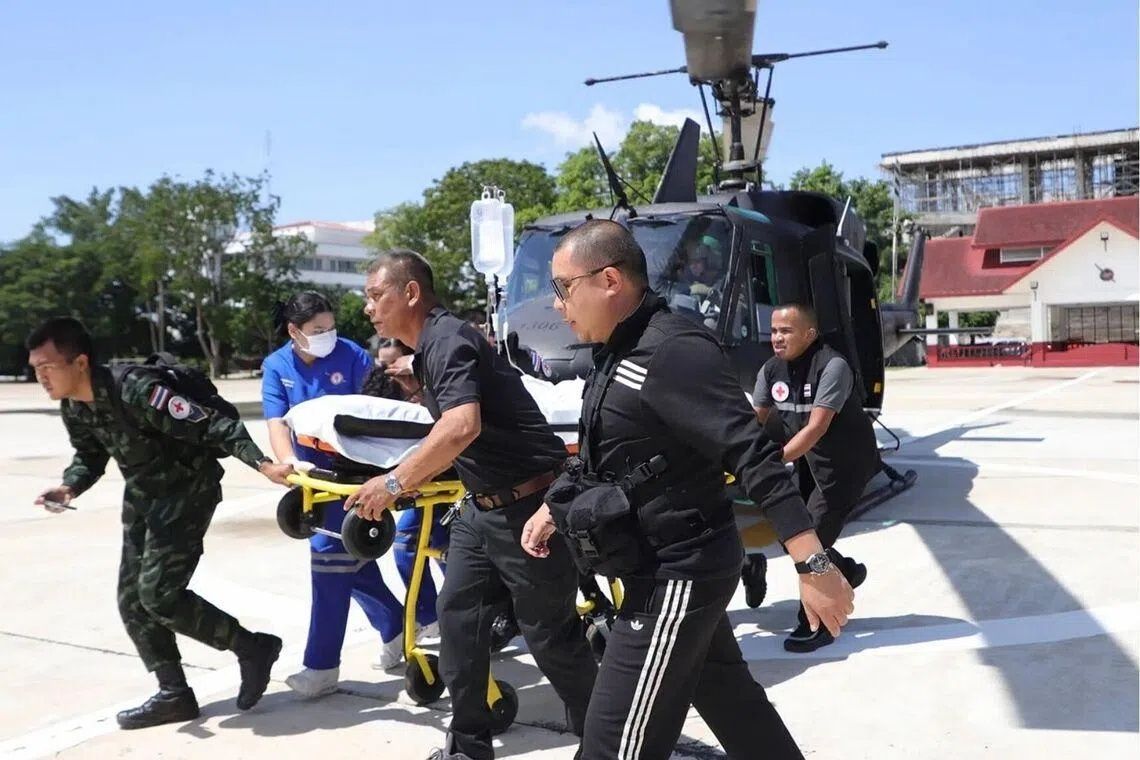
Thailand's volatile southern border region descended further into violence on Friday when two separate bomb attacks within hours targeted law enforcement personnel in Yala and Pattani provinces, leaving 11 officers injured and authorities scrambling to respond. The coordinated nature of the incidents, occurring just hours apart, underscores the persistent security challenges plaguing Thailand's conflict-affected southern frontier, where militant groups have waged a decades-long insurgency despite extensive government counterinsurgency operations.
The first attack struck at 8.10am in Yala province along the Ban Pulo Saniyae–Ban Sakai road in Ban Rae sub-district, Thanto district, when unidentified attackers detonated an explosive device targeting a border patrol police convoy, specifically personnel drawn from a unit dedicated to protecting educators. Six officers sustained injuries in the blast, though two bore the most severe consequences. Corporal Kittisak Saksang suffered facial lacerations inflicted by shrapnel fragmentation, while Corporal Poraphat Wongruaydee endured more critical trauma, experiencing chest tightness and temporary paralysis, though he retained consciousness throughout the initial aftermath.
The severity of Wongruaydee's condition became apparent following medical examination at Thanto Hospital, the initial receiving facility. Physicians identified a life-threatening accumulation of blood within his pleural cavity—the space surrounding his lungs—necessitating emergency surgical intervention. This complication prompted urgent helicopter evacuation to the better-equipped Yala Regional Hospital, where he underwent emergency procedures to drain the accumulated fluid and repair internal pulmonary damage. The medical emergency simultaneously triggered a public appeal for blood donations of all types to replenish supplies depleted by emergency transfusions during his treatment.
The second bombing occurred less than three and a half hours later, at 11.30am the same day, targeting the Pattani Police Special Operations unit at Ban Khuan Yi in Pado sub-district, Mayo district. Officers belonging to this specialized unit had just concluded establishing a checkpoint in the locality and were returning to their station when the device detonated. The attack injured five additional personnel—Sergeants Anuchit, Bunyawat, Wisitphon, Aphisit and Sumit—all experiencing chest injuries consistent with blast pressure trauma. These five officers received treatment at Mayo Hospital, a tertiary facility with greater capacity than smaller district medical centers.
For Malaysian observers and policymakers, these incidents illuminate the precarious security environment persisting in Thailand's deep south, an issue of direct regional significance given Malaysia's proximity and the transnational dimensions of the insurgency. The southern Thai conflict, rooted in historical grievances, ethno-religious tensions, and competing nationalist narratives dating back to the Chakri dynasty's late-nineteenth-century territorial consolidation, has claimed thousands of lives since its contemporary resurgence in 2004. The Pattani United Liberation Organisation (PULO), Barisan Revolusi Nasional (BRN), and splinter factions continue conducting attacks despite periodic negotiations, military offensives, and administrative reforms.
The targeting of border patrol personnel, particularly those assigned to teacher protection duties, reflects insurgent strategic calculations. Educators in the region have historically represented both instruments of Thai cultural nationalism and, from militant perspectives, symbols of state consolidation in Malay-Muslim areas. By attacking those charged with safeguarding teachers, insurgent groups simultaneously strike at state authority and amplify civilian insecurity. Similarly, the assault on police special operations units demonstrates the insurgents' capacity to conduct coordinated strikes against security infrastructure despite substantial military presence and intelligence operations.
Thailand's security apparatus responded swiftly to both incidents, deploying explosive ordnance disposal teams and forensic specialists to conduct scene investigations and evidence collection. Authorities immediately cordoned off both locations to preserve investigative integrity and prevent secondary attacks on responders. The rapid evacuation of critically wounded personnel to higher-level medical facilities reflects improvements in emergency response protocols developed through years of managing insurgent violence. However, such procedural competence masks deeper strategic challenges: the ability to treat casualties efficiently does not address the underlying drivers of insurgent recruitment or legitimacy.
The timing and coordination of these attacks raises important questions about threat perception and operational capability among insurgent networks. The compressed temporal interval between incidents—suggesting either careful planning or opportunistic exploitation of heightened alert states—indicates ongoing organizational coherence among anti-government groups despite years of targeted operations. Intelligence agencies presumably had advance knowledge of the checkpoint establishment in Pattani, yet the second attack proceeded, suggesting either intelligence gaps or insurgent acceptance of casualties in exchange for achieving symbolic and military objectives.
From a Malaysian standpoint, these developments warrant careful monitoring given the porous nature of the Thai-Malaysian border and documented instances of cross-border sanctuary usage, weapons smuggling, and personnel movement by southern Thai insurgent groups. Malaysia has hosted successive rounds of negotiated dialogue between Thai government representatives and separatist groups, attempting to broker humanitarian ceasefires and substantive peace agreements. The intermittent violence, however, complicates these diplomatic efforts and sometimes provokes hardline responses that undermine negotiation momentum. Malaysian security officials must remain alert to potential spillover, particularly in Kelantan and Terengganu, where some ideological affinity exists among certain communities sympathetic to the southern Thai struggle.
The provincial hospitals designated to treat the injured personnel—Thanto Hospital, Yala Regional Hospital, and Mayo Hospital—now face resource demands that underscore the broader humanitarian costs of persistent conflict. Blood shortages, surgical capacity limitations, and the need for specialized trauma care repeatedly emerge as pressing concerns in southern Thailand's healthcare system. These institutional pressures accumulate over time, degrading civilian medical access and diverting scarce resources from preventive health initiatives.
Moving forward, Thai authorities will likely intensify cordon-and-search operations, intelligence collection, and vehicle checkpoint enforcement throughout the affected provinces. Such responses, while tactically sound from a security perspective, risk imposing civilian hardship through extended curfews, movement restrictions, and increased military visibility. The historical record suggests that security operations absent parallel political and economic initiatives addressing root grievances typically produce temporary tactical successes followed by operational adaptation by insurgent groups.
These bombings represent the latest chapter in a protracted conflict that has reshaped security architecture, military doctrine, and civil-military relations throughout southern Thailand. For the wider Southeast Asian region, the incidents underscore the stubborn persistence of sub-national conflicts rooted in identity, history, and contestation over state legitimacy—challenges that border control and military solutions alone cannot resolve.