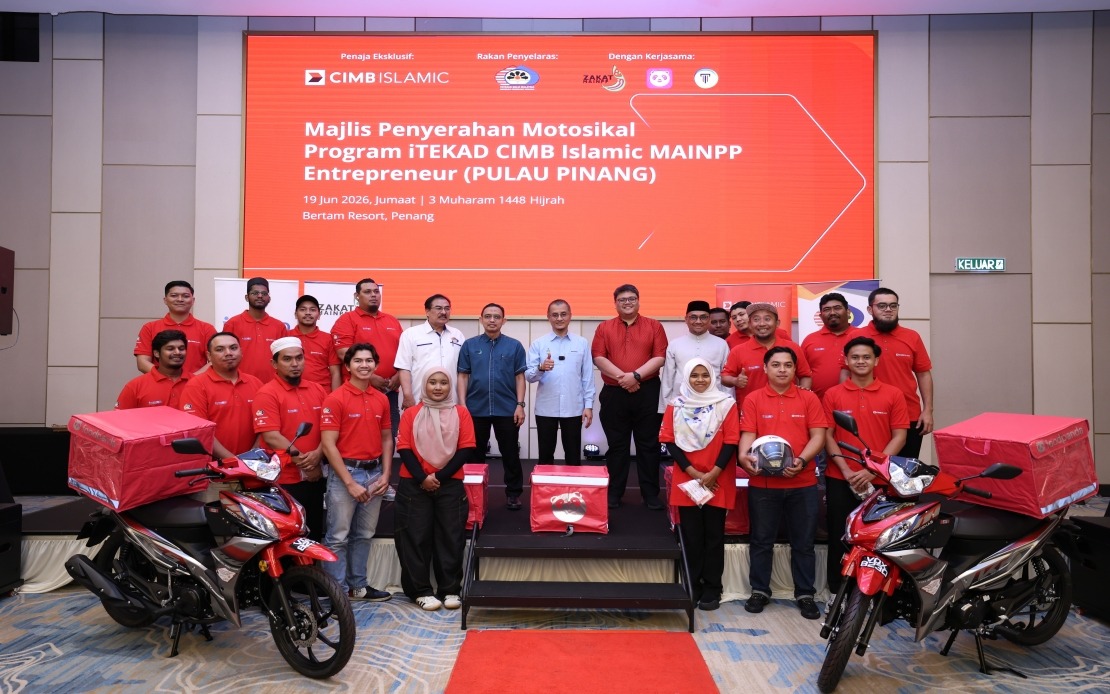
Twenty carefully selected entrepreneurs in Penang have been presented with motorcycles and delivery equipment as part of the iTEKAD CIMB Islamic-MAINPP Entrepreneur programme, a collaborative initiative designed to lift low-income asnaf households out of poverty through structured business opportunities. The motorcycle handover ceremony took place at Bertam Resort in Kepala Batas, marking a significant milestone in efforts to create sustainable livelihoods for vulnerable communities through asset provision and entrepreneurial support.
The programme represents a partnership between CIMB Islamic Bank Berhad and the Penang Islamic Religious Council, known as MAINPP, with support from implementation partners including the Malaysian Youth Foundation, Taylor's Community, and foodpanda Malaysia. This multi-stakeholder approach underscores a growing recognition that poverty alleviation requires coordinated action across financial institutions, religious authorities, and community organisations rather than isolated interventions. The collaboration leverages the comparative advantages of each partner, combining Islamic banking expertise, zakat management capabilities, youth development experience, and logistics infrastructure.
According to Datuk Dr Mohamad Abdul Hamid, Penang's Deputy Chief Minister I and MAINPP president, the initiative extends well beyond simple asset distribution. Recipients gain access to comprehensive training modules covering financial literacy, workplace discipline, and entrepreneurial fundamentals, enabling them to operate their delivery businesses in a structured, professional manner. This emphasis on capacity building reflects best practices in microfinance and social entrepreneurship programmes across Southeast Asia, addressing not just capital constraints but also human capital deficiencies that often limit success among disadvantaged populations.
The funding structure demonstrates innovative partnership financing. A total seed fund of RM400,000 has been assembled through matching grants, with CIMB Islamic Bank contributing RM200,000 from its Wakalah Zakat fund and Bank Negara Malaysia providing an equal RM200,000. This arrangement shows how central banks and private financial institutions can collaborate on social objectives while maintaining their commercial operations. For Malaysian observers, the BNM participation signals official recognition that inclusive economic growth requires deliberate intervention beyond market mechanisms.
The selection process itself was rigorous and competitive. Zakat MAINPP received 151 applications from interested participants, indicating substantial demand for such programmes among vulnerable communities. The screening methodology included formal interviews and a residential Entrepreneurship Camp conducted from May 31 to June 3, 2026, where candidates demonstrated their commitment and learning capacity over an intensive four-day period. This filtering mechanism ensures that motorcycles and equipment reach individuals with genuine motivation and realistic potential for success, rather than being distributed without regard to readiness or capability.
For the asnaf communities in Penang and similar regions across Malaysia, this programme addresses a critical gap in asset ownership. Many low-income individuals lack collateral or savings necessary to acquire business assets through conventional channels. By providing motorcycles and delivery equipment, the programme removes a major barrier to entry into the gig economy and courier services, sectors offering flexible income opportunities without requiring professional credentials or educational qualifications. Participants can immediately begin generating revenue by partnering with platforms like foodpanda or operating as independent delivery service providers.
The initiative aligns with broader policy frameworks designed to strengthen Islamic social finance in Malaysia. The integration with zakat funds represents an evolution in how traditional Islamic charitable mechanisms support economic development rather than merely addressing immediate consumption needs. By directing zakat toward productive assets and business training, the programme shifts from welfare provision toward capability enhancement, a strategic reorientation consistent with Malaysia's Vision 2030 objectives and the United Nations Sustainable Development Goals regarding poverty reduction and economic empowerment.
The timing of this announcement reflects heightened government attention to inclusive economic participation across Malaysian states. Penang's government has positioned this programme within its broader Islamic Religious Development Agenda 2030 (APAI2030), which encompasses education, economic opportunity, family welfare, and youth development. This holistic framing suggests that economic empowerment cannot be isolated from broader social development objectives. Successful delivery entrepreneurs are more likely to invest in their children's education, maintain family stability, and contribute positively to community cohesion.
For participants themselves, the motorcycles represent more than transportation assets. They symbolise institutional confidence in their capacity for self-improvement and social mobility. Recipients undergo transformation from passive welfare beneficiaries into active economic agents, a psychological and sociological shift that often generates positive momentum for sustained effort and additional skill acquisition. This mechanism of social transformation through dignified economic inclusion resonates strongly across Southeast Asian contexts where informal economies dominate and poverty cycles persist despite nominal economic growth.
The programme also demonstrates how Islamic financial institutions can operationalise their social responsibility mandates beyond corporate philanthropy. By structuring the initiative as a matching grant involving both bank funds and central bank resources, CIMB Islamic Bank strengthens its positioning as a socially conscious lender while building relationships with previously underserved populations who may graduate into formal financial services users. Similar models are being replicated across the region, suggesting growing recognition that inclusive finance and social development reinforce each other.
Looking forward, the success metrics for this programme extend beyond immediate income generation. Programme designers should monitor longer-term outcomes including business sustainability, participant progression into higher-value entrepreneurial activities, integration into formal financial systems, and potential ripple effects within families and communities. If structured appropriately with ongoing mentorship and access to additional microfinance for business expansion, such programmes can catalyse broader economic transformation within low-income populations.
The iTEKAD CIMB Islamic-MAINPP initiative ultimately reflects evolving understanding of poverty alleviation in contemporary Malaysia. Rather than treating low-income populations as perpetual aid recipients, the programme invests in their productive capacity and entrepreneurial potential. As other states and institutions consider similar models, the documented outcomes from Penang's programme may well influence the future direction of zakat distribution and Islamic social finance across Malaysia and the broader region, potentially creating a more robust ecosystem of opportunity for those currently marginalised from economic prosperity.

