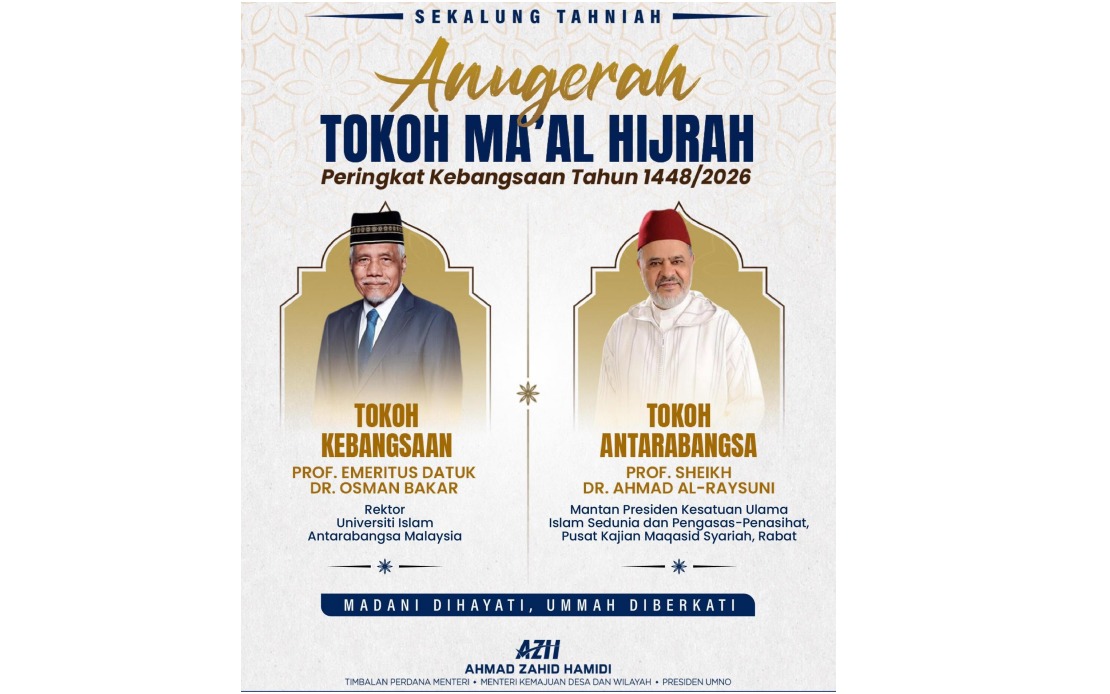
Malaysia has honoured two renowned Islamic scholars with the prestigious Tokoh Maal Hijrah awards, recognising their outstanding contributions to advancing Islamic knowledge and strengthening Muslim communities across borders. The recognition ceremony, held at the national-level Maal Hijrah celebration in Putrajaya, underscores the government's commitment to celebrating individuals who exemplify Islamic values and scholarly excellence. Deputy Prime Minister Datuk Seri Dr Ahmad Zahid Hamidi emphasised that the awards should serve as a powerful inspiration for Muslims throughout the country to continue their personal and collective advancement in pursuit of knowledge, community service and the broader development of the Islamic ummah.
Prof Emeritus Datuk Dr Osman Bakar received the National Tokoh Maal Hijrah Award, whilst Prof Sheikh Dr Ahmad Al-Raysuni, an Islamic jurisprudence specialist from Morocco, was conferred the International honour. The Sultan of Perak, Sultan Nazrin Shah, formally presented the awards, which included cash prizes, commemorative trophies and certificates of appreciation. Ahmad Zahid's acknowledgement of the recipients highlighted how their scholarly work has been instrumental in empowering Muslim communities, elevating the status of knowledge within society and disseminating Islamic values that embody mercy, wisdom and practical benefit for contemporary communities.
The Maal Hijrah commemoration carries profound symbolic significance within Islamic tradition, extending far beyond a mere historical recollection of Prophet Muhammad's migration from Mecca to Medina. Deputy Prime Minister Datuk Seri Fadillah Yusof articulated this deeper meaning, explaining that the hijrah principle encompasses enduring spiritual and practical lessons for modern Muslims. The migration narrative teaches fundamental Islamic virtues including sacrifice, communal unity, resilience in the face of adversity and an unwavering determination to pursue meaningful positive transformation. For contemporary Malaysian Muslims, these classical teachings remain directly relevant to navigating modern challenges while maintaining ethical and religious foundations.
Fadillah stressed that this hijrah spirit should permeate ongoing efforts to construct a society and nation characterised by progressive thinking, economic prosperity and steadfast adherence to moral and religious values. The recognition of scholars like Osman Bakar and Al-Raysuni demonstrates the government's view that intellectual advancement and spiritual development are inseparable components of nation-building. Rather than framing Islamic scholarship as peripheral or compartmentalised, the awards ceremony positioned religious learning and community contribution as central to Malaysia's development trajectory. This approach suggests a deliberate strategy to integrate Islamic thought leadership into national discourse and policy considerations.
Prof Emeritus Osman Bakar's achievement is particularly significant given his prominence within Malaysian and international Islamic academic circles. His career exemplifies the type of intellectual contribution that the Tokoh Maal Hijrah awards seek to celebrate and encourage. By honouring scholars who bridge local and international Islamic scholarship, Malaysia projects itself as a centre of Islamic intellectual activity and a bridge between Eastern and Western academic traditions. Similarly, recognising an international figure like Ahmad Al-Raysuni signals Malaysia's engagement with the broader Islamic world and its aspiration to participate meaningfully in shaping contemporary Islamic thought and discourse beyond national boundaries.
The awards carry implications for how Malaysia positions itself within regional and global Islamic networks. By celebrating scholars engaged in jurisprudential analysis and community empowerment, the government aligns national recognition systems with values that resonate across the Muslim world. This approach helps distinguish Malaysia's approach to Islamic affairs from purely institutional or political frameworks, instead emphasising intellectual rigour, scholarly achievement and demonstrated service to communities. For Southeast Asian Muslims seeking models of Islamic excellence and contemporary relevance, the recognition of figures like Osman Bakar and Al-Raysuni provides inspiring examples of how traditional religious learning can address modern challenges.
Fadillah's call for collective action—to work together in strengthening unity, deepening faith and increasing virtuous deeds—reflects an understanding that individual achievement and community welfare are mutually reinforcing. The awards ceremony thus functions as more than ceremonial recognition; it articulates a vision of how Malaysian Muslims might approach their responsibilities within an increasingly complex and rapidly changing regional context. The emphasis on working collectively toward the prosperity of both the ummah and the nation suggests that Islamic identity and Malaysian citizenship are presented as complementary rather than conflicting allegiances.
The timing and prominence of the awards ceremony also merit consideration within Malaysia's broader religious and political landscape. Public acknowledgement of scholarly contributions to Islamic civilisation by senior government figures demonstrates state investment in elevating religious and intellectual discourse. This positioning may influence how younger Muslims perceive the relationship between religious learning, public service and national contribution. By celebrating academics and thinkers rather than exclusively religious administrators or political figures, the government sends a message that intellectual achievement within Islamic disciplines warrants national recognition equivalent to other fields of endeavour.
For Malaysian readers and regional observers, the Tokoh Maal Hijrah awards exemplify how governments can leverage recognition systems to encourage specific values and behaviours. The emphasis on knowledge-seeking, community service and contribution to Islamic civilisation suggests that Malaysia's leadership views these qualities as essential to both religious fulfilment and national development. The awards thus operate as a soft-power instrument, promoting a particular vision of Islamic engagement that prioritises scholarship, ethical conduct and communal welfare. As Southeast Asia navigates questions about the role of religion in modern society, Malaysia's approach to honouring Islamic intellectuals offers one model for integrating religious values into broader development frameworks without compromising scholarly independence or intellectual rigour.

