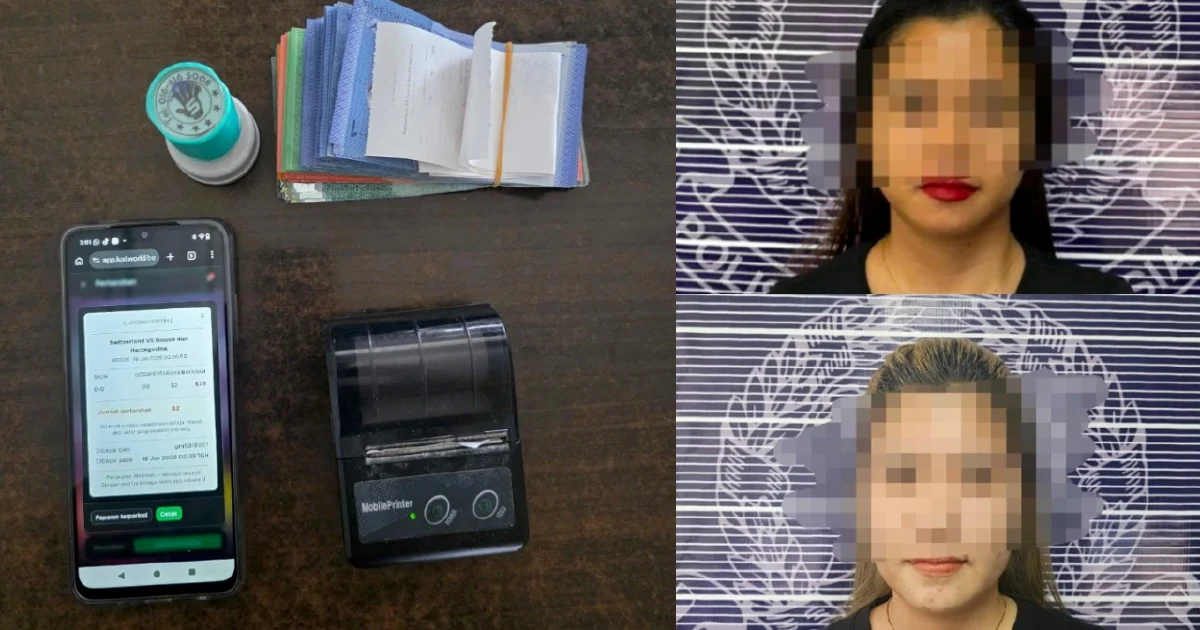
Police in Kuching have moved to dismantle what appears to be a coordinated network of illegal betting operations capitalising on the approaching 2026 FIFA World Cup tournament. The three female suspects, taken into custody during simultaneous operations across different parts of the district, are believed to have acted as agents facilitating unlawful wagers linked to the major international sporting event scheduled two years away.
The synchronized nature of yesterday's arrests suggests investigators had been monitoring the syndicate's activities with some precision, allowing them to execute coordinated raids that may help prevent further expansion of the operation. By targeting multiple locations simultaneously, law enforcement hoped to disrupt communication channels and limit the network's ability to recover or relocate their operations quickly. This approach has become increasingly common in major gambling enforcement campaigns across Malaysia, where illegal betting rings often adapt rapidly to enforcement activities.
Football betting remains one of the most persistent forms of illegal gambling throughout Southeast Asia, driven by the global appeal of international tournaments and the intense spectatorship that major competitions generate. The 2026 World Cup, which will be jointly hosted by the United States, Canada, and Mexico, has already begun attracting the attention of organized betting networks looking to capitalize on months of qualifying matches, friendly games, and promotional activities leading up to the main event. For operators, the appeal is straightforward: such tournaments create sustained periods of betting activity across multiple markets and demographics.
The role of agents in illegal betting networks deserves particular attention, as these individuals serve as critical distribution points between the central operation and end consumers. Rather than simply taking bets themselves, agents typically recruit additional participants, collect money, communicate odds and results, and distribute winnings or collect losses. This structure makes enforcement challenging, as dismantling a network requires identifying and pursuing multiple layers rather than a single centralized location. By focusing on these agents, authorities can trace connections upward to organizers and outward to other participants.
Malaysia's regulatory framework around gambling remains complex, with legal betting opportunities tightly controlled and licensed through specific state-run channels, principally Toto and 4D games. Any betting conducted outside these sanctioned outlets constitutes a criminal violation under the Common Gaming Houses Act and related legislation. The introduction of online betting, combined with changing consumer preferences and the global accessibility of international sporting events through streaming platforms, has fundamentally altered how illegal gambling syndicates operate, moving from purely localized operations to networks with distributed participants across multiple states or even countries.
Enforcement agencies increasingly recognize that major international sporting events serve as focal points for organized betting activity, making them logical times to launch preventive crackdowns. The 2024 European Championship, 2024 Olympic Games, and 2024 World Cup qualifying rounds all saw similar operations across the region, with authorities conducting raids and arrests in the months preceding these events. The pattern indicates a strategic shift toward proactive intervention rather than purely reactive enforcement, attempting to disrupt networks before they achieve operational scale.
The remand of the three suspects allows investigating officers to conduct detailed questioning without time constraints, potentially unraveling the broader structure of the betting syndicate. During remand periods, police typically seek to identify recruitment networks, financial flows, communication methods, and connections to other illegal operations that may exist in parallel. Such investigations frequently reveal surprising connections between seemingly separate betting rings or links to other criminal enterprises that use gambling proceeds to fund additional illicit activities.
For Malaysian readers familiar with online gambling's prevalence, particularly among younger demographics, these arrests underscore the government's continuing commitment to enforcing betting restrictions despite significant enforcement challenges. The ease with which illegal gambling platforms operate online and through encrypted messaging applications has created a persistent friction point between law enforcement's capabilities and the technological sophistication of operations. The focus on identifying and prosecuting agents rather than pursuing individual bettors reflects a pragmatic enforcement philosophy that targets the supply side rather than attempting to criminalize demand.
World Cup betting carries particular cultural weight in Malaysia, where football commands enormous public interest and attracts betting participation across all socioeconomic groups. The global scale of World Cup viewership creates multiple opportunities for international betting syndicates to reach Malaysian participants, whether through offshore websites, local agent networks, or hybrid operations combining both methods. This transnational dimension adds complexity to enforcement efforts, requiring coordination between domestic police and international counterparts to trace money flows and identify foreign operators facilitating these networks.
The Kuching operations form part of ongoing enforcement activity throughout Sarawak and the broader Malaysian law enforcement response to illegal gambling expansion. State police have emphasized their commitment to pursuing such cases, recognizing that every major tournament period presents a critical enforcement window. The public communication around these arrests serves a dual purpose: demonstrating state capacity to address criminal activity while potentially discouraging individuals from engaging with illegal betting networks or becoming agents themselves.