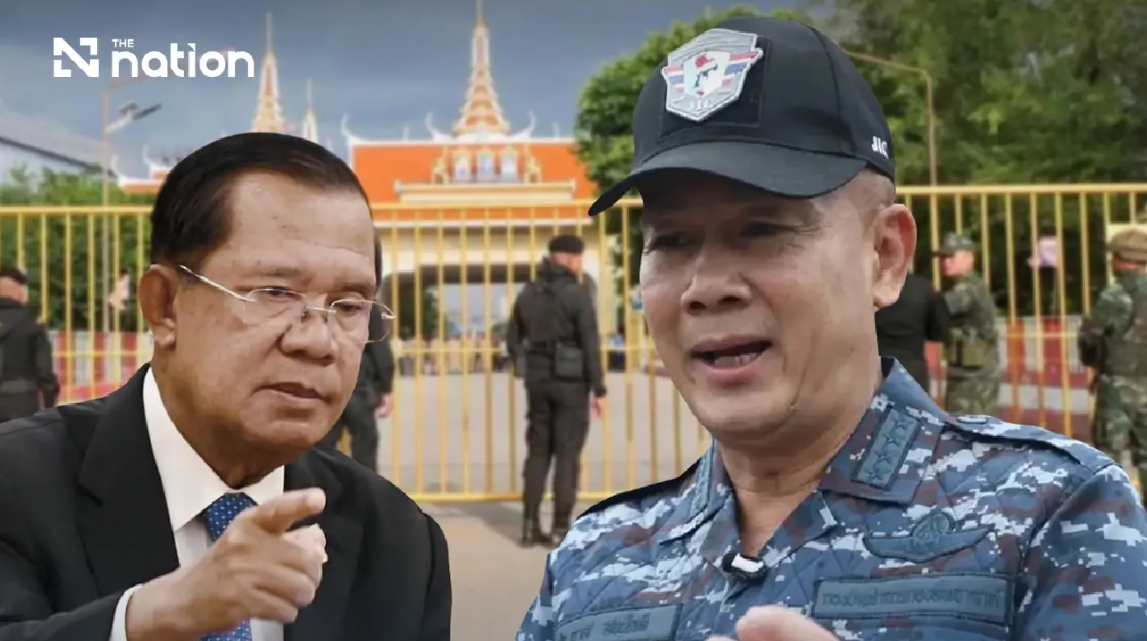
A senior Thai defence official on Friday delivered a detailed rebuttal to Cambodian Senate President Hun Sen's assertion that Thailand had weaponised its anti-scam operations as a smokescreen for what he termed "modern warfare" and territorial incursion. ACM Prapas Sonjaidee, who directs the Joint Information Centre on the Thailand-Cambodia Situation, questioned the appropriateness of making such allegations without verifiable supporting evidence presented on an international platform. His response signals Thailand's determination to counter Cambodia's narrative while pushing both nations toward fact-based dialogue rather than public recriminations.
The substance of Prapas's objection centred on what he characterised as a fundamental conflation of two distinct matters: whether particular locations housed scam operations, and whether those same areas served military purposes. This distinction matters considerably for understanding the legal and strategic dimensions of the border dispute. The Thai official maintained that simply identifying a site as a source of criminal activity could not logically justify military action unless that location was simultaneously being used to station troops, store weaponry or facilitate combat operations. The argument rests on establishing clear causation rather than allowing circumstantial proximity to substitute for evidence of deliberate strategic choice.
When examining any armed conflict, Prapas insisted, the temporal sequence of events carries decisive importance. Thailand's position, he underscored, begins not with its own military response but with what Bangkok characterises as Cambodia's initial use of force. This foundational disagreement over who fired first reflects a broader pattern in border disputes throughout Southeast Asia, where competing historical narratives and divergent interpretations of causation frequently prevent resolution. The Thai spokesman argued that any credible account must identify which side first deployed weapons, particularly if those weapons endangered civilian populations within Thai territory. Presenting only the response phase while omitting the provocation, he contended, fundamentally misrepresents the conflict's genesis.
The occupation question, central to Hun Sen's allegations, requires careful examination within the context of the bilateral ceasefire agreement that both nations have endorsed. According to Prapas, the accord explicitly permits forces to maintain positions as they stood when the ceasefire took effect. Neither side should advance toward the other, escalate tensions through provocative actions, or unilaterally redraw boundaries through military positioning. This framework creates a significant logical dilemma in Hun Sen's framing: both countries signed an agreement mandating force maintenance at specified locations, yet Cambodia simultaneously characterises Thailand's adherence to those same positions as illegal occupation. Prapas argued that this position cannot logically sustain itself without abandoning the mutual agreement both governments authored.
The proper mechanism for resolving border demarcation disputes lies with the established joint border commissions, not with unilateral military positioning or rhetorical claims made in international forums. Prapas emphasised that neither the armed forces, media organisations, nor individual leaders speaking at global venues should presume to settle boundary questions that require technical examination and consensus. This institutional approach reflects international best practice for managing contentious borders and resonates with regional interest in limiting escalation through established channels. For Malaysian observers particularly, this principle carries relevance given Malaysia's own complex maritime and terrestrial boundary situations requiring similar institutional restraint.
On the matter of civilian protection, Prapas articulated a principle of universal application: inhabitants on both sides of any border deserve equivalent safety regardless of nationality. Thai and Cambodian children and schools require identical safeguarding because humanitarian standards transcend political boundaries. Yet applying this principle fairly demands examining harm patterns comprehensively rather than selectively, examining weapons types, fire directions, precise coordinates, timing and intended targets on both sides of the conflict zone. Such detailed analysis becomes possible only when both parties commit to transparent documentation rather than curated narratives designed primarily to support predetermined conclusions about culpability.
A particularly significant element of Prapas's remarks addressed the information warfare dimension Hun Sen had raised. The Thai official acknowledged that disinformation and competing narratives constitute genuine 21st-century security challenges affecting multiple nations across Southeast Asia and beyond. However, he argued that responding to allegations of information manipulation with additional selective accusations merely perpetuates the very cycle both nations claim to oppose. Breaking this pattern requires voluntarily subjecting one's own evidence to external scrutiny rather than presenting only information convenient to one's own position. This principle applies equally to both Thailand and Cambodia, suggesting an implicit acknowledgment that neither side enjoys a monopoly on factual presentation.
Thailand's stated objectives in this dispute, according to Prapas, reject territorial conquest, hostility toward the Cambodian population or desire for renewed conflict. Rather, Thailand frames its position as rooted in protecting civilians and military personnel within its borders. Simultaneously, Prapas indicated willingness to cooperate against transnational scam operations through bilateral mechanisms, distinguishing such criminal suppression efforts from military occupation or territorial ambitions. This framing attempts to separate legitimate security concerns from accusations of imperialistic intent, though the distinction may not satisfy Cambodian leadership if fundamental disagreements persist about the sequence of military incidents.
The practical pathway forward, in Thailand's conception, requires both nations to maintain ceasefire commitments through force positioning compliance, supply comprehensive chronologies of contested incidents rather than abbreviated versions, reduce provocative actions designed to test the other side's resolve, and create diplomatic space where negotiators can work toward lasting resolution. Thailand explicitly positions itself as non-belligerent while maintaining that its response to perceived Cambodian military action was proportionate and defensive. This stance aims to secure international sympathy for the Thai position while creating diplomatic off-ramps for Cambodia should its leadership choose to shift toward dialogue.
For regional observers assessing the dispute, several analytical themes emerge. First, both Thailand and Cambodia deploy sophisticated rhetorical frameworks that appeal to international law and humanitarian principles while simultaneously presenting their opponent's actions in the most unfavourable light. Second, fundamental disagreements about factual sequences—who shot first, what locations were used for—remain unresolved and seemingly resistant to independent verification. Third, the involvement of transnational criminal enterprises complicates border security assessments across Southeast Asia generally, creating genuine ambiguity about whether particular locations warrant military attention. Fourth, neither nation appears ready to accept international mediation or independent fact-finding, preferring bilateral mechanisms that each side suspects of bias. These patterns suggest that despite rhetorical commitments to peace, structural obstacles to genuine resolution remain substantial.
The broader implications for Southeast Asia merit consideration. Border disputes, complicated by transnational criminal activity and competing geopolitical narratives, affect multiple regional countries. Thailand and Cambodia's inability to establish agreed factual baselines for their disputes demonstrates how easily such conflicts can persist indefinitely when both parties retain veto power over investigative processes and retain capacity to make competing claims on global stages. For other ASEAN members and regional stakeholders, the Thailand-Cambodia situation illustrates persistent vulnerability of the region's dispute resolution mechanisms to prolonged stalemate when both parties refuse compromise on fundamental questions about what occurred. The challenge of distinguishing genuine security needs from pretextual territorial ambitions, and of establishing credible fact-finding without appearing biased, remains central to Southeast Asian stability and remains unresolved.

