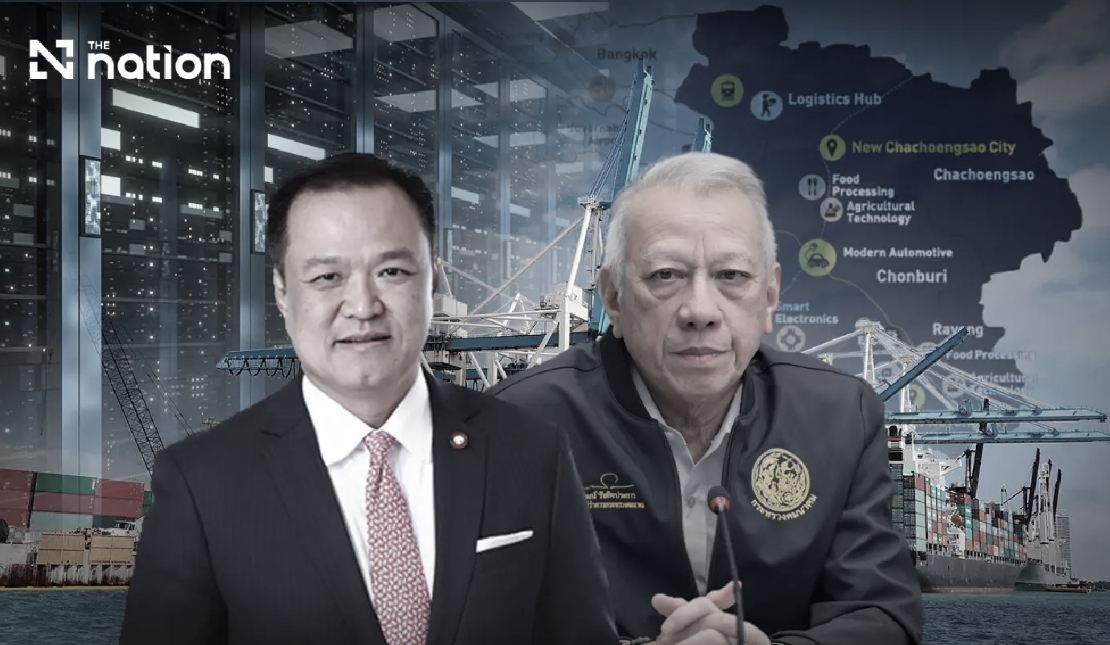
Thailand's Prime Minister Anutin Charnvirakul has reasserted direct control over the country's flagship Eastern Economic Corridor initiative, signalling a significant strategic reorientation of one of Southeast Asia's most ambitious regional development projects. The move, formalised through Prime Minister's Office orders signed on June 15, strips Deputy Prime Minister and Transport Minister Phiphat Ratchakitprakarn of his supervisory authority over the EEC Office and his chairmanship of the Eastern Economic Corridor Policy Committee. Government House officials emphasised that the decision follows consultative discussions between the two senior figures and does not represent a political rupture within the governing coalition.
The substantive shift in the EEC's positioning reflects a candid assessment that traditional heavy industry development can no longer serve as the corridor's primary economic engine. Thai government planners have identified critical infrastructure constraints—particularly in electricity supply and water availability—that impose prohibitive costs on industrial expansion. Rather than attempting to overcome these limitations through costly infrastructure upgrades, the administration has chosen to redirect investment promotion toward sectors with different resource profiles. This recalibration suggests pragmatic recognition that emerging global economic priorities differ markedly from the energy-intensive manufacturing paradigm that dominated previous development strategies across the region.
Food security has emerged as the centrepiece of the rebranded EEC investment proposition. The eastern region possesses genuine competitive advantages in agricultural production, with established strength in livestock operations, commercial fisheries, horticultural production, and fruit cultivation. Thai officials argue that heightened global attention to food supply chain resilience—amplified by recent geopolitical disruptions and climate challenges—creates unprecedented opportunities for regions capable of scaling agricultural output and processing capacity. By positioning the EEC as a comprehensive food security solution rather than merely a producer of commodities, Thai planners aim to attract investment from both multinational agricultural corporations and government-backed sovereign wealth funds seeking long-term supply chain security.
The pivot toward data centre development represents an equally significant strategic reorientation. Thailand's Energy Ministry is preparing a new electricity user category, designated Type 9, specifically tailored to data centre operations. This classification system acknowledges the sector's exceptional power consumption while establishing a transparent tariff structure that reflects actual resource demands. The creation of a dedicated regulatory framework signals serious governmental commitment to establishing Thailand as a regional data centre hub, particularly as multinational technology companies accelerate efforts to diversify their Asian infrastructure footprint beyond traditionally saturated markets. Data centre investment offers the additional advantage of requiring relatively modest water resources compared to heavy industrial operations, aligning perfectly with the corridor's infrastructural constraints.
Anutin's direct assumption of EEC leadership responsibility carries significant implications for Thailand's international investment marketing. By positioning himself as the principal government figure overseeing Thailand's economic development strategy, the Prime Minister effectively becomes the nation's chief salesman for foreign direct investment. This personalisation of the EEC portfolio reflects recognition that sovereign investment decisions increasingly depend on high-level political engagement and explicit government commitment. International investors require assurance that promised policy support and regulatory flexibility carry weight at the apex of governmental decision-making authority.
The official explanation for the leadership transition emphasised collaboration rather than conflict, with government sources attributing the change to Phiphat's own suggestion that persistent friction between the EEC Office and the Board of Investment had become counterproductive. According to this account, Phiphat himself recognised that transferring oversight to the Prime Minister would reduce interagency coordination problems and facilitate more effective project execution. While such explanations are standard in political transitions, the underlying narrative reveals genuine organisational challenges in managing complex economic development initiatives across multiple government agencies with overlapping jurisdictions and competing priorities.
Questions surrounding the high-speed rail project connecting Don Mueang, Suvarnabhumi, and U-Tapao airports have hovered over EEC governance discussions for months. The concession agreement with Asia Era One, the private development partner associated with CP Group, remains unresolved after years of contractual disputes centred on payment mechanisms. Phiphat had taken a firm stance against modifying the original construction-before-payment arrangement, resisting pressure to implement a progressive payment model tied to construction milestones. Government sources explicitly denied that the EEC leadership transition reflected disagreement over this contentious infrastructure project, with officials claiming that Anutin himself had rejected any contract amendments. This emphatic disavowal suggests that maintaining the rail project's original contractual terms carries significant policy importance regardless of which minister holds EEC oversight responsibility.
The abandoned Disneyland proposal for the EEC adds another dimension to the strategic recalibration under Anutin's direction. Government sources indicate that the Prime Minister questioned the commercial viability of major entertainment destination development, noting the absence of rigorous economic feasibility studies justifying the substantial capital investment required. This scepticism reflects a broader shift toward investment proposals grounded in empirical analysis rather than aspirational flagship projects with uncertain returns. The dismissal of the Disneyland concept demonstrates that the repositioned EEC will prioritise investments with demonstrable market demand and clear revenue generation capacity.
For Malaysian and broader Southeast Asian observers, Thailand's strategic repositioning of the EEC carries important implications for regional competition in attracting foreign investment. Malaysia's own development corridors, including the Iskandar Malaysia and Klang Valley initiatives, compete directly with Thailand's eastern region for similar investment pools. Thailand's explicit focus on food security infrastructure creates potential competitive challenges for Malaysian agricultural and agribusiness sectors, particularly in Southeast Asian markets where Thailand already maintains strong positions. Simultaneously, the data centre emphasis opens opportunities for regional coordination, as both Thailand and Malaysia possess advantages in different aspects of digital infrastructure development.
The governance restructuring under Anutin also reflects broader trends toward centralised decision-making authority in regional economic policy. By consolidating EEC oversight within the Prime Minister's office, Thailand demonstrates confidence in presidential-style economic leadership, concentrating authority rather than distributing it across multiple agencies. This approach can accelerate decision-making when coordinated effectively but carries inherent risks if political attention diverges from economic development priorities or if administrative capacity proves insufficient for managing complex, multi-sector initiatives.
Looking forward, the success of Thailand's recalibrated EEC strategy will depend largely on whether Anutin's direct involvement translates into tangible improvements in investment attraction and project execution. The previous governance arrangement under Phiphat had struggled with inter-agency coordination problems that ultimately prompted reorganisation. Simply concentrating authority in the Prime Minister's office does not automatically resolve the underlying structural challenges in managing multifaceted economic development across diverse government departments. Sustained attention, adequate staffing, and clear prioritisation will prove essential for translating strategic repositioning into concrete investment flows and completed projects that genuinely advance the corridor's development trajectory.

