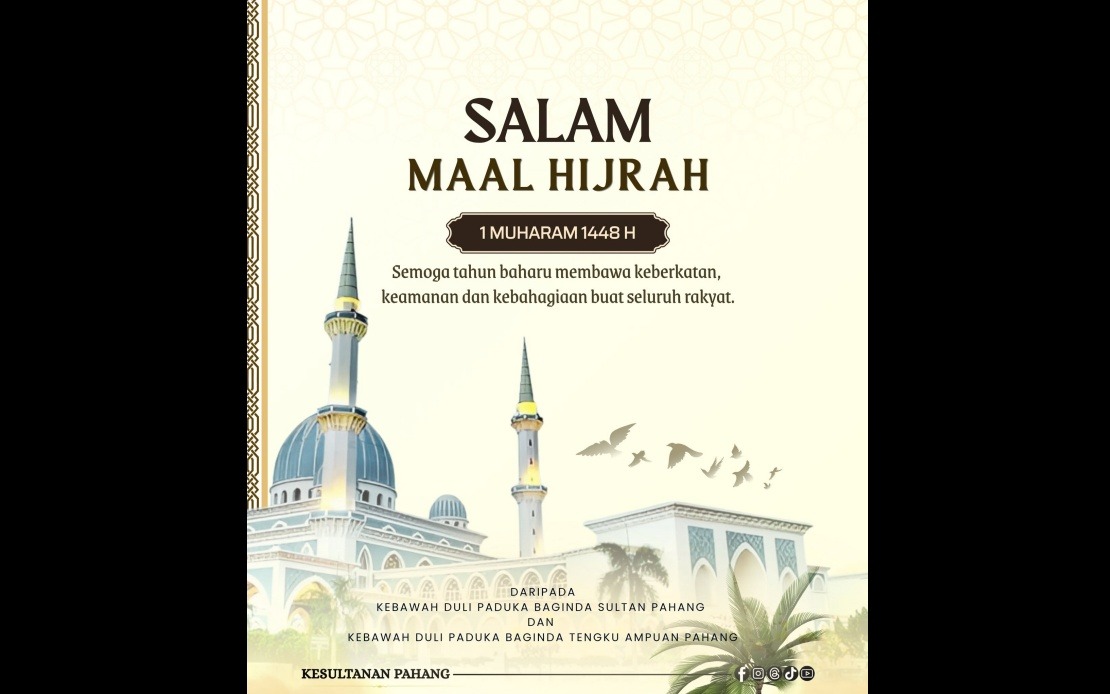
The Sultan of Pahang, Al-Sultan Abdullah Ri'ayatuddin Al-Mustafa Billah Shah, and the Tengku Ampuan of Pahang, Tunku Azizah Aminah Maimunah Iskandariah, have extended formal greetings to Muslims across the state as the Islamic calendar marks the commencement of 1448 Hijrah. The royal message, shared through the Kesultanan Pahang's official social media channels, carries the traditional wishes for blessings, tranquility, and prosperity as the new lunar year unfolds across the Muslim-majority nation.
The significance of Maal Hijrah extends far beyond ceremonial observance in Malaysia's religious and cultural calendar. The occasion commemorates Prophet Muhammad's migration from Mecca to Medina, an event that fundamentally reshaped Islamic civilization and established the foundations of the first Islamic state. For contemporary Malaysian Muslims, the new year represents a symbolic moment for introspection, spiritual recalibration, and community renewal—themes that feature prominently in official messages from state leaders each year.
Tengku Ampuan Tunku Azizah's joint participation in the greeting underscores the Pahang royal household's commitment to religious leadership and community engagement. As the state's first lady, her association with the message reinforces the monarchy's dual role as both temporal and moral authority figures, a tradition deeply embedded in Malaysian constitutional arrangements where sultans serve as Islam's custodians within their respective states.
Pahang Menteri Besar Datuk Seri Wan Rosdy Wan Ismail amplified the royal sentiments by framing the new year as a catalyst for personal and collective transformation. His statement positioned the Hijrah narrative as a metaphor for contemporary societal improvement, drawing parallels between the Prophet's journey and the spiritual recommitment expected from believers during this annual milestone. This layering of religious and administrative messaging demonstrates how Malaysian authorities leverage religious occasions to reinforce governance narratives.
The Menteri Besar's emphasis on renewing personal resolutions carries particular resonance for Malaysian Muslims navigating an increasingly complex social and economic landscape. His call to strengthen faith, amplify charitable contributions, and deepen community bonds addresses perennial concerns about spiritual vitality in modernizing societies. By tying these spiritual aspirations directly to state development and public welfare improvement, the message seeks to bridge the gap between individual piety and collective progress—a persistent challenge for Muslim-majority nations attempting to balance religious observance with developmental imperatives.
The invocation of unity and integrity within the Menteri Besar's message reflects broader strategic priorities within Malaysia's plural society. Pahang, as one of the peninsula's largest states and home to diverse communities, requires consistent messaging that acknowledges Muslim-majority demographics while maintaining the inclusive social compact upon which Malaysian multiculturalism depends. The emphasis on integrity, in particular, carries implicit reference to governance standards and ethical conduct—issues that have assumed heightened importance across Malaysian public discourse in recent years.
The reference to Prophet Muhammad's Hijrah as a paradigm for positive change taps into a rich tradition of Islamic leadership literature. The concept of migration encompassed not merely physical displacement but spiritual transformation, suggesting that true migration involves abandoning destructive behaviors and corrupting influences. By invoking this classical Islamic framework, state leaders position contemporary governance challenges within an established theological context, lending religious legitimacy to secular policy objectives.
The timing of these greetings, released through digital platforms, reflects the evolution of royal communication in the social media age. Traditional media outlets and official government channels remain important, yet the deliberate use of Facebook and similar platforms ensures direct reach to wide segments of the population, particularly younger demographics who primarily consume news through digital sources. This multimedia approach has become standard practice among Malaysian state authorities seeking to maintain relevance and accessibility.
Maal Hijrah observances across Malaysian states typically extend beyond symbolic greetings to encompass concrete community activities. Schools may conduct assemblies emphasizing the historical significance of the Hijrah, religious institutions organize lectures and study circles, and communities organize charitable drives to embody the spiritual renewal message. Government departments frequently issue their own statements, creating a cascading series of messages throughout the month that collectively reinforce the themes of religious recommitment and social solidarity.
For Southeast Asian observers, the Malaysian approach to religious commemoration offers insights into how Muslim-majority democracies navigate the relationship between state authority and religious leadership. The Pahang sultans' continued prominence in religious affairs, even within Malaysia's federal system, demonstrates the enduring significance of traditional monarchical institutions in contemporary Islamic governance structures. This contrasts markedly with other regional models and reflects Malaysia's particular constitutional arrangements.