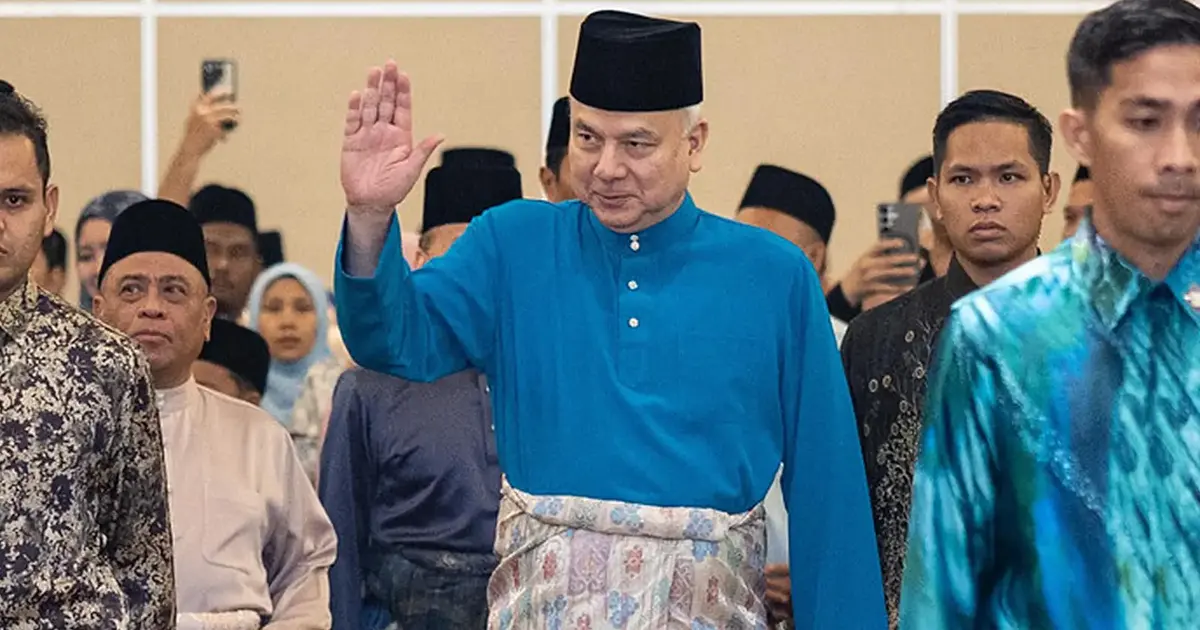
Sultan Nazrin Shah, the Deputy Agong, has delivered a pointed reminder to Malaysia's leadership cadre that governance cannot afford the luxury of impulsive decision-making, particularly when driven by emotional impulses rather than careful deliberation. The senior royal figure articulated a vision of national progress rooted not in sudden policy shifts or reactive measures, but in the deliberate cultivation of stability and foresight that characterises mature governance.
The Sultan's intervention comes at a time when Malaysia's political landscape has witnessed considerable churn in recent years, with coalitions shifting, policies reversing, and institutional decisions sometimes appearing reactive to immediate pressures rather than anchored in long-term strategic thinking. His counsel carries particular weight given the constitutional role of the monarchy in safeguarding institutional stability and the principle of measured governance. The message serves as a subtle but unmistakable check on leadership that loses sight of foundational values amid the turbulence of everyday political competition.
Central to Sultan Nazrin's thesis is the proposition that national success emerges not from the decisiveness of individual leaders but from the willingness of an entire populace to embrace cooperation as a governing principle. This framing represents a departure from personality-driven politics, which has dominated Malaysian discourse in recent years, and instead emphasises structural conditions and social attitudes that transcend any single administration. The framework suggests that resilient governance requires citizens and leaders alike to prioritise collective advancement over partisan victory or personal vindication.
The emphasis on mutual respect carries implications for how Malaysia's diverse communities navigate their relationship with one another. In a nation where religious, ethnic, and linguistic diversity remains a defining characteristic, the Sultan's call for respectful coexistence addresses tensions that periodically surface around communal sensitivities, constitutional arrangements, and resource allocation. By positioning respect as a prerequisite for national achievement rather than a luxury, he reframes social harmony as a practical necessity rather than an aspirational ideal.
Harmonious living, as outlined in his remarks, extends beyond the symbolic realm into institutional architecture and policy implementation. Malaysian governance has historically benefited when institutions function within agreed constitutional parameters, when transitions of power occur smoothly, and when debate over policy directions occurs within frameworks that acknowledge legitimate plurality of views. The Sultan's intervention implicitly critiques departures from this model, whether through institutional overreach, constitutional brinksmanship, or the weaponisation of state apparatus for factional advantage.
For Southeast Asian observers, Sultan Nazrin's counsel resonates with broader regional concerns about the quality of governance and democratic resilience. Nations across the region grapple with populism, identity-based mobilisation, and the tension between rapid change and institutional continuity. The Malaysian monarchy's traditional role as guardian of constitutional propriety and national unity gives particular force to statements emanating from the Palace, as they are understood to reflect institutional perspective rather than partisan positioning.
The timing of the statement merits consideration. Malaysia has recently navigated significant political transitions, including changes in federal coalitions and the appointment of new state administrations. Some of these transitions have involved contentious processes that divided public opinion, raised concerns about institutional independence, and prompted questioning about whether decisions were taken with adequate consultation and deliberation. The Sultan's warning against hasty, emotionally-driven decisions appears directed at ensuring future transitions, whether electoral or administrative, unfold with greater care for process and principle.
The Sultan's invocation of cooperation as foundational reflects classical constitutional monarchy doctrine, wherein the ruler stands above partisan competition to represent the continuity and transcendent interests of the nation itself. This positioning becomes increasingly important during periods when electoral politics fragment along personality lines, when institutional conflicts threaten constitutional boundaries, or when majoritarian impulses risk marginalising minority interests. A measured, consultative approach to governance—precisely what the Sultan advocates—serves as ballast against these destabilising tendencies.
For Malaysia's business community and international investors, the emphasis on stability and deliberation holds economic implications. Sudden policy reversals, institutional uncertainty, and governance by impulse create the conditions for capital flight, rating downgrades, and reduced confidence in long-term planning horizons. The Sultan's call for thoughtful leadership thus carries practical resonance beyond the symbolic realm, as sustainable economic development requires the policy consistency and institutional predictability that emerge from measured rather than reactive governance.
The broader challenge facing Malaysian leadership lies in translating the Sultan's counsel into institutional practice. Exhortations toward unity and cooperation, while valuable, require reinforcement through concrete structural changes that incentivise consultation, reward consensus-building, and discourage zero-sum competition among institutional actors. The palace can articulate the imperative for harmonious governance, but the implementation falls to elected officials, appointed administrators, and civil servants who must daily navigate conflicting pressures and competing interests.
Sultain Nazrin's intervention also implicitly addresses the tendency within Malaysian politics toward grandstanding and public confrontation as substitutes for genuine dialogue and problem-solving. The palace perspective, historically cautious and consensus-oriented, stands in tension with media-driven politics that reward dramatic gestures and inflammatory rhetoric. His warning carries an invitation for leaders to embrace quieter, less visible forms of leadership that build rather than burn institutional capital.
For Malaysia moving forward, the Sultan's message suggests that true national development depends less on any single leader's brilliance or any one coalition's dominance, and more fundamentally on the maturation of political culture around principles of respect, consultation, and mutual accommodation. This vision requires patience, restraint, and the willingness to prioritise institutional health over momentary factional advantage—qualities increasingly tested in contemporary Malaysian politics.

