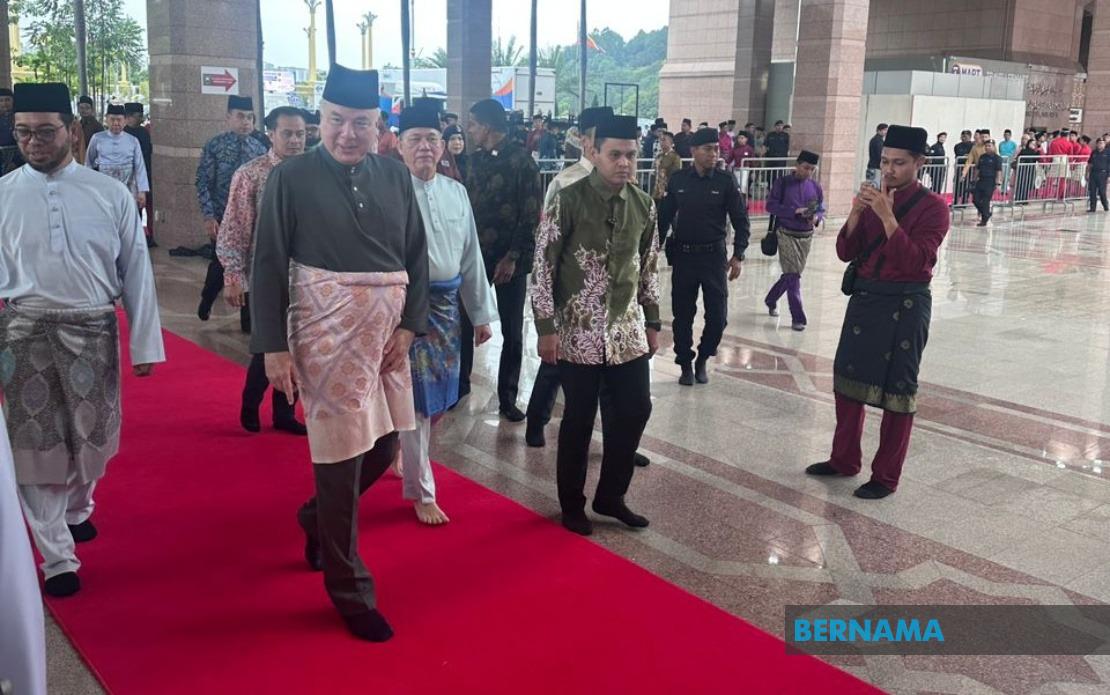
The nation's leaders must resist the temptation to govern through impulse and emotion, Deputy Yang di-Pertuan Agong Sultan Nazrin Shah warned during the National Level Maal Hijrah 1448 celebration in Putrajaya on June 17. Speaking before some 5,000 attendees at the Putra Mosque, His Royal Highness expressed deep concern about decision-makers who prioritise immediate interests over considered judgment, cautioning that such recklessness ultimately transfers the burden of poor choices onto ordinary citizens who bear the lasting consequences.
Sultan Nazrin's intervention comes at a time when Malaysia's political landscape continues to grapple with questions of governance quality and institutional stability. The Ruler of Perak stressed that true leadership demands what he termed "calmness, openness, and cautiousness"—qualities that reflect maturity in policymaking. When leaders abandon these principles in favour of reactive, emotionally-driven responses, Sultan Nazrin argued, national interests suffer and confidence in institutions erodes. His remarks implicitly critique a governing approach that responds to daily pressures rather than adhering to coherent strategic frameworks.
Drawing from Islamic history, Sultan Nazrin illustrated his point through the example of Prophet Muhammad's journey during the Hijrah, where the Prophet appointed Abdullah bin Uraiqit, a non-Muslim guide, based purely on merit and trustworthiness. This historical lesson carries particular relevance for Malaysian governance, where questions of meritocracy and competence selection remain contentious. Sultan Nazrin emphasized that Islam as a philosophical system recognizes expertise and integrity regardless of religious background, provided such appointments do not harm Muslim interests. The principle suggests that national leadership should similarly transcend narrow considerations and focus on capability—a message with obvious implications for cabinet formation, institutional appointments, and civil service advancement in Malaysia.
The Sultan articulated a vision of national progress that transcends mere celebration of past achievements. A truly great nation, he contended, must extract lessons from history to construct a superior future. This forward-looking perspective stands in contrast to political narratives that fixate on historical grievances or nostalgic recollections of previous eras. For Southeast Asian observers, Sultan Nazrin's emphasis on learning from the past rather than living within it offers a counterweight to populist appeals that often traffic in selective historical memory. Such maturity in political thinking remains valuable at a regional moment when several governments face pressure to address complex modern challenges while managing expectations shaped by competing historical narratives.
Central to His Royal Highness's address was an extended meditation on sacrifice—a quality he identified as fundamental to national achievement yet increasingly rare in contemporary Malaysian society. Sultan Nazrin distinguished between rhetorical invocation of sacrifice and its genuine practice, warning that the ummah must cultivate authentic commitment to placing collective interests above personal comfort and advantage. This diagnosis suggests concern about the erosion of public-spirited values within Muslim-majority Malaysia, where materialistic pursuits and individualism appear ascendant. The Sultan's call for sacrifice as "a way of life" rather than occasional rhetoric implicitly critiques leadership and society alike for insufficient commitment to nation-building imperatives. For a country navigating demographic pressures, economic restructuring, and regional competition, such values matter materially.
Unity emerged as Sultan Nazrin's second major theme, grounded in the Medina Charter's historical success in reconciling diverse communities through tolerance and equitable governance. The Ruler positioned unity and cooperation as foundational to advancing Islamic civilization, contingent upon "just and wise leadership." This formulation carries unmistakable implications for Malaysia's plural society, where communal harmony depends critically on institutional fairness and leadership credibility. When governance appears partial or leaders act with perceived bias, the foundation for unity weakens. Sultan Nazrin's invocation of the Medina Charter—a document predating Malaysia's own constitutional settlement by fourteen centuries—suggests that principles of inclusive governance remain timeless rather than merely contemporary accommodations. His emphasis that national success "depends greatly on the willingness of its people to cooperate, respect one another, and live harmoniously despite differences in ethnicity, culture, and religion" represents an implicit rebuke to communal polarization and identity-based politics.
Sultan Nazrin contextualized the Maal Hijrah commemoration not as mere calendar observance or historical nostalgia but as an annual moment for institutional and personal reflection. He reframed the celebration as an opportunity for societies to examine shortcomings and renew awareness of transcendent obligations beyond material preoccupation. This interpretive move transforms a religious commemoration into something functionally similar to a national self-examination, inviting both Muslim and non-Muslim citizens to consider whether their societies have drifted from foundational values. The Sultan's suggestion that people "risk becoming increasingly overwhelmed by the tides of worldly life" implicitly diagnoses contemporary Malaysia as suffering from spiritual and institutional drift—a condition that annual reflection might ameliorate.
The Sultan's address, delivered alongside Deputy Prime Minister Datuk Seri Fadillah Yusof and Minister Dr Zulkifli Hasan, carries particular weight given his constitutional position and demonstrated willingness to articulate values-based critiques. Unlike partisan politicians, whose institutional interests are obvious, royal pronouncements on governance possess residual moral authority. The choice to emphasize leadership qualities of deliberation, merit-based appointment, sacrifice, and unity reflects a coherent vision of responsible governance—one that implicitly distances itself from personality-driven politics, patronage networks, and short-termism. For Malaysian observers, these interventions suggest that institutional voices beyond electoral politics retain capacity to shape national conversation about what leadership demands.
The celebration's theme, "MADANI Dihayati, Ummah Diberkati" (MADANI Lived, Ummah Blessed), appears deliberately chosen to align with the government's MADANI framework, suggesting that Sultan Nazrin's moral counselling is intended to strengthen rather than undermine current leadership. Yet his emphasis on sacrifice, unity grounded in justice, and rejection of impulsive decision-making reads as prescriptive rather than descriptive—conditions leaders should aspire toward rather than achievements already accomplished. This subtle positioning allows the Sultan to affirm government while maintaining critical distance, offering guidance that transcends partisan allegiances. For a country where royal institutions remain culturally significant, such measured moral authority can usefully counterbalance governmental tendency toward expedient choices and communal incentives toward polarization.
The broader context includes Malaysia's ongoing political transition following the 2022 elections, during which institutional stability and governance quality emerged as significant public concerns. Sultan Nazrin's reiteration that leaders must resist emotional reactivity and prioritize careful deliberation suggests these remain live issues requiring continued emphasis. Regional observers may also note that several Southeast Asian governments face similar pressures toward personalism, short-termism, and majoritarian impulses—suggesting that the Sultan's articulation of alternative governance principles possesses relevance beyond Malaysia's borders. His invocation of the Medina Charter's reconciliation of diverse communities through just leadership offers a model explicitly rooted in Islamic tradition yet applicable across plural Southeast Asian societies.
The gathering of approximately 5,000 attendees at the Putra Mosque, including senior government figures, underscores institutional investment in the Maal Hijrah commemoration as vehicle for national values reinforcement. Such occasions permit expression of ideals that routine governance may neglect, offering ceremonial space for articulation of principles that guide long-term national orientation. Sultan Nazrin's choice to devote extended remarks to leadership ethics, sacrifice as national necessity, and unity grounded in justice rather than majoritarianism suggests these elements require periodic reiteration in contemporary Malaysian context. His call for self-reflection among both leaders and citizens frames the religious observance as having practical governance implications—bridging the categorical separation between ceremonial and operational domains. Whether such moral suasion influences actual decision-making remains uncertain, yet the effort to anchor governance within ethical frameworks rooted in historical and religious tradition offers conceptual ballast against drift toward purely expedient leadership.

