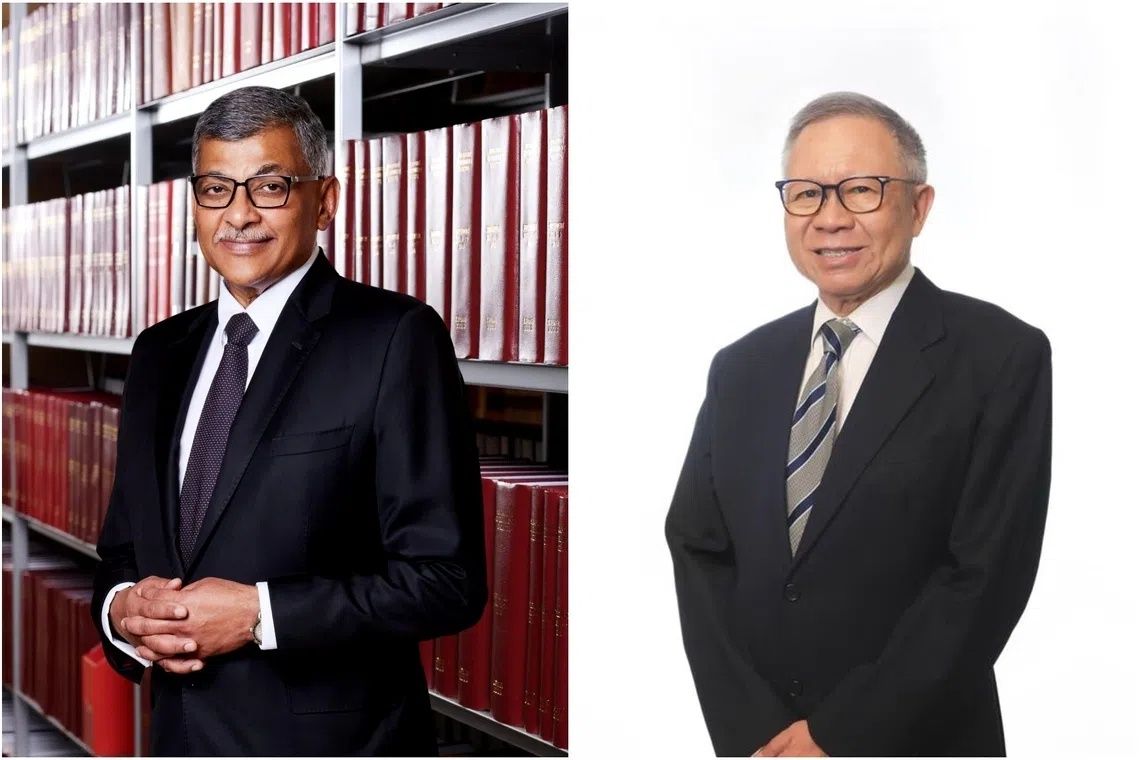
Singapore's Chief Justice Sundaresh Menon and Eddie Teo, the former chairman of the Council of Presidential Advisers, have been named recipients of the Order of Temasek (With Distinction) at this year's National Day Awards, marking recognition of their extensive contributions to the city-state's institutional development. The honour places both men among the republic's most decorated public figures, acknowledging their leadership in shaping Singapore's judiciary and governance structures during periods of significant national importance.
Menon, who is 62 years old, will formally step down from his position as head of the judiciary in February 2027 after spending 14 years in that role, having assumed office in November 2012. His tenure has been marked by a comprehensive modernisation of how justice is administered across the courts system. Under his direction, the judiciary has undergone what institutional observers regard as one of Asia's most substantial judicial transformations, encompassing both technological advancement and structural reform. The modernisation programme has introduced digital case management systems, reshaped courtroom procedures, and fundamentally altered how the public interfaces with the justice system.
Among the most significant institutional developments during Menon's leadership has been the establishment of the Appellate Division of the High Court, which has streamlined the court hierarchy and improved the efficiency of appeals processing. Equally important has been the creation of the Singapore International Commercial Court, positioning the jurisdiction as a regional centre for resolving high-value cross-border disputes. These innovations reflect a strategic effort to maintain Singapore's attractiveness as a global financial and commercial hub by offering world-class dispute resolution mechanisms. The Singapore Judicial College, established during his tenure, has become instrumental in professionalising the judiciary through ongoing education and training programmes for judges and court administrators.
Beyond structural reforms, Menon has championed what the judiciary terms therapeutic justice approaches, particularly in the Family Justice Courts and Youth Courts. This philosophy emphasises resolution and rehabilitation rather than purely punitive outcomes, representing a philosophical shift in how the courts address family disputes and youth offending. The approach has gained international attention as evidence emerges of improved social outcomes and reduced recidivism rates. In his statement acknowledging the award, Menon emphasised that Singapore's commitment to the rule of law has been foundational to the nation's development, and he characterised the honour as recognising the collective efforts of all who have contributed to sustaining public confidence in the justice system. The timing of the award is particularly symbolic, as it coincides with the bicentennial of Singapore's formal legal and judicial traditions.
Teo, now 79 years old, brings a different but equally consequential institutional perspective to this recognition. He retired in 2018 as chief of the Public Service Commission, having served the government continuously for nearly five decades. His career trajectory epitomises the meritocratic path Singapore's civil service has fostered, beginning in 1970 within the Ministry of Defence's Security and Intelligence Division. He rose to lead that intelligence agency at age 31, directing it during the sensitive late Cold War period and the immediate post-Cold War transition from 1979 to 1994. This period required navigating complex geopolitical challenges affecting Singapore's regional security posture.
Teo's subsequent roles as permanent secretary for defence and later in the Prime Minister's Office placed him at the centre of Singapore's most sensitive policy decisions during the 1990s and early 2000s. As chairman of the Public Service Commission from 2008 to 2018, he oversaw a deliberate diversification of the commission's membership, deliberately recruiting professionals from academia, law, and social work backgrounds. This expansion of perspectives reflected evolving thinking about how public sector leadership should be constituted in a more complex, knowledge-intensive economy. Following his retirement, Teo was appointed to the Council of Presidential Advisers, eventually becoming its chairman, a position he held until June 2026.
Teo's most visible recent responsibility came during the COVID-19 pandemic, when the Government sought approval to withdraw approximately S$40 billion from the country's past reserves—the largest such drawdown in Singapore's history. As a member and subsequently chairman of the Council of Presidential Advisers, Teo was directly involved in the deliberations that led to then-President Halimah Yacob's approval of this extraordinary measure. The decision proved consequential, enabling the Government to implement stabilisation measures that protected employment and business continuity without requiring significant public borrowing. Reflecting on his career, Teo identified his early years learning directly from founding Prime Minister Lee Kuan Yew and his contemporaries as formative, describing how those pioneer leaders instilled in him the values that sustained his public service commitment.
The broader context of these awards involves 7,491 individuals receiving National Day honours this year, though the Order of Temasek (With Distinction) represents the highest civilian recognition available. Beyond Menon and Teo, five individuals received the Distinguished Service Order, the next-ranking honour. Among these is Alan Chan, 73, chairman of the Land Transport Authority since 2016, whose tenure has produced measurable improvements in rail system reliability. The mean kilometres between failures on Singapore's rail network improved from 393,000 in 2017 to two million in 2026, reflecting systematic improvements in maintenance and operational practices. Chan has also overseen delivery of major infrastructure projects including the Thomson-East Coast Line and the Singapore Rail Test Centre, while advancing electric vehicle adoption across the public transport network.
The recognition of these figures reflects Singapore's institutional approach to governance, which emphasises continuity of high-performing bureaucratic leadership while creating mechanisms for recognising and celebrating that service. For Malaysian and regional readers, these awards illuminate how Singapore maintains institutional excellence and attracts sustained high-calibre leadership to public service roles, a contrast that invites reflection on how different governance models in the region prioritise civil service prestige and compensation. Teo's explicit observation that public service, while personally rewarding, typically generates less personal wealth than successful private sector careers, speaks to a particular cultural commitment Singapore has cultivated toward attracting elite talent to government roles.
The geographic and institutional significance of these honours extends beyond Singapore itself. The Singapore International Commercial Court created under Menon's leadership has become increasingly important for dispute resolution involving Malaysian, Thai, Vietnamese, and Indonesian parties, positioning Singapore as a neutral forum for regional commercial disputes. Similarly, Singapore's reforms to its family and youth justice approaches have begun influencing policy discussions across Southeast Asia, as neighbouring countries examine whether therapeutic justice models might address their own system challenges. The institutional innovations during Menon's tenure thus carry implications that ripple throughout the region's legal communities and policymaking circles, establishing benchmarks that shape regional expectations for judicial modernisation.

