A Singapore man is facing serious criminal charges stemming from a reckless driving incident that endangered numerous road users and left two young passengers injured. Aaron Tan Yao Cong, 29, appeared in court on Thursday, June 18, to answer to five charges connected to an early-morning rampage through Singapore's roads on March 6 that culminated in a fiery collision with a school bus. The case highlights the persistent dangers posed by drink-driving and the severe consequences when such behaviour combines with aggressive, rule-breaking conduct on busy urban roads.
The sequence of events on that morning began when Tan ignored a traffic sign directing straight traffic along Cavenagh Road near Bukit Timah Road at 5:50am. Rather than proceeding as instructed, he executed a left turn that placed his vehicle directly in the path of oncoming traffic. He managed to bring his car to a halt on the left side of the two-lane Cavenagh Road heading towards Buyong Road, but this was merely the opening chapter of an increasingly dangerous sequence. Police records indicate that despite this initial stop, Tan would soon resume driving with catastrophic consequences.
Within minutes of the first incident, Tan accelerated away from the scene at approximately 6am as officers approached his vehicle. His driving became progressively more reckless as he traversed Bukit Timah Road towards Upper Bukit Timah Road, eventually reaching an average speed of 114 kilometres per hour. During this stretch, which police documented between Coronation Road and Anamalai Avenue, Tan repeatedly weaved between other vehicles, demonstrating a complete disregard for road safety regulations and the wellbeing of other motorists. This pattern of dangerous manoeuvres reflected either impaired judgment or deliberate indifference to the risks he was imposing on fellow road users.
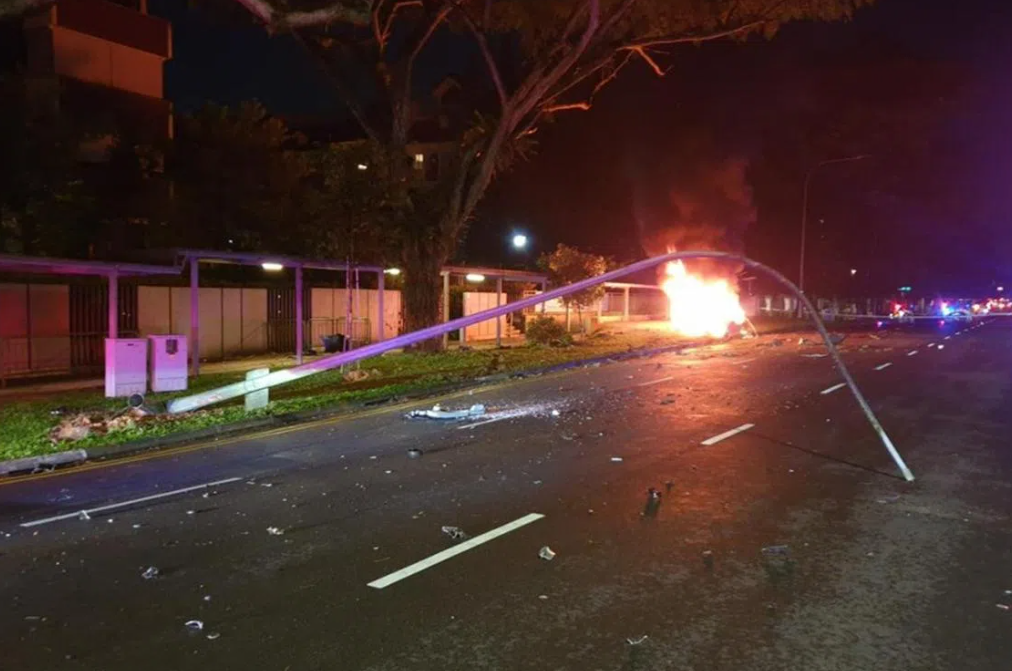
The severity of Tan's conduct escalated further when he approached the junction of Sixth Avenue at 6:16am. Rather than respecting the red traffic signal, Tan drove through the intersection and collided with a private bus that was lawfully executing a U-turn. The impact was sufficient to cause significant damage, but the collision was not the end of the incident. Tan's vehicle subsequently struck a lamp post with such force that it ignited, leaving the car engulfed in flames. Remarkably, Tan and three passengers in his vehicle managed to escape before the fire consumed the car entirely, avoiding what could have been a tragedy with multiple fatalities.
The bus involved in the collision carried the driver and two young passengers aged nine and ten years old. All occupants—Tan, his three passengers, the bus driver, and the two children—required hospital treatment for their injuries. While the specific nature of the injuries to the children has not been detailed in court documents, the fact that they needed medical attention underscores the serious physical impact of Tan's driving decisions. For the families involved, this incident transformed what should have been an ordinary school morning into a traumatic event that required emergency medical intervention.
Crucially, toxicology testing revealed that Tan had consumed alcohol before driving. When arrested at the scene, he refused to provide a breath sample, an act in itself a separate criminal offence. Subsequent blood testing conducted after his arrest showed alcohol content of 148 milligrams per 100 millilitres of blood, significantly exceeding Singapore's legal limit of 80 milligrams per 100 millilitres. This finding is particularly concerning given Tan's history with alcohol-related driving offences. He was previously convicted in 2019 of both drink driving and driving without due care and attention, indicating a pattern of poor judgment and failure to learn from earlier consequences.
The five charges Tan now faces represent the legal system's attempt to address the multiple dimensions of his culpability. Beyond the core charge of drink driving, he is accused of dangerous driving causing hurt, leaving his vehicle in a dangerous position, failing to cooperate with breath-testing procedures, and driving against the flow of traffic. This comprehensive charging strategy reflects the severity of the incident and the multiplicity of legal violations that occurred during his rampage. His case is scheduled to return to court on July 16, where he may enter pleas to the charges.
The potential sentencing framework reveals the seriousness with which Singapore courts view such behaviour. If convicted as a repeat drink-driving offender, Tan faces up to two years imprisonment and a fine reaching $20,000. The dangerous driving causing hurt charge carries a maximum of two years' jail time and $10,000 in fines, with repeat offender provisions extending penalties to $20,000. For allowing his vehicle to remain in a dangerous position, he could receive three months' jail or a $1,000 fine. Failing to provide a breath specimen carries up to six months' imprisonment and $5,000 in fines for repeat offenders, while driving against traffic flow could result in six months' jail and $2,000 in penalties for those with prior convictions.
This incident carries particular resonance for Southeast Asian road safety discussions. Many jurisdictions in the region struggle with enforcement of drink-driving laws and achieving public acceptance of strict penalties. Singapore's approach—combining blood-alcohol testing, comprehensive charging strategies, and meaningful custodial sentences—represents an attempt to deter such behaviour through both certainty of detection and severity of consequence. The involvement of children as victims also amplifies public concern, as school-age passengers represent some of the most vulnerable road users, entirely dependent on others' responsible behaviour for their safety.
For Malaysian and regional readers, the case underscores several critical points about road safety enforcement. First, drink-driving remains a persistent problem that demands sustained law enforcement attention and public education. Second, individuals with prior alcohol-driving convictions present an elevated risk to society, warranting enhanced monitoring and stricter penalties upon reoffence. Third, the convergence of multiple violations—dangerous driving, traffic signal violations, reckless weaving, and impairment—creates catastrophic risk even in urban environments with relatively lower speed limits. Finally, the involvement of innocent third parties, particularly children, demonstrates why enforcement of traffic laws serves a protective function extending far beyond simple rule compliance.