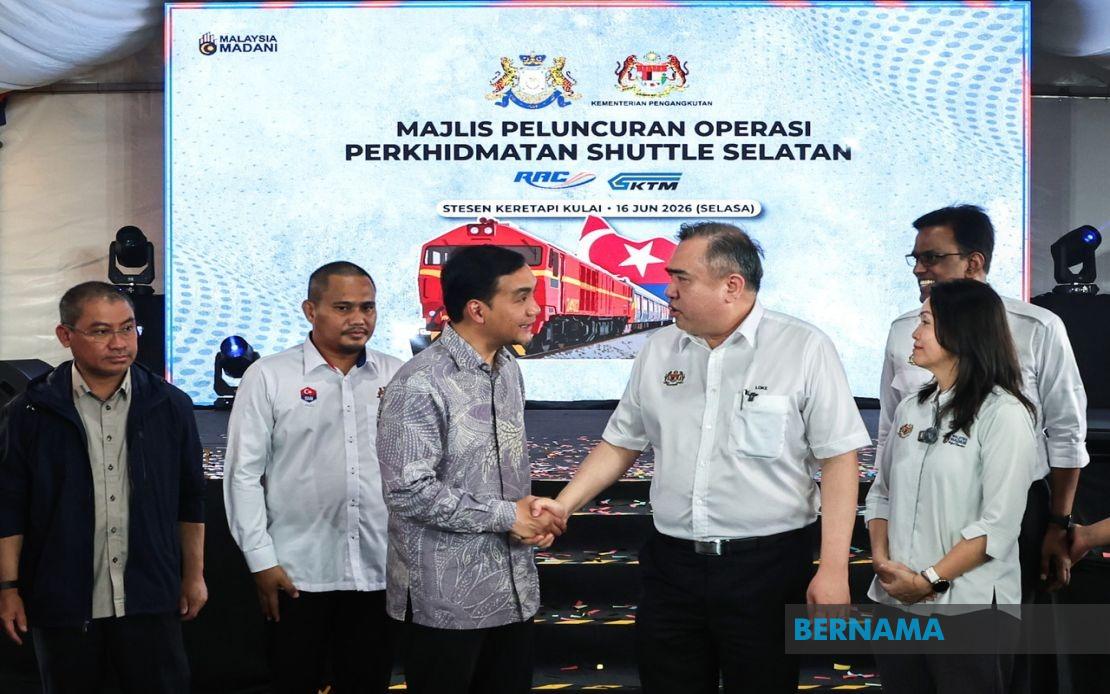
The government has officially opened Shuttle Selatan, a new rail-based commuter service designed to reshape transportation across the southern Johor corridor. Unveiled at Kulai KTM station, the service immediately connects three major population centres—Kulai, JB Sentral and Pasir Gudang—and is projected to benefit more than two million people in these areas. Transport Minister Anthony Loke described the launch as a significant step towards building an integrated public transport ecosystem in one of Malaysia's most economically dynamic states.
The shuttle operates along two primary corridors during its initial phase. The first runs between Kulai and JB Sentral in both directions, while the second connects Kempas Baru with Pasir Gudang. Journey times are competitive with road transport, with passengers reaching JB Sentral from Kulai in approximately 40 minutes and the Kempas Baru-Pasir Gudang route taking 40 to 45 minutes. These travel durations address a critical pain point in the southern Johor region, where congestion on major highways has long plagued commuters and logistics operators alike.
The government has signalled ambitious expansion plans that could transform the service into a comprehensive regional network. Future phases will extend connectivity from Paloh through Kulai via Kluang, Renggam and Layang-Layang stations, effectively creating a north-south spine across the peninsula's southern tier. Additionally, three new stations—Taman Daya, Bandar Baru Sri Alam and Pasir Putih—are planned to broaden accessibility and ensure neighbourhoods across the region gain direct rail access. These additions reflect a strategic approach to avoiding the transportation inequities that have historically affected peripheral areas.
A central challenge facing any new public transport initiative is the so-called first-last-mile problem, where commuters struggle to reach stations or complete journeys after disembarking. Shuttle Selatan attempts to solve this through multiple complementary mechanisms. Feeder bus services will connect residential areas to main stations, while integration with Bas.My routes ensures seamless transfers across operators. A dedicated shuttle service operates from Kempas Baru station, and park-and-ride facilities at AEON Bandar Dato' Onn enable drivers to switch to rail for longer journeys. This holistic design distinguishes the service from earlier transport initiatives that treated rail in isolation.
Price remains a fundamental lever in shifting commuter behaviour towards public transport. To accelerate adoption, the government introduced the Commuter MADANI Shuttle Selatan Card, with 3,000 units distributed free to Johor residents. Each RM50 card grants unlimited travel on the shuttle for a defined period, effectively subsidising initial usage. The Railway Assets Corporation allocated over RM150,000 in incentive funding specifically to encourage modal shift away from private vehicles. For budget-conscious commuters and those concerned about fuel costs, this represents a meaningful immediate saving that can overcome psychological barriers to trying rail services.
Johor's particular development trajectory makes transport infrastructure increasingly urgent. The state ranks among Malaysia's fastest-growing regions, driven by expansion in industrial manufacturing, container shipping through its deepwater ports, education hubs and cross-border trade. Unlike mature urban areas where transport patterns have crystallised, Johor's rapid growth creates an opportunity to establish sustainable commuting habits before car-dependent sprawl becomes entrenched. Shuttle Selatan directly serves workers and users traversing the industrial zones, port facilities and commercial centres that drive state revenue, potentially reducing road freight congestion and improving labour mobility across these sectors.
The service represents a convergence of federal and state policy priorities. Transport Minister Loke's involvement signalled national commitment, while Johor Menteri Besar Datuk Onn Hafiz Ghazi and the state Public Works Committee chairman Mohamad Fazli Mohamad Salleh attended the launch, demonstrating alignment between federal and state governments on transport infrastructure. This political cohesion is notable given Malaysia's history of transport projects that have faltered due to institutional fragmentation or unclear cost-sharing arrangements. The implementation involved coordinated effort from the Ministry of Transport, Keretapi Tanah Melayu Berhad (KTMB) and the Railway Assets Corporation, suggesting that institutional frameworks for delivering integrated transport services are gradually maturing.
From a regional Southeast Asian perspective, Shuttle Selatan reflects broader shifts in urban mobility policy across the peninsula. Singapore's rapid transit dominance and Thailand's elevated rail systems have prompted Malaysian policymakers to recognise that sustainable cities require proportionally greater investment in rail relative to roads. The service also carries implications for cross-border commuting, as enhanced connectivity between Johor Bahru and hinterland areas may increase integration with Singapore's transport network, particularly if future phases include connections to major employment centres or transit hubs.
The subsidised fare structure and feeder network reveal an implicit acknowledgment that profitability cannot be the sole measure of transport success. Services that reduce traffic congestion, cut transport spending for low-income commuters and enable people to access employment create broader economic value beyond fare revenue. This philosophical shift—treating transport as a public good rather than a commercial service—aligns with evolving Malaysian policy but will require sustained government commitment to subsidy and maintenance beyond initial launch enthusiasm.
For commuters across Kulai, Pasir Gudang and Johor Bahru, the immediate benefit is straightforward: a faster, more predictable travel option during congested hours. For logistics companies and port operators, reduced congestion on key arterial roads translates to faster goods movement and lower vehicle operating costs. For Johor's policymakers, the service provides a foundation for managing growth without proportionally expanding road capacity—a mathematical and fiscal necessity as vehicle ownership continues rising. The true test will come in the coming months, as usage patterns reveal whether the subsidies, infrastructure investments and political backing generate the modal shift and regional cohesion that planners envision.

