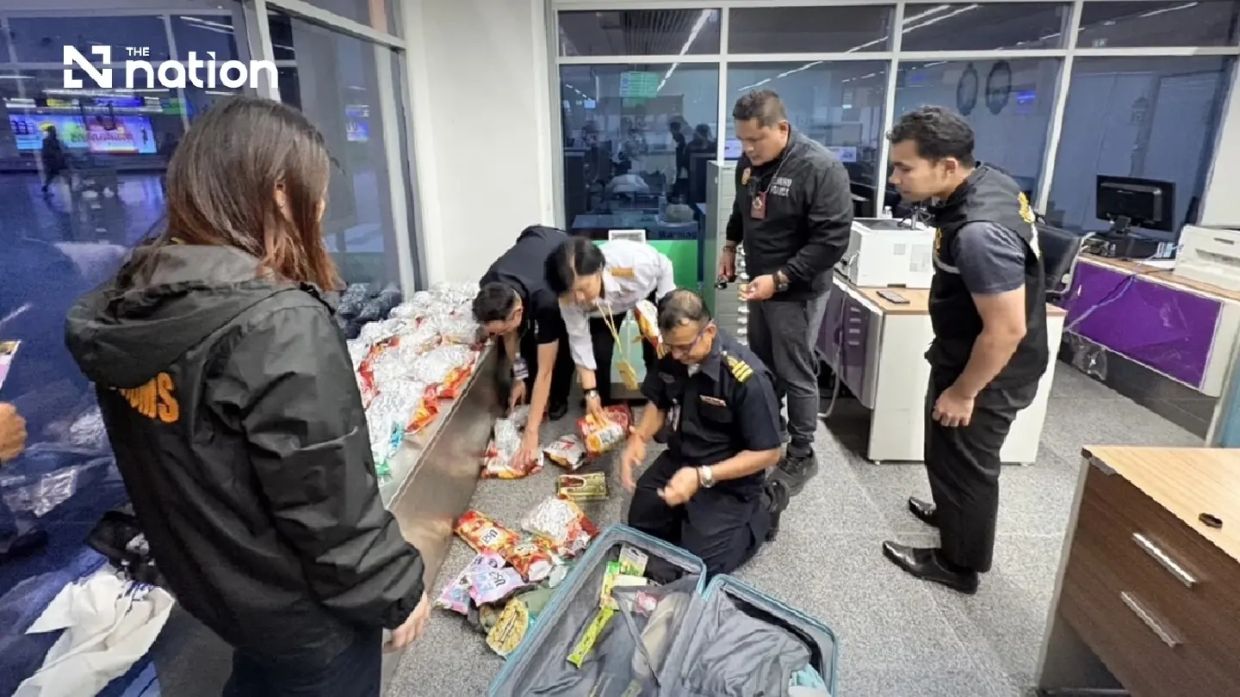
A Russian national faces smuggling charges after authorities uncovered a substantial quantity of cannabis at Phuket International Airport during a routine customs inspection on Wednesday. The arrest of Sergei Chalabari, 30, highlights ongoing efforts by Thai law enforcement to intercept drug trafficking attempts at one of Southeast Asia's busiest travel hubs. The discovery underscores the persistent challenge posed by international drug smuggling operations targeting Thailand's departure terminals.
The interception occurred at Phuket International Airport's international departure terminal in Mai Khao subdistrict, Thalang district, where customs officers were conducting standard baggage screening. Rawin Kanokakorn led the inspection team that examined two blue BP WORLD suitcases belonging to Chalabari, which together weighed eight kilogrammes. The apparently modest weight of the luggage masked a substantial narcotic cache carefully concealed within the bags.
Customs officers discovered 35 vacuum-sealed packages of cannabis flowers totalling 11.4 kilogrammes, supplemented by 12 packages of cannabis resin weighing 6.2 kilogrammes combined. The total haul of 17.6 kilogrammes represents a significant drug seizure by airport standards. The meticulous packaging and organisation of the contraband—separated into distinct portions and vacuum-sealed for transit—suggests a level of planning and expertise consistent with commercial-scale trafficking rather than personal use.
During preliminary questioning, Chalabari acknowledged ownership of both the suitcases and all items recovered within them. His confession streamlined the investigative process and established clear evidence linking him directly to the contraband. Thai authorities then formally charged him with attempting to smuggle goods beyond Thailand's borders while circumventing customs declaration and inspection procedures, a serious offence under Thai law that carries substantial penalties.
The case reflects Thailand's complex position within international drug trafficking networks. As a major transit hub and tourist destination, the kingdom remains vulnerable to smuggling attempts by foreign nationals who often underestimate the sophistication of Thai airport security. The growth of organised smuggling operations using increasingly professional concealment techniques—exemplified by the vacuum-sealed packaging in this case—presents escalating challenges for customs and law enforcement personnel tasked with interdicting contraband at departure points.
The operation involved extensive coordination between multiple agencies, indicating the seriousness with which Thai authorities treat major drug interdictions. Pol Col Salan Sankhisasanakun, superintendent of Sakhu Police Station, oversaw the case alongside Pol Lt Col Rattanawut Nukaew, deputy superintendent for investigation. Nucha Jeeradit, chief of the Phuket Airport Customs House, led customs personnel including Thanomjit Burirak from the customs control division and Charoenporn Jaengwansuk from the investigation and suppression section. This multi-level engagement demonstrates the institutional priority assigned to airport drug enforcement.
Phuket International Airport serves as a critical enforcement frontier in Thailand's broader anti-narcotics strategy. The airport processes over 28 million passengers annually, making comprehensive screening logistically demanding yet operationally essential. Success in interdicting large quantities of contraband depends upon customs officers' ability to identify suspicious luggage patterns, employ advanced detection technologies, and maintain vigilance during high-volume travel periods. The Chalabari case demonstrates that despite the resource constraints inherent in screening millions of travellers, airport customs teams continue achieving significant seizures.
The seizure occurred amid broader regional concern about cannabis trafficking, particularly following Thailand's controversial decision in 2018 to legalise medical cannabis. While Thai authorities strictly regulated medical production and distribution, the legal framework paradoxically created opportunities for organised crime to exploit regulatory loopholes and smuggle cannabis to neighbouring countries where prohibition remains absolute. The increasing sophistication of smuggling attempts at Thai airports suggests criminal organisations are actively exporting cannabis to regional markets despite official restrictions.
Chalabari's detention and transfer to Sakhu Police Station for processing represents the initial phase of Thailand's criminal justice procedures. Pol Capt Chaphinya Surithamkul, deputy investigation inspector, took formal charge of the suspect. Thai authorities will pursue prosecution under statutes addressing smuggling and narcotics trafficking, offences typically resulting in significant prison sentences, substantial fines, or both, depending on aggravating circumstances and judicial discretion. Foreign nationals convicted of drug trafficking in Thailand face particularly stringent sentencing, with sentences commonly exceeding one decade of imprisonment.
For Malaysian readers and the broader Southeast Asian audience, the case underscores the interconnected nature of regional drug enforcement challenges. Cannabis seizures at Thai airports directly impact supply chains servicing regional markets, including Malaysia where possession remains heavily criminalised. The professional smuggling techniques evident in this case—vacuum sealing, suitcase concealment, advance planning—suggest international criminal syndicates are actively developing methods designed to evade airport detection systems across Southeast Asia. Malaysian authorities may encounter similar concealment techniques as smuggling networks adapt their operations in response to enforcement successes.
The arrest also illustrates how tourism corridors facilitate drug trafficking alongside legitimate travel. Phuket's status as Thailand's premier beach destination attracts millions of international visitors annually, creating ideal cover for criminal activities disguised as ordinary passenger movements. Law enforcement agencies throughout Southeast Asia face the persistent challenge of distinguishing legitimate travellers from smugglers while maintaining efficient airport operations that support regional tourism and commerce. This balancing act remains central to contemporary transnational drug enforcement strategy across the region.

