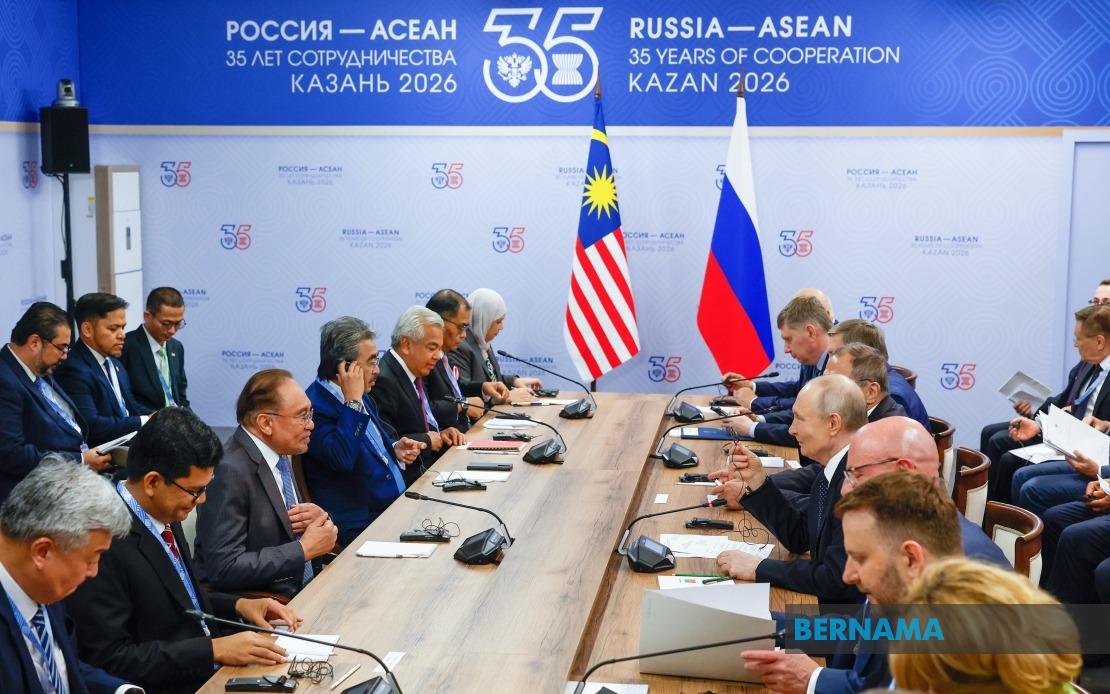
Russian President Vladimir Putin conveyed his optimism about the trajectory of Russia-Malaysia relations during a bilateral meeting with Prime Minister Datuk Seri Anwar Ibrahim on the sidelines of the ASEAN-Russia Commemorative Summit in Kazan. The two leaders discussed the significance of their countries' long-standing engagement, which stands on the cusp of a major milestone. Putin emphasized that Russia and Malaysia possess the necessary institutional frameworks and political will to deepen cooperation across multiple sectors, reflecting the maturity of their diplomatic relationship at a time when geopolitical realignments are reshaping international partnerships across Asia and beyond.
The upcoming 60th anniversary of Malaysia-Russia diplomatic relations, which will be observed next year, has become a focal point for renewed engagement between the two nations. Putin underscored that the approaching milestone arrives at a moment when both countries can point to accumulated achievements and momentum. Rather than treating the anniversary as merely ceremonial, he framed it as an opportunity to accelerate joint initiatives and explore new dimensions of cooperation. This perspective suggests Russia views Malaysia as a strategically important partner in Southeast Asia, particularly given Malaysia's influence within ASEAN and its ability to serve as a bridge between Russia and the wider regional community.
Economic ties have demonstrated tangible growth, providing concrete evidence of bilateral warming. Putin cited a 12.9 percent increase in trade during 2025, characterizing this expansion as a positive indicator of commercial health between the nations. While the absolute trade volumes remain moderate compared to Malaysia's relationships with major powers, the upward trajectory reflects both countries' commitment to expanding economic interdependence. This growth occurs against a backdrop of global supply chain realignments and increasing efforts by both Moscow and Kuala Lumpur to develop alternative partnerships following international sanctions and geopolitical tensions that have reshaped Russia's traditional trade relationships.
Institutional mechanisms undergird the bilateral relationship, extending beyond political rhetoric to operational coordination. Putin highlighted the role of regular ministerial contacts, parliamentary exchanges, and an intergovernmental commission dedicated to economic, scientific, technical and cultural collaboration. This multilayered engagement structure ensures that cooperation extends beyond the symbolic gestures of summit diplomacy. The existence of such mechanisms reflects the relationship's depth and indicates both sides' intention to sustain momentum regardless of shifting political circumstances or leadership transitions. For Malaysia, maintaining these channels provides diversified engagement with Russia across multiple government sectors, reducing dependence on top-level political relationships.
Education, science and technology cooperation represents a growth area that Putin identified as particularly important for Russia's engagement with Malaysia. These sectors have historically provided foundations for deeper understanding and people-to-people connections that transcend traditional diplomacy. Russian universities and research institutions continue to attract Malaysian students, while collaborative scientific projects create ongoing professional networks. Such exchanges have the potential to strengthen mutual comprehension and create constituencies within both societies invested in maintaining positive bilateral relations, providing resilience to the partnership during periods of political tension or international complications.
Malaysia's previous chairmanship of ASEAN and its historical role in hosting the inaugural Russia-ASEAN summit in 2005 underscore its significance within Russia's regional strategy. Putin's explicit acknowledgement of Malaysia's support for Russia-ASEAN cooperation reflects Moscow's appreciation for Malaysia's diplomatic positioning. As ASEAN seeks to maintain strategic autonomy while managing great power competition, Malaysia's willingness to sustain engagement with Russia provides the bloc with channels to multiple international actors. Putin's recognition of this role suggests Russia values Malaysia not merely as an individual partner but as a facilitator of broader Russian engagement with Southeast Asia, a region of increasing geopolitical significance.
Tourism and humanitarian cooperation, while less prominent in bilateral discussions than trade or defense matters, contribute to the relationship's texture and sustainability. These softer dimensions of engagement foster cultural familiarity and create incentives for ordinary citizens of both nations to view each other positively. As Malaysia promotes itself as a tourism destination and develops its cultural industries, expanded Russian visitor flows and cultural exchanges can generate mutual economic benefits while simultaneously building grassroots support for official partnership policies.
Putin's personal message to His Majesty Sultan Ibrahim, King of Malaysia, carries diplomatic significance beyond courtesy. By referencing previous meetings with Malaysian leaders and extending warm regards to the Malaysian monarch, Putin emphasizes the continuity and respect embedded in the relationship. In Malaysian political culture, such gestures toward the institution of the Agong carry weight and demonstrate appropriate deference to national symbols. This attention to protocol and personal respect helps anchor the bilateral partnership within Malaysia's institutional framework and constitutional hierarchy.
The Russia-Malaysia partnership exists within a complex regional environment where ASEAN members navigate relationships with multiple great powers while attempting to preserve collective neutrality and autonomy. Malaysia's capacity to maintain substantive engagement with Russia while simultaneously developing relationships with Western nations and other Asian powers reflects the balancing act that characterizes contemporary Southeast Asian diplomacy. Russia, facing reduced international engagement following its actions in Ukraine, views countries like Malaysia as important partners for maintaining global relevance and demonstrating that international isolation remains incomplete. From Malaysia's perspective, diversified great power engagement serves national interests by preventing excessive dependence on any single external actor and maximizing diplomatic leverage.
Looking ahead, the 60th anniversary presents both symbolic and practical opportunities for Malaysia and Russia to demonstrate the resilience and mutual value of their partnership. The timing comes as both nations face distinct international pressures and opportunities that could either bring them closer together or create new tensions. Malaysia's principled stance on international disputes and its commitment to inclusive regional architecture may appeal to Russian interests in preserving ASEAN as a forum where Moscow maintains dialogue capacity. Simultaneously, Malaysia's economic development needs and technology aspirations create potential areas where Russian expertise in energy, aerospace, and other sectors could contribute meaningfully. The foundation Putin described during his meeting with Anwar appears sufficiently robust to support expanded cooperation, though the relationship's future trajectory will depend on how both nations navigate an increasingly multipolar and competitive international environment where ASEAN's strategic choices remain central to Asian geopolitical outcomes.

