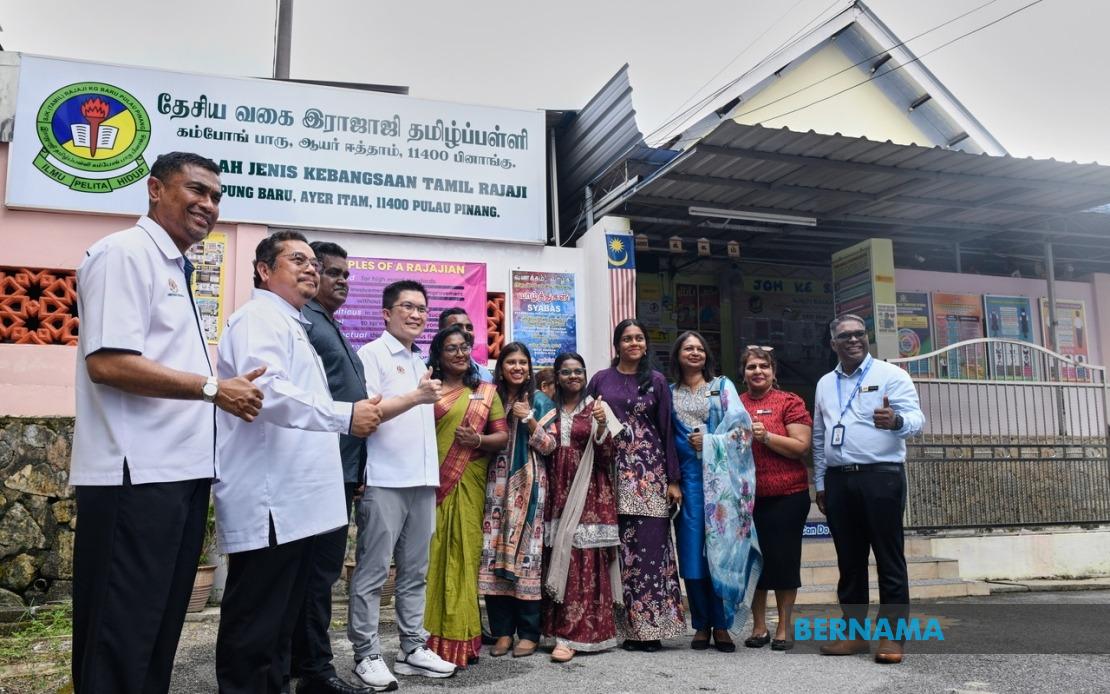
The Education Ministry has greenlighted a RM8 million relocation and construction project for Sekolah Jenis Kebangsaan Tamil (SJKT) Rajaji in George Town, marking a milestone for an institution that has operated under severe spatial constraints for nearly eight decades. The new facility will rise on a 2.3-acre plot in Farlim, Bandar Baru Ayer Itam, approximately 500 metres from the school's present location, with operations expected to commence by the 2029 academic year after an 18-month construction phase.
Deputy Education Minister Wong Kah Woh announced the development, highlighting the urgency of the initiative. The existing campus currently houses around 100 pupils in inadequate quarters, a situation that has persisted as the school has reached its 76th year of operation. The new building promises not merely functional improvement but a transformative opportunity for the institution to expand educational services and provide a learning environment aligned with contemporary standards. Wong presented the official approval letter during a ceremony in George Town, signalling the ministry's commitment to addressing infrastructure deficits in Tamil-medium schools.
The Penang state government had already paved the way for this initiative in 2022 by identifying and allocating the Farlim site specifically for SJKT Rajaji's relocation. Following this preparatory groundwork, the school's board of governors submitted a formal application to the Education Ministry last year, which progressed through administrative channels and received final approval once all coordination matters with local authorities were satisfactorily resolved. This phased approach demonstrates how state and federal education authorities collaborated to navigate logistical and regulatory requirements.
What distinguishes this project within Malaysia's education landscape is its funding mechanism. Rather than drawing entirely on government coffers, the RM8 million investment is being underwritten by a private developer through its corporate social responsibility framework. This public-private partnership model reflects a growing trend in which corporations contribute directly to educational infrastructure development, offsetting budgetary pressures on the state whilst allowing businesses to fulfil social obligations. Wong emphasised this collaborative approach as emblematic of strengthened synergies between governmental and commercial sectors in advancing educational quality.
The relocation carries particular significance for Penang's broader Tamil education ecosystem. The state administers 28 Tamil national-type schools, institutions that serve a vital cultural and linguistic role whilst often operating with constrained resources. Datuk Seri S. Sundarajoo, who chairs both the State Housing and Environment Committee and the Penang Tamil Schools Special Committee, contextualised SJKT Rajaji's transformation within a wider developmental agenda. Multiple SJKT campuses across Penang are simultaneously pursuing infrastructure improvements, whether through securing formalised ownership of operating sites or implementing phased facility upgrades.
The momentum is tangible. Sundarajoo indicated that at least three Tamil national-type school projects will hold groundbreaking ceremonies during the current calendar year, underscoring accelerated implementation timelines. Beyond SJKT Rajaji, institutions including SJKT Sungai Bakap and SJKT Juru are experiencing project revivals, suggesting a comprehensive strategy to modernise Tamil school infrastructure across the state. This coordinated approach contrasts with ad-hoc upgrading and signals intentional policy prioritisation.
From a broader Malaysian perspective, the initiative addresses longstanding challenges within Tamil-medium education. These schools frequently inherit aging physical infrastructure and operate under enrolment pressures that exceed facility capacity. The cumulative effect of deferred maintenance and spatial limitations can degrade educational outcomes and deter families from choosing Tamil-medium pathways. By channelling investment into quality infrastructure, the Penang government and federal Education Ministry implicitly acknowledge that educational excellence depends partly on physical environment quality.
The 18-month construction timeline, with a completion target of 2029, reflects realistic project management expectations in Malaysia's construction sector. This schedule allows contractors to execute work whilst minimising disruption to ongoing academic operations. The choice of the Farlim location, just half a kilometre from the present site, facilitates a relatively seamless transition, allowing the school community to remain geographically anchored within familiar environs whilst accessing entirely renovated facilities.
Sundarajoo's commentary that these developments proceed "without placing a financial burden on the state government" underscores fiscal pragmatism. As state budgets face competing demands across healthcare, infrastructure, and social services, the ability to advance educational goals through alternative funding sources allows reallocation of government resources to other priorities. Yet this reliance on private sector participation also raises questions about equitable access and whether Tamil schools in less commercially attractive areas might struggle to attract similar corporate investment.
The SJKT Rajaji project resonates beyond Penang's boundaries. Tamil-medium schools operate in most Malaysian states, frequently encountering identical infrastructure and capacity challenges. The successful execution of this Penang model—combining state land provision, federal ministry approval, and corporate funding—could offer a replicable template for other regions seeking to upgrade Tamil school facilities without straining government finances. Federal education authorities may view this initiative as a proof-of-concept demonstrating how coordinated stakeholder action can systematically address educational infrastructure gaps.
For families with children currently studying at SJKT Rajaji or considering Tamil-medium education options, the relocation represents tangible progress. Students will inherit modern classrooms, improved amenities, and presumably expanded library, laboratory, and sports facilities. Teachers will work within better-resourced environments conducive to effective instruction. The psychological impact of transitioning from cramped, aging quarters to a purpose-built campus should not be underestimated—institutional morale and sense of possibility both tend to improve alongside physical environment quality.
Looking ahead, the success of this project will depend on execution rigour. Construction quality, adherence to timelines, and proper handover procedures will determine whether the RM8 million investment delivers anticipated benefits. Equally important will be whether the relocation attracts increased enrolment, allowing the expanded facility to serve as a nucleus for Tamil language and cultural education within the Ayer Itam vicinity. The 2029 timeline provides sufficient runway for monitoring and adjustment should implementation challenges emerge.

