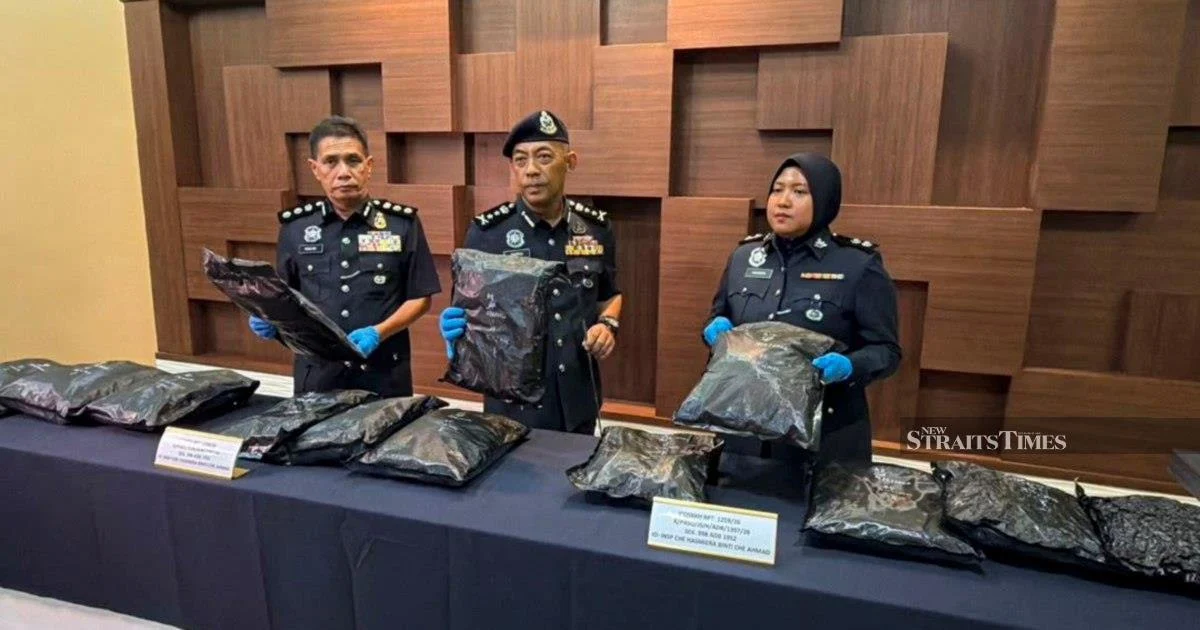
A student enrolled at a private higher education institution in Malaysia faces serious drug trafficking charges following his apprehension at Bukit Kayu Hitam with a substantial consignment of cannabis buds on Monday. The seizure, weighing 14.63 kilogrammes and valued at approximately RM1.17 million, underscores the persistent threat of narcotics smuggling through Malaysia's land borders despite intensified enforcement efforts.
The arrest occurred at the Bukit Kayu Hitam checkpoint, a critical entry point along the Malaysia-Thailand boundary in Kedah state. This location has long served as a focal point for drug interdiction operations, given its strategic geography and considerable volume of cross-border traffic. The student's detention represents another disruption in trafficking networks that exploit young, mobile individuals to move contraband across frontiers where commercial lorries and private vehicles create substantial cover for illicit cargo.
The scale of this seizure reflects the lucrative nature of cannabis trafficking in Southeast Asia. At RM1.17 million, the street value demonstrates why criminal syndicates actively recruit couriers—often targeting students and economically vulnerable individuals with promises of quick financial rewards. The 14.63 kilogramme quantity, while substantial, would have yielded considerable profit margins for organisers operating across the Malaysia-Thailand corridor, where production costs in neighbouring jurisdictions remain significantly lower than retail prices in Malaysia.
Bukit Kayu Hitam's position as a major transit hub makes it essential infrastructure for both legitimate commerce and illegal trade. The checkpoint processes thousands of vehicles and travellers daily, creating a complex enforcement environment where border officials must balance traffic flow with security imperatives. When interdiction teams detect cannabis consignments of this magnitude, it often signals systematic transportation operations rather than isolated smuggling attempts, suggesting organised criminal involvement rather than opportunistic trafficking.
The student's involvement raises questions about recruitment tactics employed by trafficking networks. Educational institutions, particularly private universities with diverse student populations and varying socioeconomic backgrounds, may present opportunities for recruiters seeking desperate or ambitious couriers. The relatively low-profile nature of student travellers compared to commercial operators, combined with documentation that facilitates cross-border movement, makes this demographic particularly vulnerable to exploitation by syndicates.
Malaysia's drug enforcement agencies have escalated operations along the Thailand border following intelligence indicating increased smuggling activity. The nation's proximity to major production centres makes it both a transit country and an increasingly contested market. Cannabis trafficking, particularly from Thailand following its partial legalisation of cannabis for medical and industrial purposes, has created new trafficking pressures that authorities struggle to contain through conventional enforcement measures.
The arrest contributes to growing evidence that cannabis remains a primary smuggling commodity at Malaysian border crossings. Unlike heroin or methamphetamine, which have established distribution networks, cannabis trafficking patterns are evolving rapidly as supply dynamics shift across Southeast Asia. The region's heterogeneous drug policies create arbitrage opportunities that criminal entrepreneurs exploit, moving product from jurisdictions where enforcement is lighter to markets where prices justify the operational risks.
This incident illustrates the vulnerabilities inherent in student populations facing economic pressures or seeking rapid income generation. Traffickers deliberately target young people with limited criminal records, reasoning that first-time offenders may receive more lenient treatment or face lower individual scrutiny at checkpoints. The student's arrest, however, indicates that border authorities have developed improved detection methodologies, whether through intelligence sharing, physical inspections, or behavioural profiling techniques.
The RM1.17 million valuation, while substantial, represents only the commodity value at final market prices. Actual profits accruing to trafficking organisations would be considerably lower after accounting for production, transportation, security, and distribution costs. Nevertheless, for participating couriers, the compensation offered typically amounts to mere thousands of ringgit—a stark disparity that highlights how trafficking hierarchies exploit junior participants while concentrating proceeds among organisers and financiers.
Looking forward, this seizure reinforces the necessity for comprehensive border security strategies combining technological enhancement with human intelligence. Organised trafficking networks adapt rapidly to enforcement disruptions, rotating routes, methods, and personnel. Successful interdiction requires not merely checkpoint arrests but coordinated investigation into supply chains, financial flows, and organisational structures. Malaysian authorities' collaboration with Thai counterparts, while improving, remains essential given the transnational character of these operations.
The student now faces prosecution under Malaysia's Dangerous Drugs Act, where cannabis trafficking carries penalties including lengthy imprisonment and potential capital punishment depending on quantity thresholds. Beyond individual consequences, this arrest serves as cautionary evidence that involvement with trafficking organisations typically culminates in law enforcement detection, lengthy judicial proceedings, and profound disruption to educational prospects and future employment opportunities. For aspiring couriers, the disparities between promised compensation and actual legal jeopardy remain starkly unfavourable.

