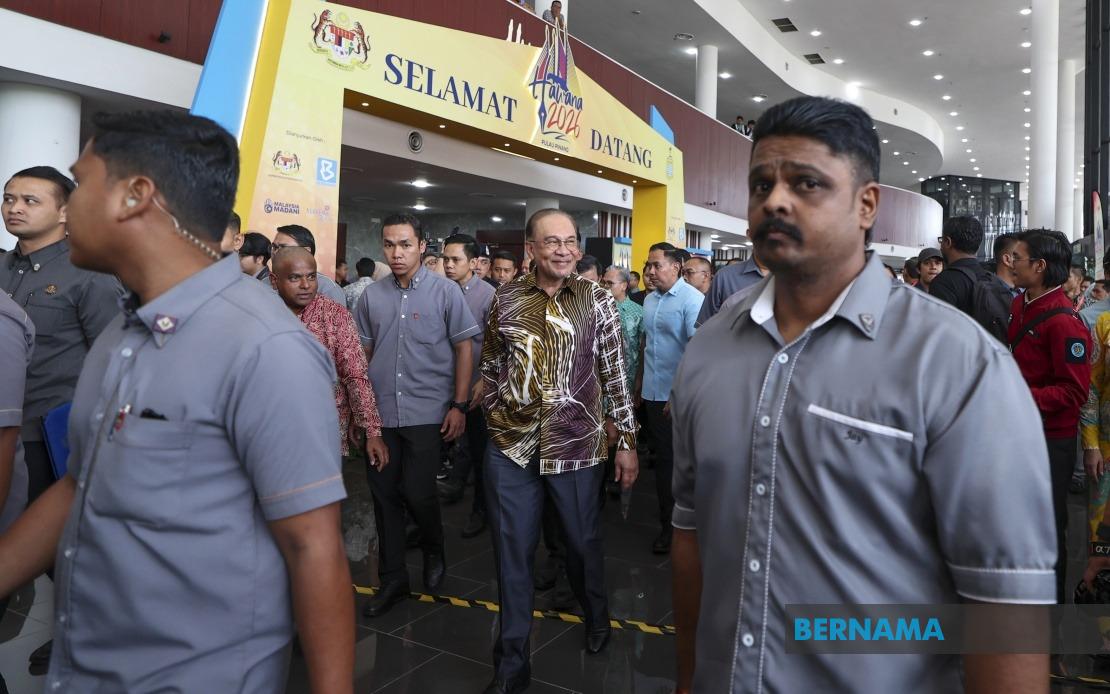
Prime Minister Datuk Seri Anwar Ibrahim arrived at the PICCA Convention Centre @ Butterworth Arena on June 20 to preside over the marquee event of Malaysia's National Journalists' Day (HAWANA) 2026 celebration. His punctual arrival at 2.40 pm set the tone for a gathering that underscores the government's continued backing for professional journalism at a time when media credibility faces mounting pressures globally. He was greeted by Penang Chief Minister Chow Kon Yeow, Communications Minister Datuk Fahmi Fadzil and Communications Ministry secretary-general Datuk Abdul Halim Hamzah, reflecting the high-level political endorsement the occasion commanded.
Before proceeding to the main ceremony, the Prime Minister took time to inspect the exhibition booths and a dedicated HAWANA 2026 Photo Gallery positioned in the venue's foyer. This informal walkabout served as both a gesture of engagement with participating media organisations and a visual demonstration of his investment in the proceedings. The opportunity to browse displays and installations allowed him to observe firsthand the breadth of media innovation and heritage on display, setting a collaborative rather than purely ceremonial tone for the day's activities.
The leadership contingent assembled for the occasion reflected the institutional importance placed upon journalism recognition. Malaysian National News Agency (Bernama) chairman Datuk Seri Wong Chun Wai anchored the event alongside chief executive officer and HAWANA 2026 Working Committee chairman Datin Paduka Nur-ul Afida Kamaludin. Also instrumental were Bernama editor-in-chief and deputy chairman of the Working Committee Arul Rajoo Durar Raj, and deputy editor-in-chief and project director Mohd Shukri Ishak. This deep involvement from Bernama underscored the agency's pivotal role in shepherding the biennial recognition initiative and reinforced the integration of state news infrastructure with broader professional standards.
A striking dimension of this year's HAWANA gathering was its distinctly regional character. ASEAN representatives lent substance to the event's transnational messaging, with Timor-Leste's Secretary of State for Social Communication Expedito Loro Dias Ximenes, Cambodia's Undersecretary of State at the Ministry of Information Prak Thaveak Amida, and Laos' Permanent Secretary of the Cabinet Office for the Ministry of Technology and Communications Phuangpasert Keosouvanh all in attendance. These high-ranking officials signalled Southeast Asian solidarity around professional journalism norms and information credibility—a matter of growing consequence as the region navigates digital disruption and cross-border misinformation challenges.
International media delegations further broadened the gathering's reach and mandate. News leadership from Timor-Leste's Agencia Noticiosa de Timor-Leste (TATOLI), headed by president Noemio Mateus Soares Falcao and deputy president Madalena DE JCP Carlos, shared platform space with counterparts from Indonesia's Antara News Agency, the Vietnam News Agency (VNA) and China's Xinhua News Agency. Indonesian journalistic bodies, including the Indonesian Journalists Association (PWI) and the Ikatan Setiakawan Wartawan Malaysia-Indonesia (ISWAMI), reinforced bilateral and multilateral bonds in the media sphere. This constellation of participants illustrated how journalism recognition has transcended parochial boundaries to become a collective Southeast Asian undertaking.
The ceremonial centrepiece involved the Prime Minister presenting the HAWANA Award and Special HAWANA Award to individuals whose contributions have meaningfully advanced journalism practice and broadened public discourse. Beyond formal honours, he also distributed contributions from the Kasih@HAWANA Fund to veteran media practitioners facing hardship, embedding a welfare dimension into the celebration that acknowledged the profession's human costs and vulnerabilities. This dual recognition—of achievement and support—reflected a more holistic view of media professionalism than honour alone could convey.
Unfolding under the thematic banner 'Media Integrity Strengthens Credibility', the 2026 main event drew approximately 1,000 media practitioners from Malaysia and internationally. This assembly constituted more than a ceremonial gathering; it functioned as a deliberate platform for ideation around journalism's contemporary challenges and trajectory. By hosting this volume of practitioners in sustained conversation, organisers intended to crystallise emerging priorities and forge strategic consensus on how the profession should evolve in response to technological disruption, audience fragmentation and trust erosion.
The event's organisational architecture reflected a structured partnership between state and news infrastructure. The Communications Ministry directed the initiative, while Bernama, the Malaysian national news agency, assumed implementing responsibilities. This arrangement meant that HAWANA functioned simultaneously as both a professional recognition mechanism and a quiet assertion of state interest in upholding journalistic standards. The duality carries implications for regional peer nations examining how governments might constructively engage with media without infringing editorial independence—a particularly pertinent question across Southeast Asia, where state-media relationships often remain contentious.
Locating the 2026 celebration in Butterworth carried geographic symbolism. Penang's east-coast position in the Strait of Malacca positions it as a natural crossroads for regional traffic and information flows. Staging HAWANA at this nodal point reinforced an implicit message: media integrity and credible information are not metropolitan luxuries but necessities distributed across Malaysia's geographic and demographic breadth. For Penang specifically, hosting the event elevated the state's profile as a venue for serious discourse and professional gatherings beyond tourism and manufacturing.
The HAWANA initiative itself, now in its 2026 iteration, has matured into a signature expression of Malaysia's media philosophy. By anchoring journalism recognition to annual or biennial celebration, the government signals that media professionalism, accuracy and public service constitute foundational values worthy of sustained institutional commitment. In the Southeast Asian context, where numerous countries grapple with media polarisation and state-press tension, Malaysia's investment in recognising journalistic excellence without apparent editorial constraint offers a model of engagement that peer nations monitor with interest.
The convergence of domestic and international participants, governmental backing, and thematic focus on media integrity positions HAWANA 2026 as more than ceremony. It functions as a working conference affirming shared professional commitments across borders and ideological systems. For Malaysian journalists specifically, the presence of regional and international counterparts validates their struggles for editorial independence and professional standards. For foreign media delegations, Malaysia's hosting demonstrates a country confident enough in its press environment to convene regional discussion on journalism's future without defensiveness or constraint.