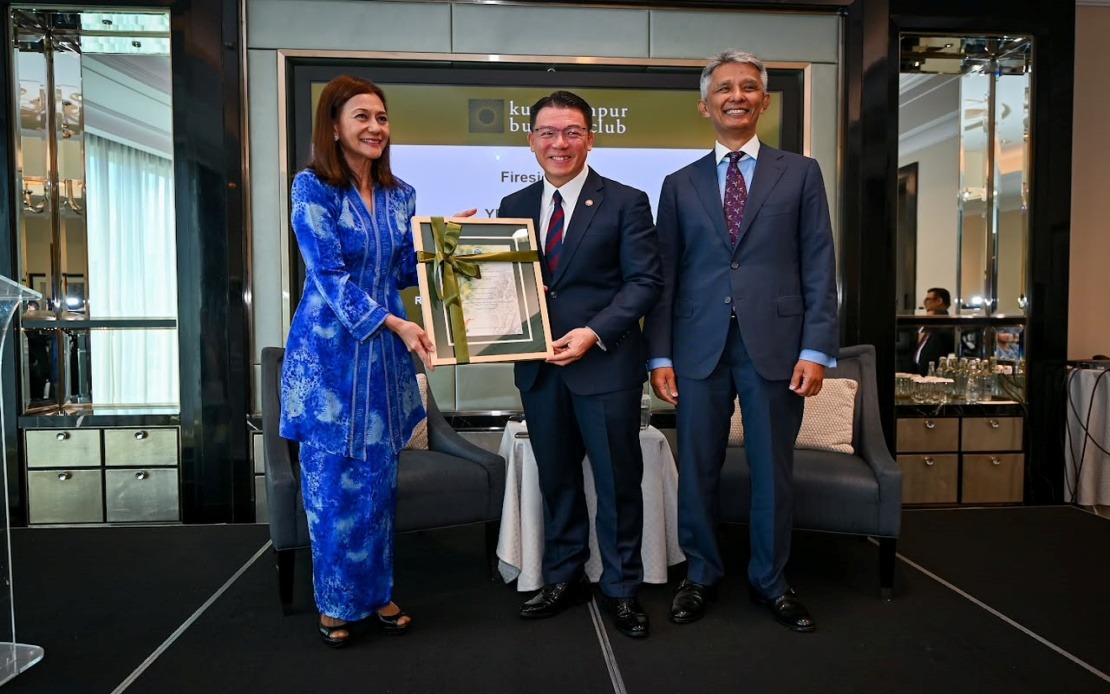
Housing and Local Government Minister Nga Kor Ming has stressed that unwavering policy continuity under the MADANI framework represents a cornerstone for translating Malaysia's ongoing economic reforms into tangible, enduring prosperity. Speaking following a fireside chat organised by the Kuala Lumpur Business Club, Nga emphasised that maintaining a steady course in governance and reform efforts remains vital for preserving investor confidence and ensuring the nation's competitive edge in an uncertain global economic environment.
The minister articulated a vision where policy consistency directly correlates with Malaysia's ability to weather international headwinds and position itself advantageously for future expansion. He contended that the coherence and predictability of government direction influence how multinational corporations and financial institutions assess the country's investment prospects, ultimately shaping capital flows and employment opportunities across sectors from manufacturing to services.
Nga identified a second electoral mandate as instrumental in enabling the government to advance its structural reform agenda without disruption. Such continuity would furnish policymakers with the temporal and political capital required to deepen institutional reforms, enhance the state apparatus's operational effectiveness, and pursue long-term economic blueprints that demand years to yield full returns. The logic underpinning this argument reflects a broader management principle: transformational change requires sustained commitment rather than episodic interventions.
Under the leadership of Prime Minister Datuk Seri Anwar Ibrahim, Nga characterised the MADANI government as having achieved measurable progress across governance improvements, economic administration, and diplomatic outreach. These accomplishments, he suggested, collectively reinforce perceptions of Malaysia as a nation taking its development seriously and capable of honouring commitments to both domestic and international partners. Such perception-building is crucial in an era where perception often precedes and influences investment decisions.
Concrete metrics substantiate Nga's narrative. Malaysia has enhanced its position within global competitiveness rankings, attracting enterprises seeking manufacturing and operational hubs in Southeast Asia. The nation's trade resilience, despite global supply chain disruptions and economic volatility, testifies to the underlying strength of macroeconomic fundamentals and sectoral diversification that reforms have helped foster. This resilience matters particularly for Malaysian exporters and companies integrated into regional value chains, as it signals that domestic policy frameworks support rather than impede business continuity.
The government's advancement in Malaysia's Corruption Perceptions Index ranking carries direct implications for corporate governance standards and contract certainty. International firms assessing investment proposals weigh governance quality heavily; improvements in this domain reduce perceived risks and lower the cost of capital for Malaysian enterprises. Simultaneously, enhanced credit ratings from international rating agencies translate into reduced borrowing costs for government and corporations, freeing resources for productive investment rather than debt servicing.
Geopolitical and diplomatic achievements have expanded Malaysia's strategic partnerships in ways that unlock investment and technological opportunities. The RM52.73 billion strategic partnership with Turkmenistan and collaborative energy initiatives with Russia exemplify how consistent foreign policy orientation generates concrete economic returns. These arrangements facilitate technology transfer, secure energy supplies, and diversify revenue streams, reducing dependence on any single market or partner. For Malaysian firms, such partnerships create opportunities for regional expansion and access to new customer bases.
The notion of policy continuity resonates particularly within Malaysia's context, where economic transformation initiatives often span electoral cycles. Projects addressing urban development, industrial corridors, and digital infrastructure require steady investment and regulatory frameworks that political discontinuity can disrupt. The Future Cities initiative discussed at the Kuala Lumpur Business Club event exemplifies such long-term undertakings; reimagining urban economies demands harmonised planning across multiple government levels and private sector stakeholders, a coordination that benefits from consistent strategic direction.
For Malaysian business leaders, Nga's remarks essentially advocate for a stable operating environment. Enterprises planning expansion or research investments require confidence that policy signals emanating from Putrajaya today will remain valid eighteen months hence. Uncertainty around policy direction often freezes capital deployment; businesses defer decisions pending clarity on regulatory and fiscal frameworks. Conversely, perceived policy durability unlocks spending and hiring.
The emphasis on structural reform deepening warrants particular attention. Superficial reforms that merely adjust procedures without addressing underlying institutional rigidities deliver limited economic payoff. Malaysia's agenda appears focused on substantive institutional strengthening—governance frameworks, bureaucratic efficiency, and regulatory quality—rather than cosmetic adjustments. Achieving such depth requires repeated engagement across multiple policy cycles, reinforcing the case for continuity.
International experience suggests that emerging economies achieving sustained growth typically maintain consistent development philosophies across election cycles, though personnel and implementation details may shift. Singapore, South Korea, and Vietnam offer regional examples where long-term vision continuity, transcending political transitions, correlated with impressive development trajectories. Nga's argument implicitly invokes these comparative lessons, suggesting Malaysia too benefits from similar consistency.
Yet continuity itself requires scrutiny and adjustment based on outcomes. The challenge lies in maintaining strategic consistency while permitting tactical flexibility and course corrections when evidence warrants. The MADANI framework's success depends not merely on consistency but on consistent pursuit of policies that demonstrably improve living standards, create employment, and enhance institutional quality. For Malaysian observers, distinguishing between dogmatic adherence to failing approaches and principled commitment to working strategies remains essential to evaluating whether policy continuity truly serves national interests.