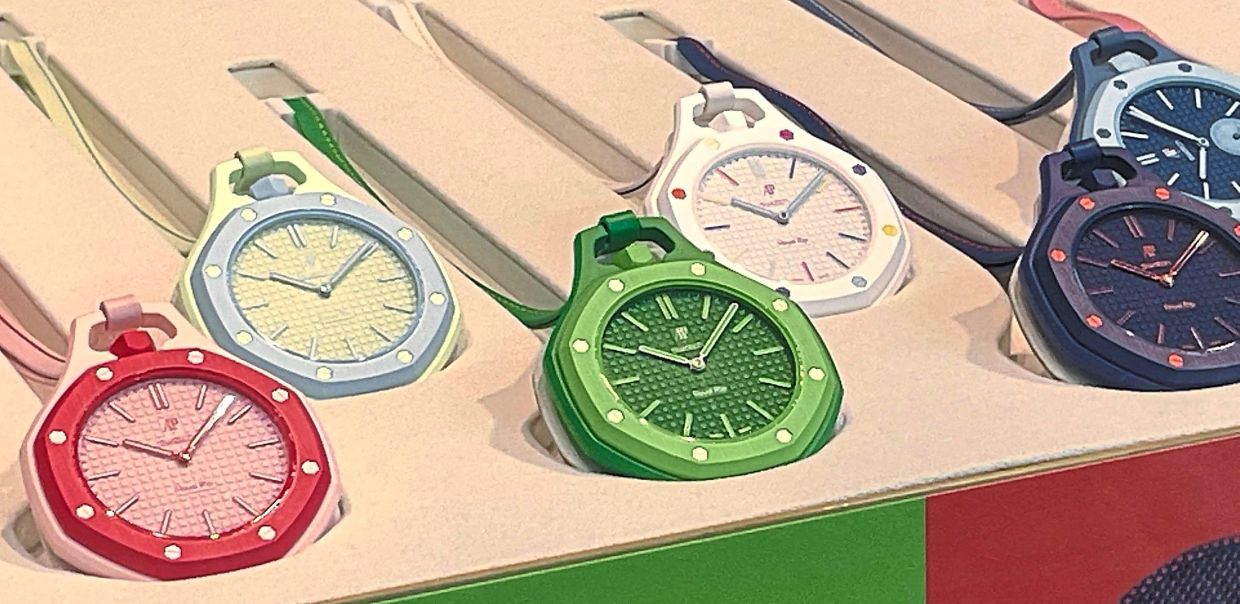
The watch industry witnessed a pivotal moment on May 16 when Swatch and Audemars Piguet unveiled Royal Pop, a surprising partnership that democratised one of watchmaking's most prestigious designs by transforming it into colourful bioceramic pocket watches retailing for under S$600 (RM1,800). The release ignited significant interest across global markets, yet simultaneously exposed a deeper shift in luxury strategy: the deliberate cultivation of artificial scarcity and the remarkable willingness of consumers to invest time and effort pursuing products without guaranteed availability or official edition limitations.
Leading up to the official announcement on May 12, cryptic promotional campaigns emerged across newspapers and digital platforms, teasing something simultaneously "iconic" and "unexpected" without revealing specifics. This strategic opacity proved potent. Communities of enthusiasts flooded social media platforms, watch forums and Reddit with speculation, while artificial intelligence-generated renderings proliferated across Instagram. The mystery was carefully maintained through stringent non-disclosure agreements and tightly compartmentalised production teams, ensuring that authentic imagery and technical specifications remained shrouded until the unveiling. This engineered anticipation transformed the launch into a cultural event rather than a mere product release.
When Royal Pop finally debuted, it defied nearly all public expectations. Rather than producing affordable wristwatches that could directly challenge Audemars Piguet's core market, the collaboration introduced eight strikingly colourful pocket watches drawing unmistakably from Gerald Genta's legendary Royal Oak blueprint. The designs incorporated the Royal Oak's signature octagonal bezel, distinctive Petite Tapisserie dial decoration and eight visible hexagonal screws—instantly recognisable elements that connected the new pieces to decades of horological prestige. The collection offered two distinct formats: Lepine configurations featuring a crown positioned at 12 o'clock in traditional style, and Savonnette models with the crown relocated to 3 o'clock alongside a small seconds subdial.
Mechanically, the pocket watches housed hand-wound SISTEM51 movements, which, while mechanically compelling for their elegant minimalist construction, represented a philosophical departure from traditional haute horlogerie craftsmanship. The bioceramic material furthered this departure, imbuing the collection with a playful, almost whimsical character that sat apart from luxury watchmaking conventions. This distinction proved crucial to the collaboration's strategy. Royal Pop was never positioned as an economical alternative to the Royal Oak wristwatch, but rather as a creative reinterpretation of the Royal Oak's visual language translated into an entirely different timepiece category. With entry-level Royal Oak wristwatches commanding prices near S$30,000 (RM94,881), producing an affordable wristwatch collaboration could have posed existential risks to Audemars Piguet's carefully maintained exclusivity. By redirecting the project toward pocket watches—a niche, historically rooted category far removed from Audemars Piguet's contemporary business focus—the brand could playfully deconstruct the Royal Oak's design vocabulary without directly cannibalising its flagship product line.
For Swatch, Royal Pop represents an evolution of its transformative 2022 MoonSwatch collaboration with Omega, which fundamentally demonstrated the commercial potential of pairing an accessible mass-market manufacturer with a prestigious luxury partner. That landmark release triggered extensive queues in major cities worldwide, necessitated police deployments to manage crowd congestion in multiple locations, and sparked aggressive resale markets where secondary sellers quickly multiplied retail prices. The MoonSwatch proved that controlled scarcity, even at price points below S$400 (RM1,265), generates disproportionate cultural cachet, mainstream media attention and substantial financial returns. Royal Pop extends this proven formula while amplifying the underlying concept.
However, Royal Pop introduces a significant structural distinction from MoonSwatch. Omega operates as a subsidiary within the Swatch Group's corporate structure, whereas Audemars Piguet functions as an independent entity. This independence elevates Royal Pop beyond a conventional co-branded exercise into something strategically more ambitious: a demonstration that Swatch aspires to function as a cultural platform enabling elite, independent luxury houses to substantially broaden their demographic reach whilst preserving the integrity of their core product offerings. The collaboration signals that established luxury brands increasingly recognise the commercial opportunity in engaging younger, less affluent consumers through creatively constrained collaborations.
Pat Law, founder of Goodstuph, a Singapore-based social marketing consultancy, articulated this dynamic compellingly: "Luxury today is not just about ownership anymore. It's about proximity. Swatch gets cultural elevation. Overnight, a playful plastic watch inherits decades of craftsmanship, heritage and horological snobbery." From Swatch's perspective, association with Audemars Piguet transforms its market positioning from mass-market commodity manufacturer to culturally respectable collaborator with horological royalty. The partnership grants Swatch legitimacy within watch enthusiast communities that have historically dismissed the brand as disposable.
For Audemars Piguet, the calculus involves different considerations and considerably higher risks. According to Law, "AP gets relevance at scale without having to dilute its product line. Most young consumers would not walk into an AP boutique. But now the brand gets to live rent-free in their heads years before they can afford one." This observation captures a crucial insight: Royal Pop allows Audemars Piguet to occupy psychological territory among consumers currently unable to purchase traditional products, establishing brand affinity that potentially converts into future high-value purchases as these younger audiences mature and accumulate wealth. The brand achieves cultural penetration impossible through traditional retail and marketing channels.
Yet academic research on luxury brand management raises important cautions about such democratisation strategies. While collaborative collections with accessible price points undoubtedly generate short-term excitement, heightened sales volumes and social media engagement, the long-term consequences remain ambiguous and potentially concerning. Scholars studying luxury brand architecture have documented evidence suggesting that excessive democratisation of visual and design identity through widely accessible products may gradually erode carefully constructed perceptions of exclusivity and aspiration. When significant populations gain tangible access to a luxury brand's most recognisable design codes, the psychological distance between the aspirational luxury product and the mass-market iteration diminishes, potentially undermining the emotional premium that justifies extraordinary pricing.
The Audemars Piguet case specifically illustrates this tension acutely. The Royal Oak stands among watchmaking's most iconic designs, instantly recognisable to experts and laypeople alike. By scaling this design into pocket watches distributed through Swatch's extensive retail network, Audemars Piguet risks familiarising younger consumers with its most valuable intellectual property through an inferior format. Should Royal Pop achieve the commercial success of MoonSwatch, millions globally will wear bioceramic reimaginings of the Royal Oak design. The question becomes whether this widespread ownership of the design language—even in pocket-watch format—eventually commodifies the Royal Oak's visual identity, making future wristwatch purchasers less willing to pay luxury premiums for design elements they already possess in another form.
The Royal Pop launch ultimately reveals contemporary luxury's fundamental paradox. Exclusivity and extreme scarcity no longer suffice to maintain brand prestige in an era of instant global communication and social media virality. Younger consumers increasingly value cultural proximity and participatory access over traditional exclusion. Luxury brands must now perform a delicate balancing act: achieving sufficient scale and visibility to remain culturally relevant and aspirational, whilst preserving enough exclusivity around core products to justify premium positioning. Swatch and Audemars Piguet have executed this balance skillfully through Royal Pop's pocket-watch format, yet the broader strategy carries inherent risks. As more elite brands pursue similar collaborations with mass-market partners, the cumulative effect may gradually redefine what luxury means, shifting it from ownership of exclusive products toward participation in culturally significant moments—a paradigm fundamentally different from traditional luxury architecture.

