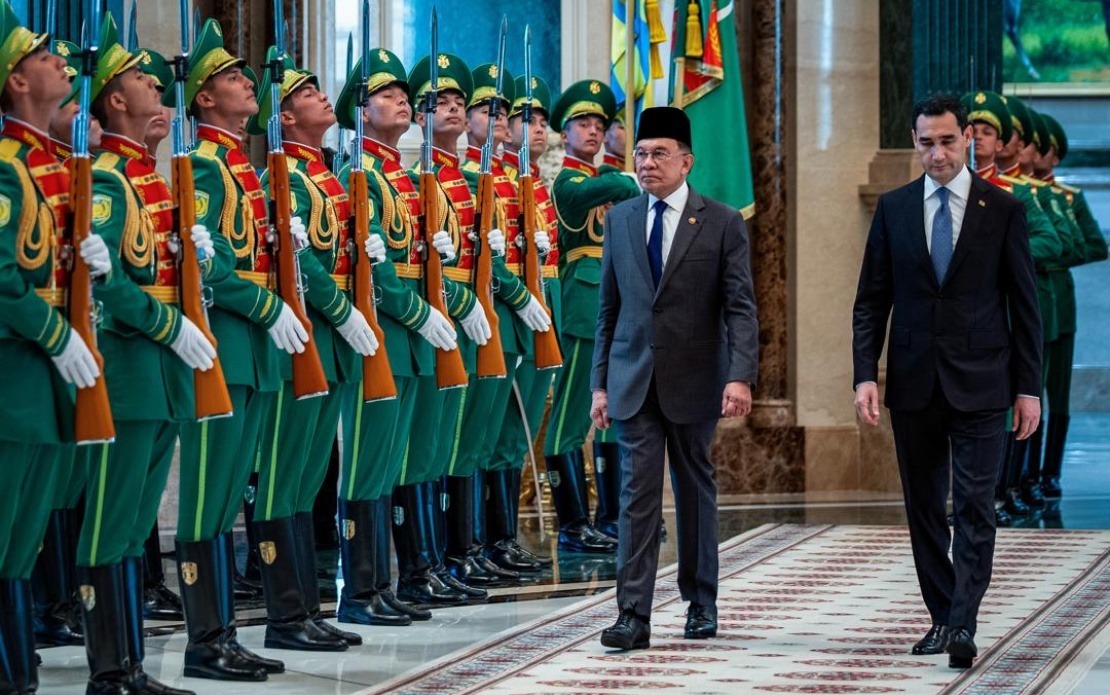
Prime Minister Datuk Seri Anwar Ibrahim was accorded a full ceremonial welcome at the Turkmenistan Presidential Palace in Ashgabat on June 19, underscoring the significance Malaysia places on its relationship with the Central Asian nation. The occasion marked his debut official state visit to Turkmenistan since assuming office as Malaysia's 10th Prime Minister in November 2022, having accepted an invitation from Turkmenistan President Serdar Berdimuhamedov.
The formal reception reflected the protocol typically extended to heads of government on state visits, with President Berdimuhamedov personally receiving Anwar upon arrival. A ceremonial guard of honour was assembled for the occasion, while the national anthems of both Malaysia and Turkmenistan were performed in formal tribute to each country. Such ceremonial elements serve symbolic purposes in diplomatic relations, signalling respect and the importance attached to bilateral engagement at the highest levels of government.
Following the formal reception, Anwar was introduced to members of the Turkmenistan Cabinet and other senior government officials present at the palace. The Malaysian delegation accompanying the Prime Minister was subsequently presented to President Berdimuhamedov, facilitating preliminary engagement between the visiting Malaysian officials and their Turkmenistan counterparts. These introductions establish personal connections that often facilitate smoother diplomatic discussions and future coordination between government ministries.
The substantive diplomatic work began with a restricted bilateral meeting between Anwar and Berdimuhamedov, commonly referred to as a "four-eyed" or one-on-one session. These intimate discussions typically address sensitive or confidential matters requiring frank dialogue between the two leaders without the presence of broader delegations. Following this private exchange, the leaders convened for a full bilateral meeting that included their respective delegations, allowing for wider-ranging discussions on matters of mutual concern and opportunities for enhanced cooperation.
The two-day visit, which commenced on June 18, represents Malaysia's continued diplomatic engagement with Central Asia, a region that has gained increasing importance in Malaysian foreign policy. Turkmenistan, as one of the world's leading natural gas producers and a strategically positioned nation along the historic Silk Road, holds particular relevance for Malaysia's diversification of international partnerships. The visit signals Kuala Lumpur's commitment to strengthening ties with non-traditional partners and exploring avenues for trade, investment, and cultural exchange beyond Southeast Asia.
Central Asia has been largely underutilised in Malaysia's diplomatic calculus despite the region's significant resources and potential for partnerships. Turkmenistan, in particular, possesses vast energy reserves and serves as a bridge between Europe, Asia, and the Middle East. For Malaysia, engagement with Central Asian nations offers opportunities to explore energy cooperation, knowledge exchange in sectors such as petrochemicals and liquefied natural gas, and participation in regional initiatives that may enhance its standing beyond the immediate Southeast Asian theatre.
The bilateral agenda likely encompassed discussion of trade relations between the two countries, which remain modest compared to Malaysia's engagement with other regions. Malaysian companies have limited visibility in Central Asia, presenting opportunities for expansion, particularly in sectors where Malaysia holds competitive advantages such as Islamic finance, telecommunications, and manufacturing. Similarly, Malaysian interest in Central Asian energy resources could be a focus of discussions, as the nation seeks to diversify its energy sourcing and explore long-term supply arrangements.
Cultural and people-to-people exchanges typically feature prominently in inaugural state visits, as they lay the groundwork for sustained public support for diplomatic initiatives. Malaysia's significant Muslim population and Turkmenistan's Islamic heritage provide a natural foundation for enhanced cooperation in education, religious scholarship, and cultural programmes. Educational exchanges, particularly at the tertiary level, and scholarly collaborations can strengthen understanding between the societies and create networks of individuals with personal stakes in bilateral relations.
This visit also reflects broader geopolitical considerations in Malaysia's foreign policy. As major powers compete for influence in Central Asia, Malaysia's measured engagement demonstrates its desire to maintain balanced relations with diverse partners while avoiding alignment with any particular strategic bloc. Such an approach aligns with Malaysia's traditional non-aligned posture and its preference for a multipolar international order that accommodates middle-power participation and influence.
The timing of Anwar's visit, occurring nearly two years into his tenure as Prime Minister, suggests a deliberate effort to expand Malaysia's diplomatic footprint in regions previously less prioritised. Central Asia's growing importance in global energy markets, coupled with its position in emerging connectivity initiatives, makes it strategically significant for nations seeking to diversify partnerships and influence. Anwar's visit to Turkmenistan therefore represents more than ceremonial diplomacy; it signals Malaysia's intent to position itself as a serious international player with interests extending well beyond its traditional geographic sphere.
Looking forward, the outcomes of discussions between Anwar and Berdimuhamedov are expected to shape the trajectory of Malaysia-Turkmenistan relations over the coming years. Joint communiqués or memoranda of understanding may emerge, potentially establishing frameworks for cooperation in specific sectors. Such instruments, even when non-binding, establish political commitments that can facilitate substantive engagement between government agencies and private sector actors from both nations.
For Malaysian observers and policymakers, this visit underscores the government's commitment to actively cultivating relationships with emerging partners. In an increasingly multipolar world where traditional Western partnerships face scrutiny and reassessment, exploring relationships with dynamic Central Asian nations provides valuable strategic options. The success of this inaugural visit may well determine whether Central Asia becomes a more prominent feature of Malaysia's long-term foreign policy architecture.

