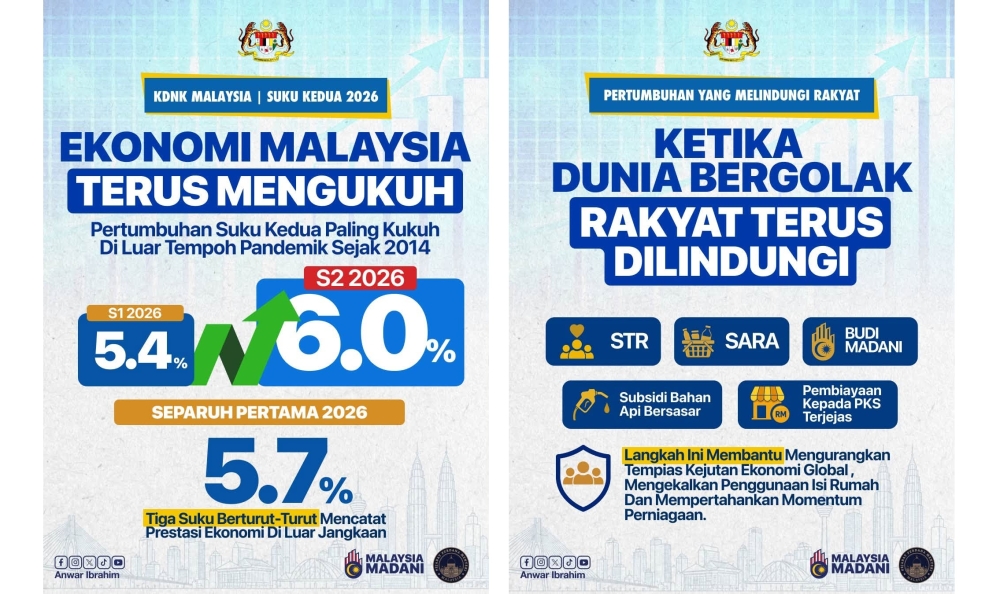
Prime Minister Datuk Seri Anwar Ibrahim on Wednesday expressed satisfaction with Malaysia's economic trajectory in the second quarter, presenting the results as validation of the government's dual approach to managing growth whilst protecting ordinary Malaysians from volatile global market conditions. The stronger-than-anticipated expansion reflected underlying economic momentum across multiple sectors, signalling that despite persistent headwinds on the international stage, the country's fundamentals remained sound and policy interventions were delivering tangible benefits to the population.
The government's defensive strategy against imported inflation has centred on targeted subsidies and price controls that shield consumers from commodity price shocks originating overseas. By preventing rapid pass-through of global energy and food cost increases to retail prices, policymakers have maintained household purchasing power during a period when many regional economies struggled with eroding living standards. This approach represents a deliberate trade-off: accepting higher fiscal costs in exchange for social stability and preserved consumer demand that sustains domestic economic activity.
Anwar's characterisation of the economic data carries political significance beyond mere statistical reporting. Coming at a time when opposition voices frequently criticise government spending and fiscal management, the premier's emphasis on protecting households reframes the budgetary constraints Malaysia faces within a narrative of responsible stewardship and popular benefit. The messaging underscores how economic policy intersects with political legitimacy, particularly for a coalition government still consolidating its mandate following the 2022 elections.
Malaysia's economic resilience reflects structural advantages that distinguish it from certain regional peers. The country's diversified manufacturing base, substantial financial services sector, and growing digital economy provide multiple growth engines less susceptible to single-sector external shocks. While semiconductor exports remain cyclical and sensitive to global chip demand, the broadening economic foundation reduces the economy's vulnerability to any one industry's downturn. This diversification has proved crucial during periods when global trade flows contracted sharply.
However, the sustainability of the government's inflation-shielding approach faces mounting questions. Fiscal deficits required to maintain subsidies constrain resources available for investment in productivity-enhancing infrastructure, education, and research and development. Economists increasingly warn that whilst subsidies protect near-term living standards, they may inadvertently slow the structural transformation Malaysia requires to sustain competitiveness as labour costs rise and regional competitors upgrade their capabilities. The tension between immediate social relief and longer-term development priorities remains largely unresolved in current policy frameworks.
The regional context amplifies both opportunities and risks for Malaysia's economic trajectory. Southeast Asian neighbours pursuing more hawkish inflation-fighting strategies through restrictive monetary policy face weaker near-term growth but potentially stronger medium-term stability. By contrast, Malaysia's cushioning approach sustains immediate dynamism but risks inflation becoming more entrenched if global commodity prices remain elevated. The correct policy balance depends significantly on inflation trends proving temporary rather than structural—an assumption that became increasingly questionable as 2023 progressed.
International investors monitoring Malaysian economic management will scrutinise whether the government can maintain growth momentum whilst gradually reducing subsidy dependence without triggering either inflation acceleration or demand destruction. This credibility question affects Malaysia's funding costs and currency stability, influencing whether the ringgit can sustain strength necessary for import competitiveness. Capital flows remain sensitive to perceptions of fiscal discipline, meaning economic management cannot divorce itself from financial market dynamics.
The sectoral composition of Q2 expansion warrants closer examination than prime ministerial statements typically provide. Service sector contributions, particularly tourism recovery and financial services, reflect snapback effects from pandemic depression rather than sustainable structural growth. Manufacturing and particularly export-oriented industries face headwinds from weakening global demand, suggesting that once cyclical rebound effects exhaust themselves, underlying growth momentum may prove more modest. Policymakers privately acknowledge these concerns whilst publicly projecting confidence to avoid undermining business and consumer sentiment.
Domestically-oriented sectors including construction, retail, and hospitality benefited from resumed activity and government stimulus spending. However, these stimulus effects represent one-time boosts rather than recurring structural improvements. As government spending eventually moderates to meet fiscal targets, growth contributions from these sectors would naturally decline unless underlying productivity improvements offset stimulus withdrawal. The challenge lies in embedding structural gains that persist once temporary support measures end.
For Malaysian households, the economic narrative remains mixed despite prime ministerial optimism. Whilst price controls shelter purchasing power, wage growth has struggled to match even officially-measured inflation rates, implying real income declines particularly for fixed-income earners and those outside formal employment. Youth unemployment persists at concerning levels, and skill mismatches between labour supply and employer demands remain substantial. Economic expansion measured in aggregate GDP terms does not necessarily translate into broadly-shared prosperity or improved security for significant population segments.
Looking forward, Malaysia's economic management will test whether growth and stability can be simultaneously achieved or whether policy-makers ultimately must navigate difficult trade-offs between competing objectives. The government's current approach implicitly gambles that global conditions improve sufficiently to permit gradual subsidy reduction without triggering either inflation or growth collapse. Should international circumstances deteriorate unexpectedly, the policy flexibility to respond decisively becomes constrained by accumulated fiscal pressures and previous commitments. This dynamic explains why economic officials emphasise current expansion results—they represent the baseline performance against which future challenges will be measured.

