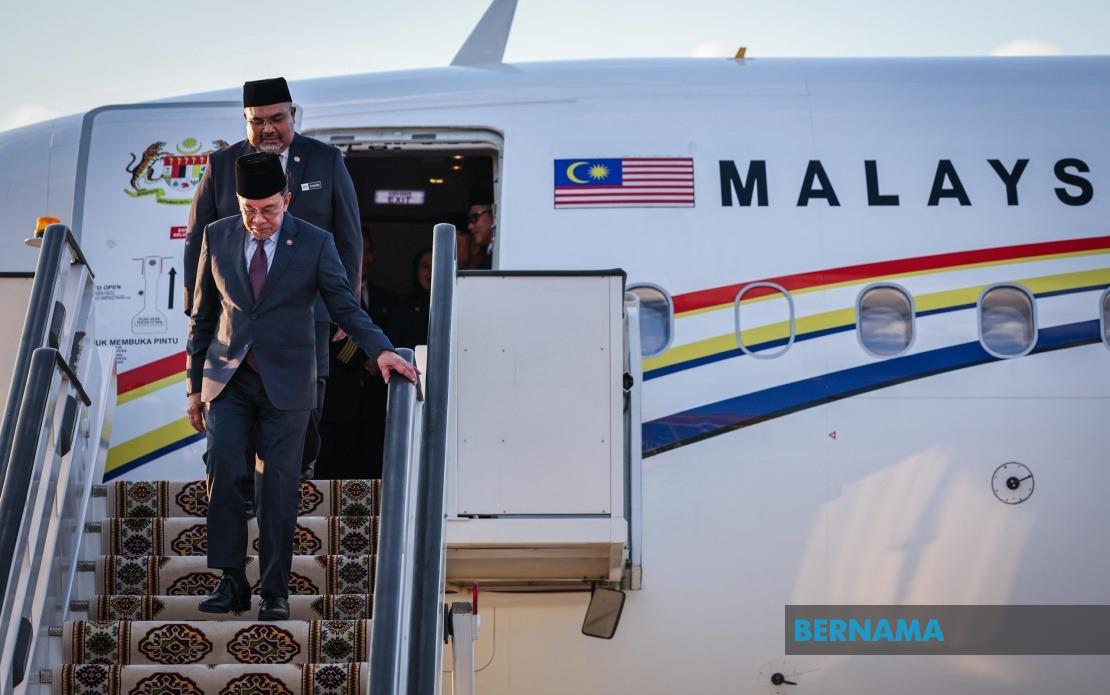
Prime Minister Datuk Seri Anwar Ibrahim landed in Ashgabat on June 18, completing the second leg of his Central Asian tour after concluding a working visit to Kazan. The aircraft touched down at Ashgabat International Airport at 8 pm local time, marking the beginning of a carefully scheduled two-day diplomatic mission through June 19. The visit underscores Malaysia's expanding engagement with Central Asia and reflects the strategic importance that Kuala Lumpur places on diversifying its international partnerships beyond traditional Southeast Asian routes.
The prime minister's delegation was notably comprehensive in composition, reflecting the multifaceted nature of the bilateral relationship. Accompanying Anwar were Minister of Investment, Trade and Industry Datuk Seri Johari Abdul Ghani and Minister of Economy Akmal Nasrullah Mohd Nasir, signalling that economic and trade discussions would occupy centre stage throughout the visit. Senior officials from both the Prime Minister's Office and the Foreign Ministry rounded out the contingent, indicating that this was a formal state-level engagement rather than a routine diplomatic exchange. Malaysia's Ambassador to Turkmenistan Mohd Suhaimi Ahmad Tajuddin coordinated the ground arrangements, while Turkmenistan's Deputy Chairman of the Cabinet of Ministers for Oil and Gas Guvanch Agajanov led the host delegation.
This visit represents a reciprocal gesture in diplomatic relations, following Turkmenistan President Serdar Berdimuhamedov's official visit to Malaysia in December 2024. The invitation was extended by President Berdimuhamedov himself, elevating the status of the engagement and suggesting that both nations view strengthening ties as a priority. For Anwar, the journey to Ashgabat holds historical significance: it is his first official visit to Turkmenistan and marks the fifth prime ministerial visit from Malaysia to the Central Asian nation. This numerical milestone reflects the gradual but steady warming of bilateral relations over preceding decades, though the frequency suggests there remains considerable untapped potential in the relationship.
The economic dimension of the visit carries substantial weight. Trade data reveals that in 2025, Turkmenistan ranked as Malaysia's fourth-largest trading partner among Central Asian nations, a position of growing importance for both economies. The bilateral trade volume reached RM75.80 million, with Malaysian exports valued at RM75.50 million—representing a healthy 9 per cent increase compared with the previous year. While these figures may appear modest in the context of Malaysia's global trade, they reflect a trajectory of expansion in a region where economic ties are still being developed. For Malaysia, establishing deeper commercial connections with Central Asian nations offers diversification benefits and access to energy and raw material supplies, whilst positioning the country as a reliable business partner in a strategically significant region.
Beyond government-to-government trade, the private sector connection through Petronas demonstrates Malaysia's long-term commitment to Turkmenistan's economy. The national oil company has positioned itself as one of the most significant foreign investors in Turkmenistan, with cumulative investments reaching RM52.73 billion since 1996. This figure is particularly striking given that it dwarfs the merchandise trade volume, illustrating the scale of Malaysia's energy sector engagement in the country. Petronas's sustained presence in Turkmenistan over nearly three decades has created employment, transferred technology, and generated revenue streams for both the Malaysian corporation and the Turkmen government. Such deep energy sector partnerships often become the bedrock upon which broader bilateral relationships are built, and Anwar's visit provides an opportunity to discuss expansion of these investments and resolution of any outstanding operational challenges.
The itinerary assembled for Anwar's visit blends ceremonial elements with substantive diplomacy. Upon arrival on the evening of June 18, the prime minister was scheduled to attend a dinner reception with the Malaysian diaspora and friends of Malaysia based in Ashgabat. Such gatherings serve multiple purposes: they allow the prime minister to connect with Malaysians living abroad, reinforce Malaysia's cultural presence in the region, and provide informal settings for discussing business opportunities and community concerns. The diaspora event also signals to Turkmen society that Malaysia values its citizens and maintains engagement with communities across the globe.
The formal business of the visit commences on June 19 with a full slate of high-level engagements. President Berdimuhamedov will host a welcoming ceremony at the Presidential Palace, followed by a one-on-one meeting between the two leaders. These tête-à-tête sessions often prove the most productive moments in bilateral visits, allowing frank discussion of sensitive issues and broad strategic alignment without the constraints of formal proceedings. The subsequent bilateral talks will involve the full delegations from both sides, providing opportunities for officials to address sector-specific concerns, explore new areas of cooperation, and iron out implementation details of existing agreements.
Document signing represents another significant component of the visit's agenda. Both governments have prepared a joint statement and multiple agreements and memoranda of understanding for execution, indicating that negotiations have progressed substantially prior to Anwar's arrival. These instruments typically cover areas such as energy cooperation, investment facilitation, education exchanges, and cultural partnerships. For Malaysia, such agreements create legal frameworks that encourage private sector investment and facilitate commercial transactions. For Turkmenistan, they signal openness to Malaysian participation in key economic sectors and affirm the mutual desire for deeper engagement.
The itinerary also incorporates cultural and religious dimensions that reflect respect for Turkmenistan's traditions. Anwar is scheduled to perform Friday prayers at the Turkmenbashi Ruhy Mosque, also known as the Gypjak Mosque, a gesture that acknowledges the shared Islamic faith between Malaysia and Turkmenistan whilst underscoring the role of religious communities in bilateral relations. Such public acts of worship by visiting dignitaries carry symbolic weight in Muslim-majority nations, demonstrating the foreign leader's respect for local customs and religious values.
The Malaysia-Turkmenistan Forum represents an innovative platform for advancing business-to-business connections. By jointly officiating this event with President Berdimuhamedov at the Chamber of Commerce and Industry of Turkmenistan, Anwar provides high-level political backing for private sector engagement. Such forums typically feature presentations by companies seeking to establish operations in both markets, discussions of investment opportunities, and networking opportunities for entrepreneurs and business executives. The presence of the prime minister signals government commitment to removing bureaucratic obstacles and creating an enabling environment for commerce.
From a broader regional perspective, Anwar's visit underscores Malaysia's strategic pivot toward Central Asia as an emerging economic frontier. Unlike Southeast Asia, where Malaysia already maintains extensive bilateral relationships, Central Asia remains relatively underdeveloped in terms of economic ties with Malaysia. The region offers potential in energy security, raw materials, and logistics partnerships, particularly as global supply chains continue to diversify away from traditional hotspots. Turkmenistan, with its vast hydrocarbon reserves and geographic position as a crossroads between Asia and Europe, holds particular appeal for Malaysian companies seeking expansion opportunities beyond Southeast Asia.
The timing of the visit also merits consideration. Following Berdimuhamedov's December 2024 visit to Malaysia, the relatively swift reciprocal visit demonstrates both nations' commitment to maintaining diplomatic momentum. In international relations, such quick follow-up visits often presage deeper cooperation, as they suggest that initial discussions have been productive and that both sides wish to capitalize on the emerging relationship. The visit may also be positioned as part of Malaysia's broader engagement strategy with Central Asia, potentially laying groundwork for expanded ties with other nations in the region.
Conclusion of the visit with a press conference featuring Malaysian media provides transparency regarding outcomes and helps communicate achievements to domestic stakeholders in Malaysia. Prime Minister Anwar, as both head of government and minister of finance, will likely emphasize the economic benefits to Malaysia from deepened energy partnerships and expanded trade opportunities. The visit exemplifies how Malaysia, despite its small size relative to global powers, pursues strategic partnerships across diverse regions to enhance its economic resilience and political influence.

