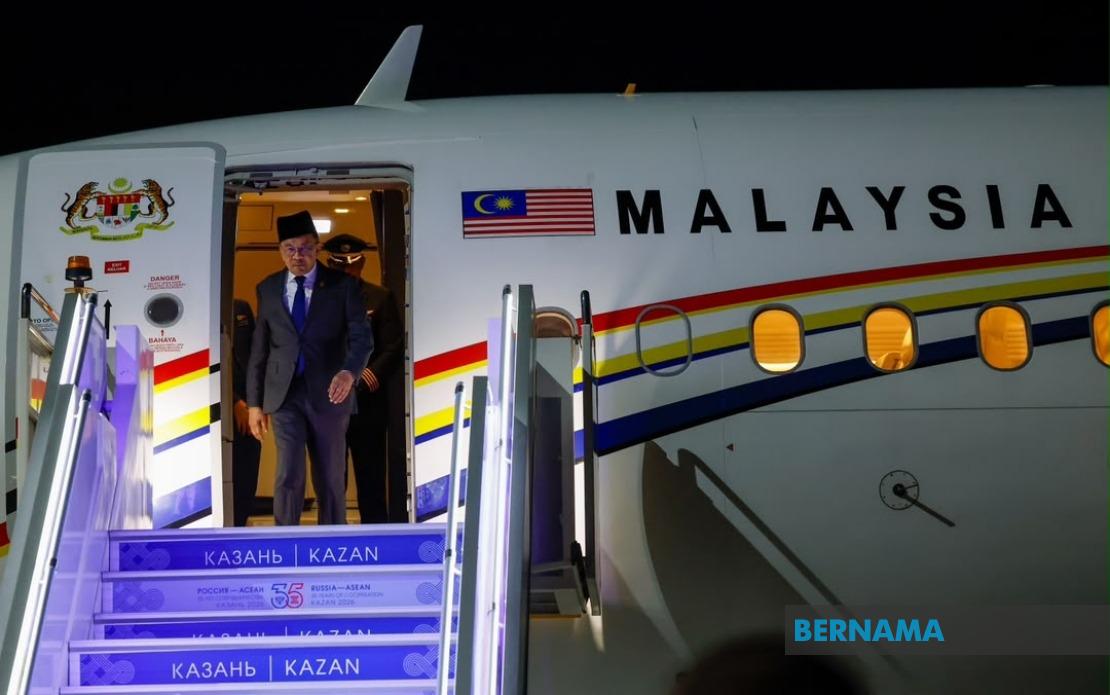
Prime Minister Datuk Seri Anwar Ibrahim touched down in Kazan early Wednesday morning for a two-day working visit centred on attending the ASEAN-Russia Commemorative Summit scheduled for June 17-18. The delegation landed at Kazan International Airport at 10.20 pm local time, concluding a journey to the capital of Russia's Republic of Tatarstan. Accompanying the Prime Minister were several senior cabinet members, including Minister of Investment, Trade and Industry Datuk Seri Johari Abdul Ghani and Minister of Economy Akmal Nasrullah Mohd Nasir, alongside key personnel from his office and the Foreign Ministry, signalling the government's commitment to this multilateral engagement.
The arrival ceremony reflected the diplomatic significance of the occasion, with Malaysia's Ambassador to Russia Datuk Cheong Loon Lai greeting the Prime Minister on behalf of the Malaysian mission. The Russian reception committee included Ilya Nachvin, the Minister of Digital Development of Tatarstan, alongside Kazan Mayor Ilsur Metshin and officials from the State Protocol Department. This bilateral reception underscores the symbolic importance Russia places on the ASEAN delegation's visit, particularly given the broader geopolitical context in which regional groupings are increasingly seeking to maintain strategic equilibrium.
The summit represents a watershed moment in the ASEAN-Russia relationship, marking the 35th anniversary of formal relations between the two sides since their establishment in Kuala Lumpur in 1991. This three-and-a-half-decade partnership has evolved through multiple phases of international relations, surviving Cold War legacies and navigating the complexities of post-Cold War dynamics. The commemorative nature of this gathering provides participating nations, including Malaysia, with an opportunity to assess what has been accomplished and to recalibrate strategic priorities for the years ahead.
According to the Ministry of Foreign Affairs statement, the summit will focus on comprehensive cooperation spanning multiple sectors. The agenda encompasses traditional areas such as trade, investment, and energy cooperation, alongside newer domains including the digital economy, science and technology, cultural exchange, educational partnerships, and people-to-people connectivity. This breadth of engagement reflects how bilateral and multilateral relationships have expanded beyond conventional diplomatic and security frameworks to encompass the full spectrum of human and economic interaction in the modern era.
The summit is expected to produce four substantial outcome documents that will provide a framework for future collaboration. The Kazan Declaration on the 35th Anniversary of ASEAN-Russia Relations serves as the overarching political statement, while separate joint statements on energy and cultural cooperation address specific priority areas. Most significantly, the Comprehensive Plan of Action to Implement the ASEAN-Russia Strategic Partnership 2026-2030 offers a detailed operational roadmap for the next five years, translating high-level political commitment into concrete programmes and initiatives that governments and private sectors can implement.
For Malaysia specifically, participation in this summit reinforces Kuala Lumpur's broader foreign policy orientation centred on ASEAN Centrality and maintaining robust relationships with major powers across the globe. In an era of increasing geopolitical fragmentation, Malaysia's presence at forums bringing ASEAN and Russia together demonstrates the country's investment in preserving dialogue platforms that keep major powers engaged with Southeast Asian concerns. This approach is particularly relevant given regional anxieties about great power competition and the potential for Southeast Asia to become a contested terrain among rival blocs.
During his time in Kazan, Anwar is anticipated to hold bilateral meetings with Russian President Vladimir Putin and the Head of the Republic of Tatarstan, in addition to multilateral engagements with fellow ASEAN leaders. These discussions are expected to cover Malaysia's priority themes of promoting dialogue and peace in conflict-affected regions, supporting economic resilience amid global uncertainties, addressing energy and food security challenges that directly impact Malaysian interests, and strengthening cultural and people-to-people exchanges that build long-term social foundations for interstate relations. Energy security in particular carries special relevance for Malaysia as a significant oil and gas producer seeking diversified markets and investment partnerships.
This Kazan visit represents Anwar's third journey to Russia since assuming the premiership in November 2022, demonstrating consistent high-level engagement with Moscow. His previous visits included attendance at the Eastern Economic Forum in Vladivostok in September 2024 and an official visit to Moscow in May 2025 during which he and Putin discussed an expansive range of cooperation areas including trade, investment, agricultural partnerships, aerospace initiatives, and energy collaboration. The frequency and substance of these engagements indicate that Russia figures prominently in Malaysia's diversification strategy for external relations.
The strategic context for this summit reflects broader shifts in international affairs, where traditional Western-centric frameworks no longer exclusively shape global diplomacy. ASEAN's maintenance of equidistant relationships with major powers including Russia, China, the United States, and India represents a deliberate policy choice to preserve the region's strategic autonomy. Malaysia's participation underscores this commitment, as the country continues to navigate complex international waters by engaging comprehensively with all major powers rather than aligning exclusively with any single bloc.
Energy cooperation emerges as a particularly salient theme given global energy transitions and supply chain vulnerabilities exposed in recent years. Both Russia and ASEAN nations, including Malaysia, are invested in stable energy markets and reliable supply relationships. Discussions on this front likely touch on liquefied natural gas partnerships, renewable energy development, and technological cooperation in energy efficiency, all areas where both Russia and Southeast Asian nations have complementary interests and capabilities.
The food security dimension reflects global challenges that transcend traditional geopolitical boundaries. Russia's role as a major grain exporter and ASEAN's diverse agricultural base create opportunities for mutually beneficial cooperation in agricultural technology transfer, supply chain resilience, and market access arrangements. For Malaysia, securing reliable sources of key agricultural commodities while maintaining stable prices remains an ongoing priority in a context of climate uncertainty and competing global demands.
The digital economy and science cooperation components signal recognition that future competitiveness depends on technological advancement and digital infrastructure development. ASEAN nations are increasingly conscious of the need to avoid technological dependency on any single power, making Russia's offerings in cybersecurity, satellite technology, and digital innovation particularly relevant for countries seeking diversified technological partnerships.
Ultimately, this Kazan summit and Anwar's participation exemplify Malaysia's commitment to sustaining ASEAN as a relevant diplomatic force capable of engaging with all major international actors on terms that preserve Southeast Asian agency and interests. By maintaining active dialogue with Russia while simultaneously engaging the United States, China, and India, Malaysia and ASEAN seek to construct a regional environment where no single power can dominate and where smaller nations retain meaningful voice in shaping outcomes affecting their futures.

