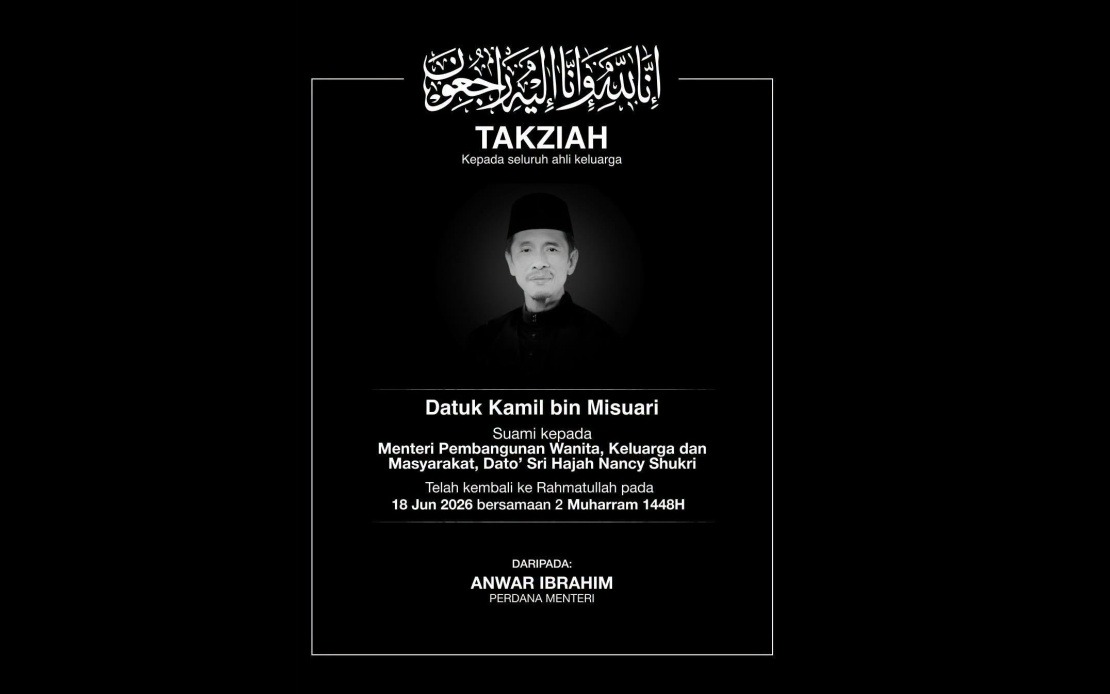
Prime Minister Datuk Seri Anwar Ibrahim and his wife Datuk Seri Dr Wan Azizah Wan Ismail have offered their heartfelt condolences to Women, Family and Community Development Minister Datuk Seri Nancy Shukri following the death of her husband, Datuk Kamil Misuari, who passed away this evening at a hospital in Kuala Lumpur.
In a statement shared on Facebook, the Prime Minister conveyed prayers for the bereaved family, requesting divine strength and resilience as they navigate through this period of grief. The message underscored the difficult nature of the loss and sought to provide spiritual comfort during their time of mourning, reflecting the customary expressions of sympathy extended by Malaysia's political leadership in such circumstances.
The Premier's condolence message invoked Islamic prayers and blessings for the deceased, requesting forgiveness of sins, acceptance of good deeds, and a place of honour in the hereafter. Such expressions, rooted in Islamic tradition, are standard practice among Malaysia's Muslim leadership when acknowledging the passing of fellow community members, demonstrating the intertwining of faith and public duty in the nation's political discourse.
Datuk Kamil Misuari, who was 65 years old, had been married to Nancy for nearly four decades, having tied the knot in 1985. Their marriage produced three children, and by all public accounts, he maintained a supportive presence throughout his wife's career in government service, including her current role overseeing women's affairs and family development initiatives.
The Office of the Minister of Women, Family and Community Development made the official announcement of his passing, confirming the death occurred at a Kuala Lumpur medical facility. The timing of the announcement and subsequent expression of condolences from the nation's highest office underscores the respect accorded to ministerial families within Malaysia's political establishment.
Arrangements have been made to transport the deceased's remains to Sarawak, his home state, where he will be laid to rest at the Samariang Muslim Cemetery in Kuching. The decision to return the body to his native state reflects common practice in Malaysia, where deceased individuals are typically buried in their ancestral hometowns, allowing extended family and community members to participate in the funeral rites and pay their final respects.
This episode highlights the personal dimensions of Malaysia's political life, reminding observers that behind governmental portfolios and ministerial responsibilities are individuals navigating the same life events and sorrows as the general population. Nancy Shukri's position as a senior cabinet minister does not insulate her or her family from the universal experience of loss, and the formal acknowledgment by the Prime Minister and his wife serves to humanise the upper echelons of government.
Ministerial deaths and significant family losses occasionally prompt broader reflections within Malaysia's political community about the demands placed upon those in public office. The balance between personal responsibilities and professional obligations becomes particularly acute during periods of bereavement, and such incidents sometimes lead to discussions about support systems available to members of the political class.
The expression of condolences from the office of the Prime Minister, conveyed through modern digital platforms such as Facebook, illustrates how contemporary Malaysian politics integrates traditional expressions of sympathy with contemporary modes of communication. This blend of old and new reflects the evolving nature of political engagement in the digital age, where major announcements and personal messages from leadership frequently reach the public through social media channels.
For Nancy Shukri, whose tenure as Women, Family and Community Development Minister has centred on supporting Malaysian families and addressing domestic concerns, this personal tragedy arrives at a time of significant professional responsibility. The ministry she leads handles matters ranging from child welfare and gender equality to family counselling services, areas that take on additional personal resonance given her current circumstances.

