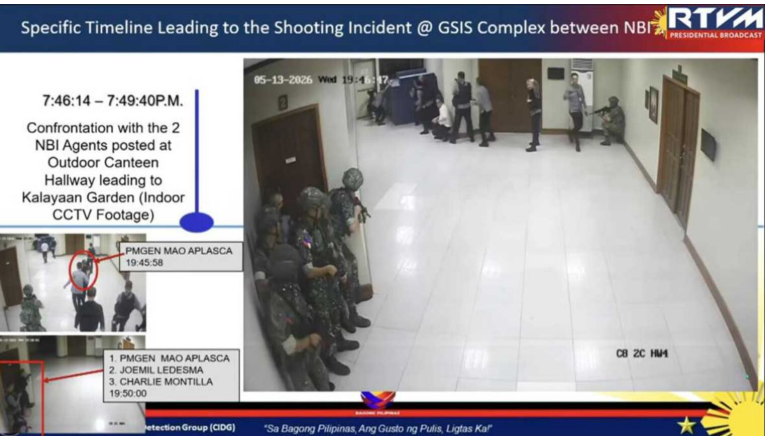
The Philippine Department of Justice has opened a formal investigation into the circumstances surrounding a shooting at the Senate building on May 13 and the escape of Senator Ronald dela Rosa from protective custody early the following morning, with preliminary evidence pointing toward the possible involvement of government officials in both incidents. Justice Secretary Fredderick Vida confirmed that prosecutors have been compiling evidence and witness testimonies to establish whether the two events are connected or represent a coordinated breach of security at the nation's upper legislative chamber.
According to Vida's account of the investigation's initial phase, evidence collected from the National Bureau of Investigation, media personnel who were present, and security camera recordings indicates that shots were fired from the fifth floor of the Senate building directed at an identifiable NBI vehicle stationed at the GSIS premises. This detail is particularly significant because it suggests the shooting was not random or opportunistic, but rather a targeted operation with knowledge of specific vehicle locations and protective movements, raising questions about how such detailed operational intelligence might have been obtained.
The investigation remains in its nascent stages, with Vida emphasizing that the DOJ's panel of prosecutors continues to gather and analyze evidence. When pressed about whether authorities had identified specific individuals as targets of investigation, Vida indicated that no formal accusations have yet been leveled, though he noted that preliminary findings suggest multiple personalities connected to the incidents hold positions within the government structure. This careful wording reflects the sensitive nature of the case and the potential implications of investigating officials at senior levels.
Vida's public statements attempted to balance transparency with caution, acknowledging that the evidence pointing toward public official involvement is preliminary while ensuring the public that the department intends to conduct a thorough examination. The Justice Secretary pledged that the investigation would proceed professionally and objectively, without fear or favor—language that carries particular weight given the political implications of investigating a senator's security breach and the question of whether officials facilitated his escape from custody.
The May 13 shooting itself represents an extraordinary breach of security at the Senate. The targeting of an NBI vehicle suggests either detailed advance knowledge of protective operations or the involvement of persons with access to real-time information about security movements and vehicle locations. For a Malaysian audience familiar with the challenges of maintaining secure government institutions, the incident underscores how vulnerabilities can exist even in supposedly fortified buildings and how institutional security depends fundamentally on the integrity of those tasked with protecting officials.
The escape of Dela Rosa from protective custody adds another layer of complexity to the investigation. The escape occurred in the early morning hours of May 14, immediately following the Senate shooting, suggesting a potential connection between the two events. The senator may have fled believing his security was compromised, or there may have been deliberate assistance in facilitating his departure from protective custody. Either scenario points toward serious gaps in security protocols or potential collusion by officials responsible for his protection.
For Southeast Asia broadly, the incident raises uncomfortable questions about the vulnerability of government institutions to internal threats and the challenges posed when security breaches may involve those entrusted with protection responsibilities. The Philippines' experience reflects issues that resonate across the region, where institutional integrity and the rule of law depend on officials adhering to their constitutional duties despite political pressures or factional conflicts. The DOJ's investigation will likely shape how similar incidents are handled in the future and what reforms may be necessary to prevent security personnel from being compromised.
Vida's assertion that no individual is above the law, coupled with his equally important caveat that no person should be judged before evidence is examined, reflects awareness of the broader stakes. An overzealous investigation that targets officials without sufficient evidence risks appearing politicized, while insufficient investigation of potential official involvement would undermine public confidence in the justice system. The balance the DOJ strikes will influence public perception of whether justice institutions can operate fairly when investigating those in power.
The investigation's focus on establishing links between the shooting and the escape suggests prosecutors believe the incidents may represent part of a coordinated operation. This working hypothesis would explain why multiple public officials appear to be implicated and why evidence points to specific knowledge of security operations. If confirmed, such coordination would represent not merely a lapse in security but a potential conspiracy involving those with authority and access to sensitive information.
As the investigation proceeds, several critical questions remain unanswered. How was sniper fire from inside the Senate building possible without immediate armed response? What role did communications and coordination play in the escape from protective custody? Were there warnings or communications between individuals that might indicate premeditation? The answers to these questions will determine not only which officials face charges but also what systemic reforms the Senate and DOJ implement to prevent similar incidents.
The DOJ's handling of this case will be scrutinized closely by observers across the Philippines and Southeast Asia. A thorough, impartial investigation that holds officials accountable regardless of rank would reinforce confidence in the justice system. Conversely, any appearance that investigations are shielded or limited by political considerations would deepen public skepticism about whether institutions can police themselves effectively.

