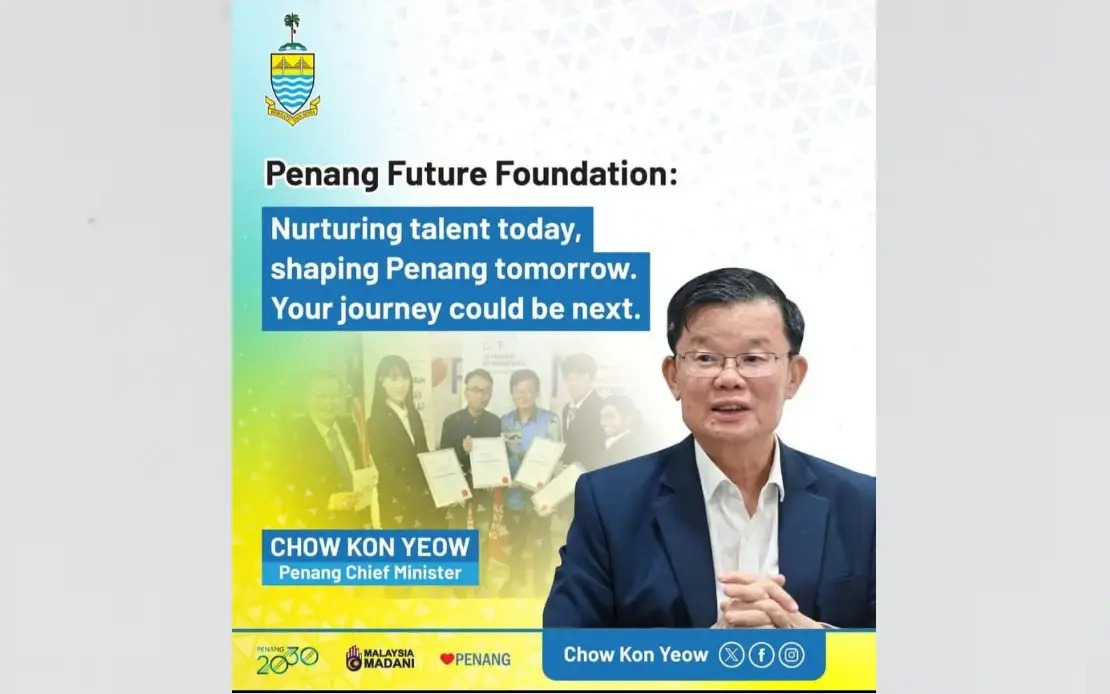
The Penang Future Foundation, a state government talent initiative launched in 2015, has channelled roughly RM47.7 million into scholarship support for 863 deserving Malaysian students over the past decade, underscoring the region's commitment to developing human capital as a strategic economic priority. Now in its 11th operational year, the foundation represents a sustained effort to identify and nurture academic excellence across the country, with particular emphasis on fields critical to Penang's continued industrial competitiveness and innovation ecosystem.
Chief Minister Chow Kon Yeow articulated the foundation's core mission as instrumental to the state's ambitious 50-year growth trajectory, positioning talent acquisition and retention as essential counterweights to capital and infrastructure investment. His statement reflects a broader recognition within Malaysia's regional governance that human resource development cannot be left to chance or market forces alone; strategic public-private partnerships in scholarship provision create competitive advantage in attracting multinational enterprises and fostering homegrown innovation ecosystems that regional economies increasingly depend upon.
The foundation's funding architecture merges resources from both government and corporate sectors, creating a sustainable model that distributes financial burden while multiplying impact. This hybrid approach proves particularly valuable in Southeast Asia, where state budgets face competing pressures, yet private enterprises benefit directly from a pipeline of skilled workers trained in relevant disciplines. For Malaysia, such collaboration also signals to investors that the country takes workforce development seriously, a reassurance that matters increasingly as regional competitors sharpen their own talent attraction strategies.
In the most recent award cycle, 58 scholars received support across disciplines spanning Science, Technology, Engineering, Mathematics, Accountancy, and Finance. This concentration reflects pragmatic prioritisation; these fields correspond directly to labour market demand and command premium salaries, making them powerful incentives for high-achieving students. The selection across these domains also acknowledges that modern economic growth depends not solely on engineers and technicians but on financially literate professionals capable of managing complex business operations and digital transformation initiatives.
The foundation maintains two distinct scholarship tiers to capture a broader talent pool. The PFF Penang Scholar programme targets elite performers with Cumulative Grade Point Averages of 3.67 or above, recognising that exceptional academic achievement often predicts capacity for advanced technical or professional roles. Simultaneously, the PFF Mutiara Scholar tier welcomes applicants with GPAs between 3.00 and 3.66, embodying an inclusive philosophy that talent distribution follows a bell curve and that many capable contributors fall outside the uppermost percentile. This two-track design prevents the system from becoming an exclusive preserve of the exceptionally brilliant, instead casting a wider net that captures motivated performers who may excel in practical application even if raw academic scores remain moderate.
For Malaysian students nationwide, the openness of applications represents opportunity beyond Penang's borders, though the implicit message suggests preference for those willing to contribute to the state's development. This nationwide recruitment reflects confidence in the foundation's capacity to identify merit regardless of geography while also positioning Penang as an attractive destination for ambitious young people seeking educational advancement. The strategy acknowledges that talent migration between regions is inevitable; offering scholarships to students from elsewhere in Malaysia creates goodwill, expands the talent pool, and potentially establishes networks that benefit the state's professional ecosystem for decades.
The 2026 application window, opening July 15 and closing August 5, provides a defined timeframe that allows prospective applicants to plan their applications strategically. Prospective scholars must monitor the foundation's website at www.penangfuturefoundation.my for detailed eligibility criteria, application requirements, and supporting documentation. This digital-first approach reflects modern administrative practice while assuming adequate internet access among the target demographic—a reasonable assumption for secondary and tertiary students but potentially excluding candidates from less digitally connected backgrounds.
Larger implications for Malaysia's competitive positioning in Southeast Asia become evident when examining such initiatives. Thailand, Vietnam, and Indonesia have launched competing scholarship schemes designed to anchor talent domestically and attract regional excellence. Penang's sustained commitment to scholarship provision, now spanning eleven years and distributing nearly RM50 million, demonstrates strategic consistency and institutional confidence. Yet the foundation's relatively modest scale—863 scholars over a decade represents fewer than 90 recipients annually—suggests that significant human capital gaps persist and that scholarship provision, while valuable, cannot alone solve structural workforce challenges in knowledge-intensive sectors.
The emphasis on STEM and accountancy disciplines reflects global workforce trends but also specific sectoral demands within Penang's manufacturing, electronics, and business process outsourcing industries. As Malaysia positions itself for Industry 4.0 transformation, demand for workers comfortable with artificial intelligence, data analytics, and digital systems will intensify. Scholarship programmes anchoring students in these domains today represent investments in competitive capacity tomorrow, though success ultimately depends on whether scholarship holders remain in Malaysia post-graduation or pursue opportunities abroad—a perennial challenge for developing economies.
For prospective applicants, the foundation offers genuine opportunity for educational advancement without accumulating debt, a consideration particularly significant in a region where student loan burdens constrain social mobility. Yet the competitive nature of selection means that applications will far exceed available awards, making the process rigorous. Students considering applications should begin preparing documentation immediately, ensuring academic records are impeccable and supporting essays articulate genuine commitment to contributing to Malaysian economic development rather than merely seeking free education. The foundation's decade-plus track record suggests serious institutional commitment to rigorous selection and meaningful long-term support for recipients.

