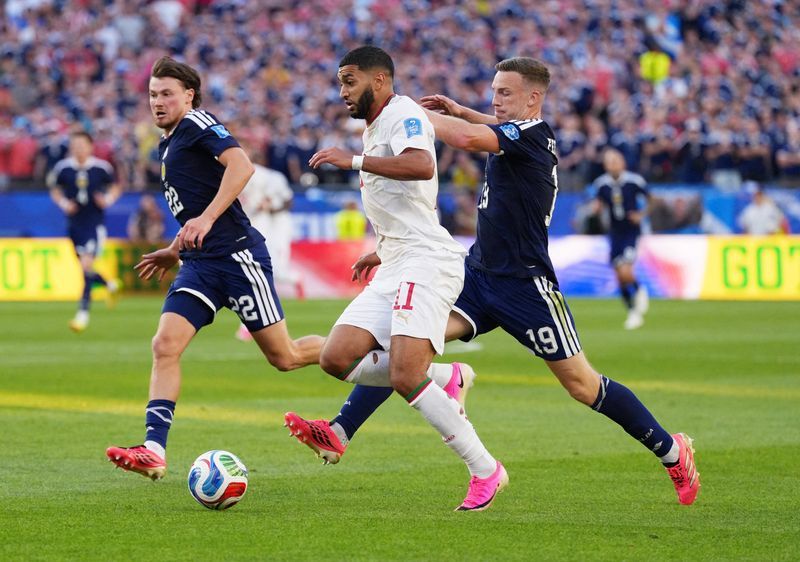
Morocco delivered a masterclass in controlled aggression at Foxborough, Massachusetts, dismantling Scotland with a 1-0 victory that reinforced the North Africans' credentials as genuine contenders in this tournament. The decisive moment arrived with remarkable swiftness—Ismael Saibari pounced on a Brahim Diaz cross to finish after just 71 seconds, claiming the honour of scoring the quickest goal in this World Cup while catching the Scottish defence fatally out of position. With this victory, Morocco now occupies top spot in Group C with four points from two matches, positioning themselves favourably for qualification with only Haiti standing between them and the knockout rounds.
The speed of Morocco's breakthrough was symptomatic of a deeper tactical superiority that persisted throughout the ninety minutes. The Moroccan squad demonstrated an almost suffocating control over proceedings, systematically pressuring their opponents into submission and dictating the rhythm of play from the opening whistle. Scotland, buoyed by their historic first World Cup victory in 36 years against Haiti in their opener, arrived expecting a competitive contest but instead found themselves constantly chasing shadows. The deceptive scoreline obscured the true gulf in class; Morocco's dominance was so complete that Scotland managed not a single shot on target until deep into the first-half stoppage time, a statistic that underscores how thoroughly outplayed the Scottish side appeared.
The opening goal emerged from textbook defensive positioning errors rather than any complicated attacking sequence. Grant Hanley, Scotland's central defender, stepped out too aggressively in an attempt to intercept Diaz's delivery, leaving a yawning chasm in the defensive line through which Saibari exploited with clinical precision. This moment proved instructive for Morocco's remaining fixtures and for how subsequent opponents might approach facing this well-organised unit. Saibari himself has become an emblem of Morocco's rising quality at international level, having already scored in the previous match against Brazil and reportedly securing a medical clearance for a move to Bayern Munich, the German Bundesliga champions. His achievement of scoring in his first two World Cup appearances places him in rare company—only Egypt's Mohamed Salah has achieved this feat among African players at the tournament.
The dominance extended well beyond that opening salvo. Morocco created numerous opportunities throughout the first half, with the right side of their attack proving particularly menacing. Bilal El Khannouss fired over the bar in the 36th minute following another incisive Moroccan move, while Azzedine Ounahi orchestrated several dangerous sequences down the left flank. One particularly telling moment saw Ounahi cut the ball back from the byline, with two Moroccan attackers positioned to finish, yet both narrowly failed to connect—a marginal difference between a commanding 1-0 lead and an entirely decisive 2-0 advantage. Ounahi's pre-match comments about targeting the World Cup final did not appear mere bravado given the manner in which his teammates executed their game plan.
Scotland's impotence in the attacking third reflected both Morocco's defensive discipline and the Scottish squad's inability to generate meaningful offensive momentum. The visitors pressed sporadically late in the contest, mustering some half-chances that goalkeeper Angus Gunn protected without requiring heroic intervention. However, these glimpses of attacking intent arrived far too late to influence the contest's trajectory. The Scottish approach seemed to lack the coherence and creativity required to breach a well-organised Moroccan rearguard that appeared comfortable operating on the front foot throughout.
The second-half narrative continued Morocco's pattern of controlled superiority. Saibari tested the crossbar with a deflected effort, while El Khannouss drew a quality save from Gunn via a glancing header minutes after the interval. Scotland's desperation mounted with each passing minute, yet the Mediterranean squad's composure and structural integrity prevented any meaningful pressure from materialising. This performance will have registered as a significant warning to other Group C contenders regarding Morocco's genuine tournament ambitions.
Morocco's fixture list offers a straightforward path towards knockout qualification. Their final group-stage assignment against Haiti on Wednesday presents a vastly inferior opponent compared to Scotland or their earlier encounter with Brazil. The mathematical picture suggests that even a draw against Haiti would likely suffice to secure one of the top two positions. Scotland, by contrast, faces a mountainous challenge against five-time champions Brazil on the final matchday, requiring not merely victory but also hoping that Morocco either slip up against Haiti or that other results favour their goal difference. The permutations underscore how effectively Morocco have positioned themselves through this opening pair of matches.
It bears noting that the Moroccan captain Achraf Hakimi faced an uncomfortable reception from sections of the Scottish crowd, reflecting the serious allegations the defender confronts off the pitch. Yet from a purely footballing perspective, Hakimi's team demonstrated that they possess the tactical discipline, technical proficiency, and physical intensity to compete at the highest level of international football. This performance against Scotland suggests that Morocco's run to the World Cup semi-finals in Qatar two years ago was no anomaly but rather the beginning of an upward trajectory for North African football.
The broader implications for Southeast Asian perspective merit consideration. Morocco's emergence as a global football power demonstrates that Asian nations cannot assume regional success automatically translates to success on the world stage. The North African nation has invested systematically in player development and tactical coherence, creating a squad that operates as a unified organism. For nations across Asia pursuing similar ambitions, Morocco's example illustrates the importance of sustained structural investment, intelligent recruitment, and the development of a cohesive team philosophy that prioritises collective discipline over individual flair. Scotland's struggles highlighted how tactical sophistication and collective organisation can overwhelm talent when deployed without sufficient preparation or adaptability.

