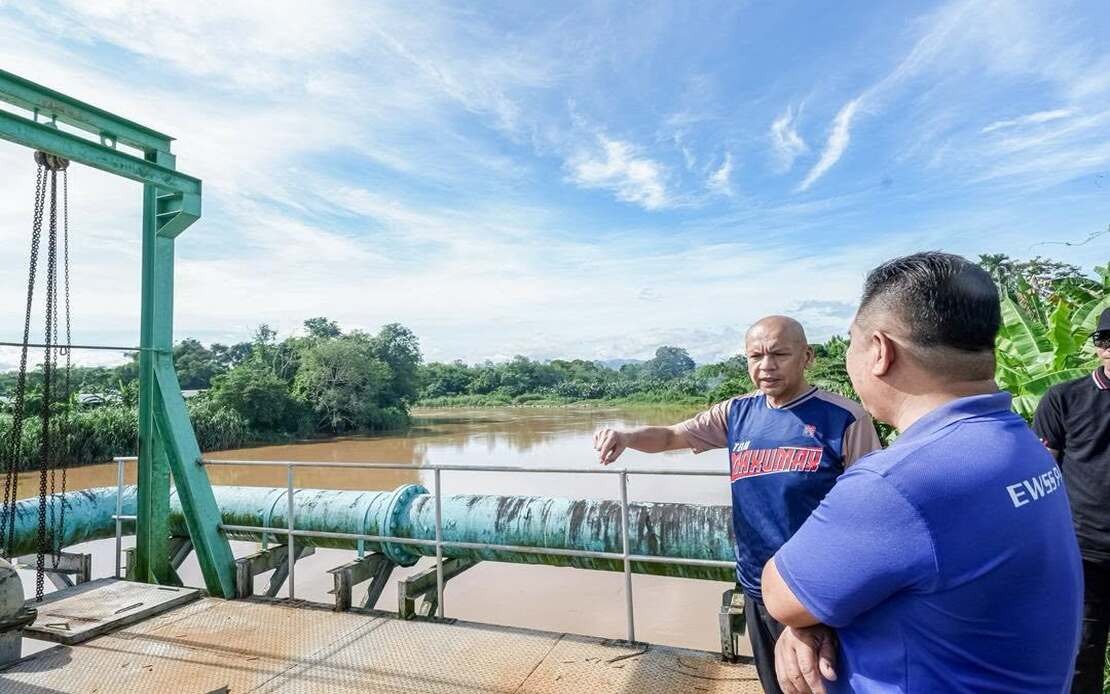
Datuk Armizan Mohd Ali, serving as both Domestic Trade and Cost of Living Minister and Member of Parliament for Papar, made an on-site inspection of water supply infrastructure projects in the district on June 19, seeking to verify that improvement initiatives were tracking according to schedule and delivering tangible relief to communities experiencing water shortages. The ministerial visit followed a comprehensive coordination meeting held on June 15, where officials briefed him on the progress of multiple water stabilization efforts underway across the constituency.
Two major capital projects currently in implementation form the backbone of Papar's water infrastructure overhaul. The first involves a substantial upgrade to the Kogopon Water Treatment Plant, which will expand its daily processing capacity from 40 million litres to 80 million litres—effectively doubling current output. The second project targets the Kampung Kabang water intake point, with improvements designed to enhance the reliability and quality of raw water supply feeding into the treatment network. Together, these initiatives represent a strategic response to mounting pressure on the district's water system as consumption patterns intensify across residential and commercial sectors.
The timing of Armizan's visit acquired additional urgency given recent operational setbacks at two critical treatment facilities. Both the EWSS Plant and the JETAMA Limbahau Plant encountered significant disruptions during the week preceding his inspection, stemming from elevated turbidity levels in raw water sources. Turbidity, measured in nephelometric turbidity units (NTU), indicates the concentration of suspended particles and sediment in water, which can compromise treatment efficacy and water quality. When inlet readings exceed safe thresholds, operators must suspend treatment operations until conditions normalize, a protective measure that paradoxically reduces supply availability during peak demand periods.
The raw water turbidity challenge reflects broader environmental pressures affecting Sabah's water resources. Heavy rainfall, upstream erosion, and seasonal variations can dramatically increase sediment loads in natural water sources, overwhelming conventional treatment processes designed for baseline conditions. For communities already struggling with insufficient supply, such disruptions compound frustration and demand urgent solutions. Armizan's emphasis on direct field monitoring underscores recognition that bureaucratic reporting alone often obscures ground-level realities that demand immediate policy attention.
Parar's water supply difficulties exemplify challenges confronting numerous Malaysian districts where population growth and economic development have outpaced infrastructure investment. The locality has experienced recurring shortages as agricultural expansion, urbanization, and residential consumption have strained systems designed for smaller populations. Unlike major urban centres with redundant distribution networks and multiple water sources, smaller towns typically depend on limited treatment facilities and intake points, making them vulnerable to single-point failures or environmental fluctuations.
The Kogopon expansion represents a substantial commitment to supply-side expansion, though infrastructure modernization alone cannot resolve systemic vulnerabilities. Complementary investments in demand management, leak reduction in aging pipe networks, and raw water source protection are equally critical for sustainable solutions. Many Malaysian water utilities lose significant volumes to pipe leakage—some estimates suggest 30 to 40 percent in certain districts—meaning that capacity additions provide only partial benefit without concurrent efforts to minimize losses.
Armizan's focus on monitoring plant operations and reviewing infrastructure projects reflects a governance approach emphasizing ministerial oversight of critical services. While such engagement can accelerate problem-solving and resource allocation, it also highlights potential weaknesses in routine management structures if ministerial intervention becomes necessary to ensure normal operations. The implication is that local water authorities may require additional technical capacity, funding autonomy, and performance accountability to function effectively without frequent escalation to federal leadership.
The turbidity incidents at EWSS and JETAMA Limbahau plants illuminate the vulnerability of treatment systems to environmental variability. Modern approaches to water security increasingly incorporate multi-barrier strategies, combining source protection, advanced treatment technologies, and robust backup systems. The proposed doubling of Kogopon's capacity, if coupled with turbidity-resistant treatment methods and alternative source development, could substantially improve system resilience for the Papar population.
For Malaysian policymakers and regional water managers, Papar's experience offers instructive lessons. Water infrastructure investment cycles often lag behind demand growth, creating periodic crises that demand expensive emergency interventions. Strategic planning must anticipate development trajectories and environmental constraints, building surplus capacity and diversified supply sources. Additionally, the episode demonstrates how climate variability—manifested here as elevated water turbidity—increasingly affects even basic service delivery, requiring infrastructure design that accounts for intensifying environmental extremes.
The ministerial visit's emphasis on ensuring projects progress "according to plan" carries particular significance given Malaysia's mixed record on infrastructure project delivery. Construction delays, cost overruns, and scope modifications have plagued numerous national development initiatives, eroding public confidence in promised improvements. Armizan's direct monitoring signals commitment to accountability, though sustained follow-up and transparent reporting on timelines, budgets, and outcomes will determine whether community trust in these water supply promises endures beyond the ministerial announcement.