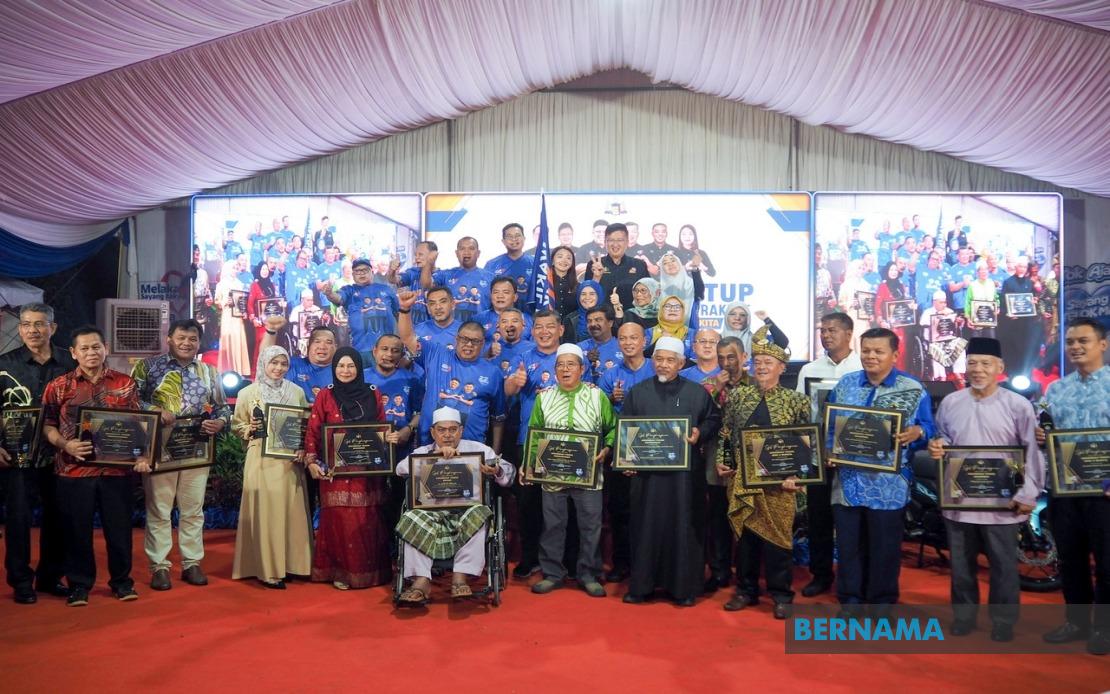
Melaka Chief Minister Datuk Seri Ab Rauf Yusoh has redefined how the state measures success in its Wakil Rakyat Untuk Rakyat (WRUR) initiative, arguing that the true benchmark lies not in how many programmes are launched, but in how effectively government bodies address the everyday concerns of ordinary citizens. Speaking at the closure of the WRUR programme for Kota Melaka parliamentary constituency in Telok Mas, Ab Rauf emphasised that meaningful governance demands a shift away from counting initiatives and towards measuring tangible improvements in residents' lives. This philosophical reorientation reflects broader questions about how Malaysian state governments evaluate their public service delivery amid growing citizen expectations for accountability and efficiency.
The WRUR approach, which has now been deployed across 19 state constituencies in Melaka, operates on a deceptively simple principle: every complaint from the public, regardless of background or geography, must be documented, monitored, and resolved. This emphasis on exhaustive complaint tracking and follow-through represents a departure from the traditional top-down development model, where government agencies typically decide which projects to implement based on internal assessments. Instead, the programme inverts the hierarchy by making public grievances the primary driver of government action. The data accumulated thus far provides quantifiable evidence of this methodology's efficacy. Of the 4,027 complaints lodged across all constituencies where WRUR has operated, more than 2,633—exceeding 65 per cent—have been successfully resolved. This resolution rate suggests that the programme has created functional pathways for grievance redressal that previously did not exist or were ineffective.
Kota Melaka marks the third parliamentary constituency to host the WRUR programme, following Alor Gajah and Hang Tuah Jaya. During its four-week implementation window, the initiative generated impressive raw numbers: over 500 programmes were executed, and more than 200,000 residents benefited. Yet Ab Rauf's cautious framing of these figures—describing them as secondary to actual impact—hints at political sophistication. In the Malaysian context, where opposition parties and civil society organisations frequently critique state governments for inflating project statistics without demonstrating lasting change, such rhetoric serves to preempt criticism. The Kota Melaka phase alone recorded 470 individual complaints, with 31 resolved during the programme period and the remainder queued for processing based on priority. Crucially, Ab Rauf has instructed all relevant agencies to persist in addressing these grievances after the formal programme concludes, ensuring continuity rather than allowing problems to be abandoned once the initiative's media spotlight dimmer.
The integration of this grassroots feedback mechanism into Melaka's governance structure carries implications beyond the immediate constituencies. Malaysia's federal and state systems have historically suffered from disconnect between bureaucratic decision-making and citizen needs, particularly in lower-income and rural areas where advocacy capacity is weakest. By institutionalising complaint recording and tracking, the WRUR programme creates an informal mechanism for surfacing previously invisible problems. This is particularly relevant for Malaysian readers in underserved regions, where infrastructure decay, social service gaps, and environmental degradation often persist without triggering government action simply because there is no structured channel through which to escalate grievances. The programme does not eliminate bureaucratic inertia, but it does establish accountability pressure by forcing agencies to document their responses to documented public concerns.
State Tourism, Heritage, Arts, and Culture Committee chairman Datuk Abdul Razak Abdul Rahman provided additional context regarding Telok Mas, the state constituency where Kota Melaka's WRUR programme was held. Over the preceding five years, 328 local development projects valued at nearly RM68 million have been implemented in Telok Mas, reaching 12 residential areas. These projects span the conventional infrastructure portfolio: road upgrades, river and drainage improvements, sewerage system enhancements, housing repairs and construction, and modernisation of community facilities. The scale of investment suggests that Melaka's state government has committed substantial resources to constituency-level development, though without granular data on whether these projects were responsive to documented public demand or allocated through traditional channels. The diversification of spending across infrastructure, welfare, and economic support programmes indicates an attempt at holistic development strategy rather than narrow focus on single sectors.
Welfare and health assistance constitutes a significant portion of targeted state spending in Telok Mas. Abdul Razak reported that 6,098 residents received food, welfare, and health aid exceeding RM1.2 million during the same five-year period, while 213 medical beds were distributed to households requiring home care equipment. These figures underscore the social safety net function that state governments perform in Malaysia's tiered welfare system. While the federal government provides statutory schemes such as BR1M and employment insurance, state-level programmes often address gap populations—elderly individuals without children nearby, disabled residents in resource-poor households, and families experiencing temporary income shocks. The distribution of medical beds, in particular, reflects targeted support for ageing populations and chronic disease management, demographic realities that Malaysian states will increasingly confront as their populations age.
Cost-of-living support emerged as another prominent component of Telok Mas's state programmes. The Jualan Rahmah and Jualan Murah initiatives, which provide subsidised essential goods through controlled-price retail outlets, have been implemented 70 times since 2022. These programmes directly address inflation pressures that have strained household budgets across Malaysia, particularly for lower-income groups unable to stockpile goods or purchase in bulk. The Free Petrol Programme, benefiting 15,000 residents with RM177,000 in assistance, targets fuel costs—a significant variable expense for working-class households and small traders. Such programmes represent state-level responses to inflationary pressures without waiting for federal intervention, demonstrating how sub-national governments can deploy budgetary resources to cushion citizens against economic shocks. However, the sustainability of such initiatives depends on state revenue capacity, making them vulnerable to fiscal constraints during economic downturns.
Educational support in Telok Mas has focused on critical examination periods and merit-based incentives. The state provided assistance to 1,694 SPM examination candidates, recognising that examination preparation costs—tuition, study materials, transportation—create barriers for economically disadvantaged students. Simultaneously, 255 high-performing Form Five students and university attendees received educational incentives totalling RM244,200, constituting merit-based investment in human capital development. This dual approach—assistance for disadvantaged candidates and incentives for excellent performers—reflects an attempt to balance equity and excellence within the constraints of state budgeting. For Malaysian readers concerned about educational equity, such targeted interventions matter because they can meaningfully affect tertiary education access for able students from modest backgrounds, ultimately affecting social mobility trajectories.
Tourism development initiatives in Telok Mas and surrounding areas signal economic diversification efforts beyond conventional administrative functions. The Ministry of Tourism, Arts and Culture has allocated RM2.4 million to upgrade facilities in Sungai Punggor and Alai, with completion expected in 2027. Dataran Telok Mas is being transformed into a one-stop centre for tourism and local traditional products, potentially creating commercial opportunities for artisans and small-scale traders. Most ambitiously, the Bukit Larang geosite has been identified for assessment as a national geopark, positioning Melaka as a destination for geological tourism. Such initiatives are relevant to Malaysian readers throughout Southeast Asia because they reflect how state governments are seeking non-extractive economic models—tourism and heritage-based development rather than resource extraction. The geopark designation, if achieved, would elevate Melaka's profile in the regional tourism circuit and create employment in hospitality and cultural industries.
The broader WRUR model, as articulated by Ab Rauf, represents a governance philosophy that could have application across Malaysia's thirteen states. By institutionalising complaint reception and establishing transparent resolution tracking, the programme addresses a fundamental accountability deficit. Conventional government feedback mechanisms—municipal suggestion boxes, parliamentary constituency clinics, party meetings—operate sporadically and often invisibly. The WRUR's systematic documentation and public reporting create political pressure to respond because inaction becomes quantifiable failure. For Malaysian readers in constituencies experiencing service deficits, this structural accountability mechanism potentially matters more than the specific programmes undertaken. Whether pothole repairs, housing upgrades, or health assistance, the value lies in the disciplinary effect of documented grievance management. However, the programme's long-term success depends on whether the instruction to continue processing complaints after the formal programme period truly persists, or whether priority drops once media attention wanes and the initiative concludes.

