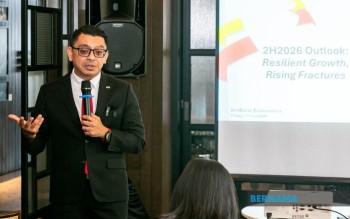
Malaysia's port operators are entering a period of expanded opportunity as global trading patterns shift and maritime industries accelerate their environmental transition, according to analysis from AmBank (M) Bhd. The country's strategic location along the Strait of Melaka and its established infrastructure position it as an increasingly attractive alternative for shippers seeking stability amid broader geopolitical uncertainties. Chief economist Firdaos Rosli outlined these prospects during a media briefing on the bank's second-half 2026 outlook, highlighting both the structural tailwinds propelling port activity and the competitive imperatives that will determine which regional hubs thrive in coming years.
The reshaping of global supply chains represents perhaps the most immediate growth driver for Malaysian port facilities. Geopolitical tensions centred on West Asia have prompted multinational corporations and logistics operators to reassess their routing strategies, with many gravitating towards Southeast Asian transhipment nodes perceived as more secure and operationally reliable. This reorientation has translated into concrete gains for Malaysia's two primary container terminals. Port Klang and the Port of Tanjung Pelepas collectively handled 29.17 million twenty-foot equivalent units in 2025, underscoring the scale of containerised cargo flowing through Malaysian facilities. The momentum has continued into 2026, with Port Klang achieving five per cent year-on-year growth and PTP recording a more robust eight per cent expansion during the January-to-May period, suggesting that the trade diversion effect remains robust rather than temporary.
However, Firdaos cautioned that sustained prosperity cannot be assumed without deliberate investment and strategic foresight. The container shipping sector globally faces persistent capacity constraints and infrastructure bottlenecks that have kept freight rates elevated despite the normalisation of some underlying geopolitical factors. The Baltic Exchange Index, which tracks dry bulk shipping costs, spiked above 120 per cent year-on-year in both February and May, remaining significantly elevated at 64.6 per cent in June. This sustained price inflation suggests that supply-side limitations—vessel availability, port congestion, and cargo-handling capacity—continue to outweigh demand fluctuations. For Malaysian operators, this dynamic creates both opportunity and obligation: the higher freight environment attracts volume-seeking carriers, yet meeting that demand requires continual expansion of berths, container yards, and handling equipment.
The port sector's competitive landscape is increasingly shaped by environmental considerations that extend beyond regulatory compliance into operational differentiation. Malaysia is strategically positioning itself as a regional pioneer in green maritime fuels, a transition that promises both regulatory alignment and commercial advantage. The government's Green Bunkering Regulatory Roadmap establishes an ambitious target of 40 per cent low-carbon fuel consumption across maritime operations by 2050, a timeline that signals serious policy commitment rather than aspirational rhetoric. This framework creates demand for alternative fuels including liquefied natural gas and methanol, both of which carry lower carbon footprints than conventional marine diesel.
Port of Tanjung Pelepas has moved ahead of the regulatory curve by establishing operational capacity in both LNG and methanol bunkering, positioning itself as a preferred port of call for environmentally conscious shipping lines and their cargo clients. This infrastructure investment reflects recognition that shipping lines increasingly face pressure from major customers—particularly multinationals with carbon reduction commitments—to demonstrate measurable progress in lowering fuel-related emissions. For Malaysian operators, the adoption of green bunkering capability represents a form of non-price competition that can attract premium cargo and longer-term terminal agreements, buffering margins against the commoditised competition that typically characterises port services.
The geopolitical foundations underlying Malaysia's port renaissance merit closer examination, as they reveal both the durability and potential fragility of the current advantage. West Asian tensions have proven more persistent and operationally disruptive than many analysts anticipated, prompting shipping lines to expand their route options and reduce reliance on traditional chokepoints. This calculated diversification has benefited Malaysian terminals, which offer proximity to major Asian consumption centres, established customs and operational protocols, and increasingly, a reputation for efficiency. Yet as Firdaos noted, the relationship between West Asian disruption and Malaysian port growth has evolved: the conflict no longer manifests as direct oil market volatility but rather as enduring friction in maritime transportation networks, where delayed sailings, insurance premiums, and routing uncertainties persist.
The persistence of elevated freight rates despite partial normalisation of underlying geopolitical tensions reveals important structural patterns in global shipping. Firdaos observed that shipping costs have not followed the typical pattern of sharp post-disruption correction; instead, rates have stabilised at historically elevated levels, indicating that transient shocks have crystallised into lasting supply constraints. These constraints reflect not merely the conflict itself but the broader industry response to it: shipping lines have reconfigured fleet deployments, rerouted major arteries of global trade, and adjusted scheduling to accommodate longer voyages and additional transshipment points. Malaysian ports, particularly PTP, have become embedded in these new routing architectures, suggesting their gains possess deeper structural foundations than cyclical disruption.
The investment imperatives facing Malaysian port operators warrant sustained attention from policymakers and terminal shareholders alike. While current volume growth rates appear healthy, maintaining competitiveness in an increasingly crowded regional market requires coordinated capacity expansion. Singapore's port authority has responded to similar opportunities by accelerating berth expansion projects; Vietnamese ports continue aggressive modernisation; and Indonesia's domestic port network is receiving substantial infrastructure investment. Malaysian operators must therefore view the present window of opportunity as time-limited, demanding decisive capital allocation to terminal expansion, automation upgrades, and supporting logistics infrastructure.
The convergence of supply chain diversification and environmental transition creates a particularly favourable positioning for Malaysian ports in the medium term. Shipping lines undertaking simultaneous route reconfiguration and fuel-transition strategies naturally gravitate towards ports offering both stable access and forward-looking environmental capability. This combination of factors distinguishes Malaysian terminals from competitors that excel in either dimension but struggle with both. The window for consolidating this competitive advantage, however, remains finite; other regional ports are developing comparable green bunkering infrastructure and supply chain positioning.

