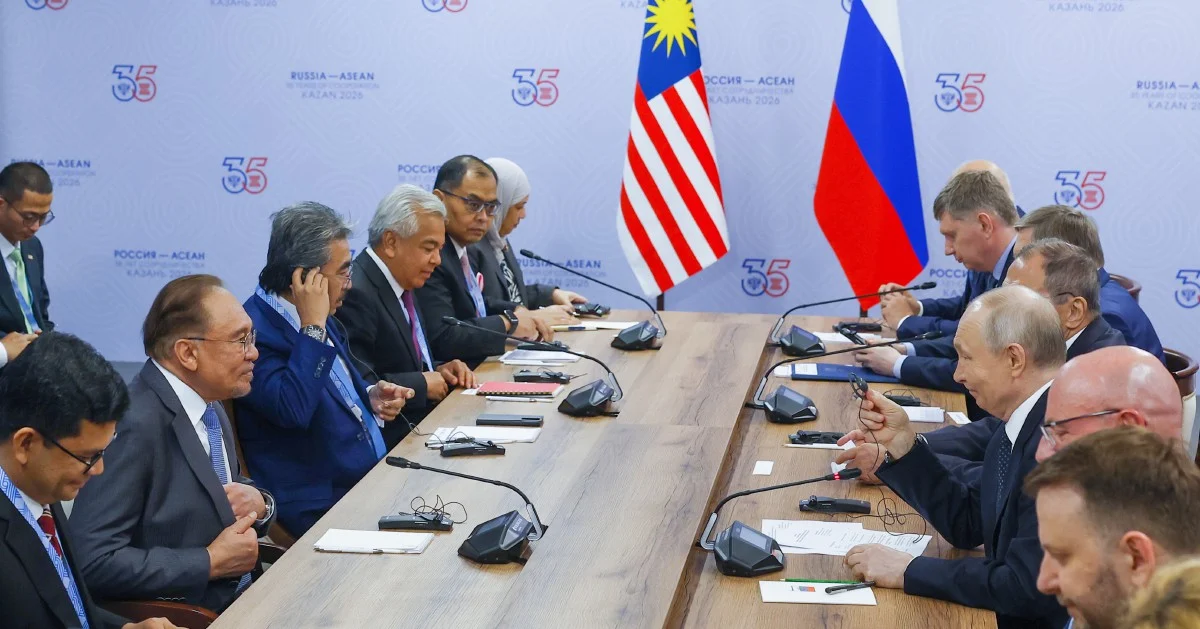
Prime Minister Datuk Seri Anwar Ibrahim used a summit meeting in Kazan to publicly acknowledge Russian President Vladimir Putin's support for Malaysia's energy sector collaboration with Petronas, underscoring the growing strategic alignment between the two nations in one of Asia's most vital resource domains. The expression of gratitude signals a shift in Malaysia's diplomatic positioning, as Kuala Lumpur seeks to diversify its energy partnerships beyond traditional Western suppliers and leverage Russia's considerable hydrocarbon expertise and resources.
The timing of this exchange carries significance for regional energy markets. Malaysia, home to one of Southeast Asia's largest national oil and gas companies in Petronas, has long faced the dual challenge of sustaining domestic energy supplies while investing in future technologies. By cultivating closer ties with Russia, Anwar's administration appears to be hedging against supply chain vulnerabilities and exploring avenues for technology transfer and joint exploration initiatives that could benefit Malaysian energy security for decades to come.
Russia's backing for Malaysia-Petronas cooperation reflects broader geopolitical recalibration taking place across the Indo-Pacific. Facing international sanctions over its Ukraine intervention, Moscow has actively sought to strengthen economic relationships with Asian nations, particularly those positioned as non-aligned or balancing powers. Malaysia, which has maintained a cautious stance on global power rivalries while prioritising economic pragmatism, presents an attractive partner for Moscow's energy diplomacy.
From Petronas's perspective, Russian support for expanded cooperation opens multiple possibilities. The national oil company could explore joint ventures in liquefied natural gas projects, deepwater exploration technologies, or downstream refining operations. Russia possesses advanced capabilities in challenging offshore environments that could prove invaluable for Petronas's operations in the South China Sea and beyond, particularly as the company navigates the energy transition and seeks to maintain production amid climate pressures.
The Kazan meeting also contextualises Malaysia's broader energy policy evolution under Anwar's leadership. The Prime Minister has signalled ambitions to position Malaysia as a regional energy hub while managing the complex transition toward renewable sources. Energy cooperation with Russia should not be viewed in isolation but as part of a portfolio approach that maintains hydrocarbon revenues whilst gradually shifting toward cleaner alternatives. This pragmatic stance reflects the economic realities facing Malaysia, where petroleum and gas revenues remain crucial for government coffers and energy security.
Energy partnerships between Malaysia and Russia could extend beyond traditional oil and gas sectors. Discussions might encompass nuclear energy exploration, given Russia's technological leadership in this field and Malaysia's long-standing interest in diversifying its energy generation mix. Such cooperation would position both nations as serious stakeholders in the region's long-term energy architecture and could influence regional discussions on climate change mitigation and energy independence.
For Southeast Asia more broadly, closer Malaysia-Russia energy ties represent a meaningful diversification of supply chains and technological sources. The region has historically depended on Western companies and partnerships for energy expertise and capital. Russian involvement could inject greater competition and alternative pathways for development, particularly benefiting nations seeking to reduce dependencies on any single external power. This shift particularly matters given ongoing concerns about supply chain concentration and the strategic vulnerabilities exposed by recent global disruptions.
Anwar's public appreciation toward Putin also serves a domestic political purpose. By demonstrating active engagement with major world powers and securing tangible benefits for Malaysia's energy sector, the Prime Minister reinforces his administration's competence in managing international relations and delivering economic value to Malaysians. Energy sector developments directly impact petrol prices, electricity costs, and government revenues—issues that resonate deeply with ordinary citizens navigating post-pandemic economic recovery.
The energy cooperation framework agreed between Malaysia and Russia likely includes specific mechanisms for knowledge sharing, workforce training, and investment facilitation. Petronas has long invested in developing Malaysian talent pools capable of managing complex energy operations, and Russian partnership could accelerate this process by bringing international expertise to Malaysian facilities and enabling Malaysian engineers to work on sophisticated projects abroad.
Looking forward, the strength of Malaysia-Russia energy ties will depend on several factors, including global sanctions trajectories, commodity price movements, and the willingness of international financial institutions to facilitate transactions. Nevertheless, Anwar's public endorsement signals that Malaysia's government views such cooperation as strategically valuable and politically sustainable. This positioning suggests continued Malaysian emphasis on pragmatic engagement with all major powers rather than alignment with any particular bloc—a approach increasingly central to Kuala Lumpur's foreign policy identity in an era of great power competition.
The partnership also carries implications for ASEAN's collective energy diplomacy. As individual member states pursue bilateral arrangements, questions arise about coordinating positions on energy security within the regional grouping. Malaysia's Russian engagement could either complement or potentially complicate ASEAN consensus-building, depending on how aggressively the partnership is pursued and how it interacts with other member states' strategic preferences and relationships with Moscow.

