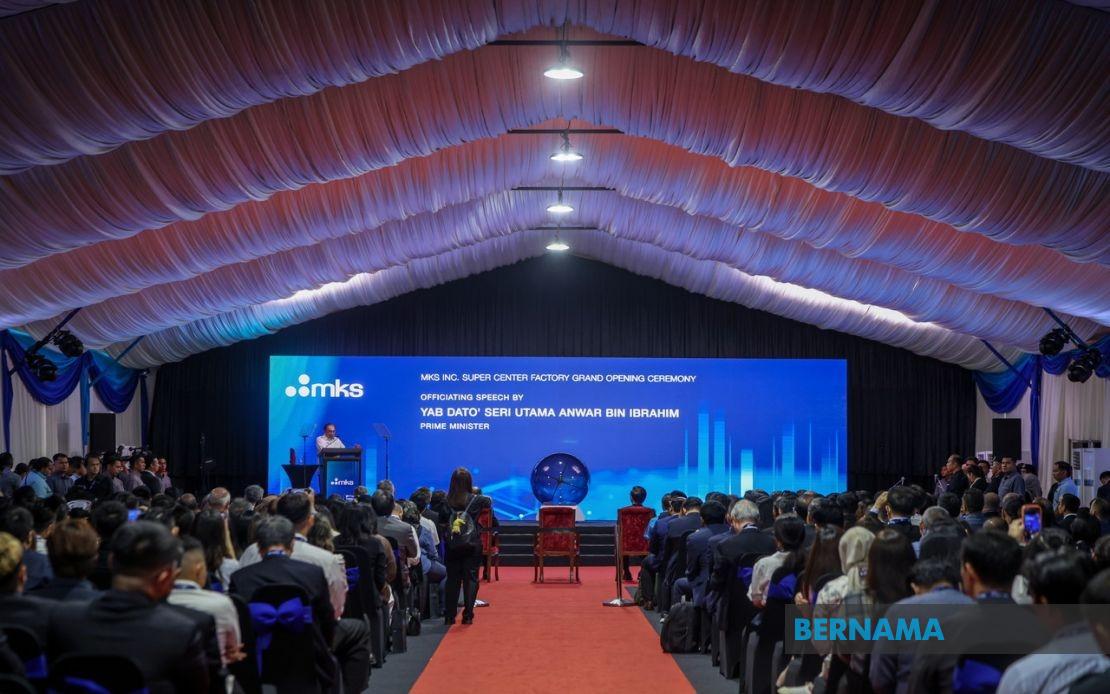
Prime Minister Datuk Seri Anwar Ibrahim has underscored Malaysia's deliberate approach to international relations as a strategic asset that continues to generate tangible economic rewards for the nation. Speaking at the official opening of the MKS Super Centre factory in Bandar Cassia Technology Park, Batu Kawan on June 20, Anwar emphasised that the country's refusal to align exclusively with any single power bloc has become a defining strength in an increasingly polarised world. This positioning, he argued, has reinforced global confidence in Malaysia as a reliable and principled partner, simultaneously opening doors to collaborative ventures that might otherwise remain closed under more rigid diplomatic frameworks.
The Prime Minister's remarks come as Malaysia navigates an intricate geopolitical landscape where economic partnerships have become inseparable from foreign policy considerations. His reference to recent engagements spanning the United States, China, India, and Russia illustrates the breadth of Malaysia's diplomatic reach. The visit by former US President Donald Trump last year symbolised renewed American engagement with Southeast Asia, whilst simultaneous dialogue with Beijing, New Delhi, and Moscow demonstrates Malaysia's capacity to maintain productive relationships without sacrificing its sovereignty or independence. This calibrated approach reflects a sophisticated understanding that economic opportunities often flow through channels established by diplomatic trust and political consistency.
An exemplary manifestation of this strategy's tangibility emerged through Petroliam Nasional Bhd's recent agreement in Turkmenistan, which the Prime Minister cited as concrete evidence of Malaysia's diplomatic positioning translating into commercial advantage. The energy sector partnership illustrates how neutral countries can attract investment and secure resource agreements that might be restricted to ideologically aligned nations in a more fragmented global order. For Malaysia, access to energy partnerships across Central Asia represents not merely commercial gain but also diversification of supply chains and geopolitical risk mitigation, crucial considerations for a nation dependent on stable energy imports.
The broader implications of Malaysia's neutral positioning extend beyond bilateral arrangements to encompass regional influence and soft power accumulation. By maintaining independence whilst expressing principled positions on contentious international issues, Malaysia preserves the moral authority to mediate disputes and broker agreements that benefit not only itself but the wider Southeast Asian region. This diplomatic flexibility positions the nation as a potential facilitator in areas where Western and Chinese interests collide, or where Russian engagement requires careful calibration. The economic opportunities arising from such positioning include trade negotiations, investment attraction, and participation in regional economic frameworks that reward balanced players.
Anwar's emphasis on welcoming participation from all countries whilst maintaining clear positions on global affairs reflects a nuanced understanding of contemporary international commerce. In an era where corporations and governments increasingly seek partners perceived as politically neutral and strategically non-threatening, Malaysia's reputation becomes a commercial asset. Foreign investors are drawn to jurisdictions offering predictability, non-interference, and access to multiple international markets simultaneously. The factory opening ceremony itself, attended by Penang Chief Minister Chow Kon Yeow and Deputy Minister Sim Tze Tzin, underscores how this diplomatic approach translates into local investment and manufacturing growth.
The location of the MKS Super Centre in Penang's Technology Park carries additional significance within Malaysia's development narrative. Penang has established itself as a technology and manufacturing hub, and its continued attraction of international investors depends partly on Malaysia's perceived stability and openness to diverse partnerships. The presence of high-level government officials at the ceremony signals government commitment to leveraging diplomatic advantages for economic benefit. The technology sector particularly values jurisdictions that maintain good relationships across supply chain networks spanning multiple geopolitical zones, making Malaysia's neutral stance commercially advantageous for companies seeking to operate without navigating excessive restrictions or boycotts.
Within Southeast Asia, Malaysia's approach offers a template for smaller nations seeking to maximise economic opportunities without sacrificing autonomy. Unlike countries forced to make binding choices between competing power blocs, Malaysia demonstrates that strategic ambiguity, when paired with consistent principles and transparent communication, can yield superior outcomes. This model holds particular relevance for fellow ASEAN members navigating similar pressures, and Malaysia's demonstrated success in converting diplomatic balance into economic gains may influence broader regional positioning. The willingness of major powers to accommodate Malaysia's independence suggests that genuinely neutral partners have become increasingly valuable in an unstable international environment.
The energy sector provides particularly instructive examples of this principle in practice. Malaysia's ability to negotiate with producers in the Middle East, Central Asia, and other regions depends substantially on its reputation as a non-aligned actor unencumbered by geopolitical constraints. Similarly, the technology and manufacturing sectors benefit from supply chain diversity and access to markets across different political spheres. Companies considering Malaysia as an operational base can confidently plan long-term investments knowing the country maintains relations with multiple trade partners and is not subject to sudden policy reversals driven by external pressure. This stability becomes increasingly valuable as global supply chains fragment and companies seek geographic diversification.
Looking forward, Malaysia's strategic positioning appears poised for continued relevance and economic benefit. The proliferation of global competition between major powers, far from threatening Malaysia's neutral stance, actually enhances its value. Countries and corporations seeking alternatives to polarised arrangements increasingly seek partners embodying independence and principled engagement. The government's articulation of this advantage through high-level statements and public investment decisions signals commitment to maintaining the diplomatic consistency upon which Malaysia's economic opportunities ultimately depend. As Anwar's remarks indicate, this approach is neither passive nor merely defensive, but rather an active strategy consciously deployed to attract investment, secure partnerships, and advance national development objectives whilst preserving the strategic autonomy essential to Malaysian sovereignty and long-term prosperity.

