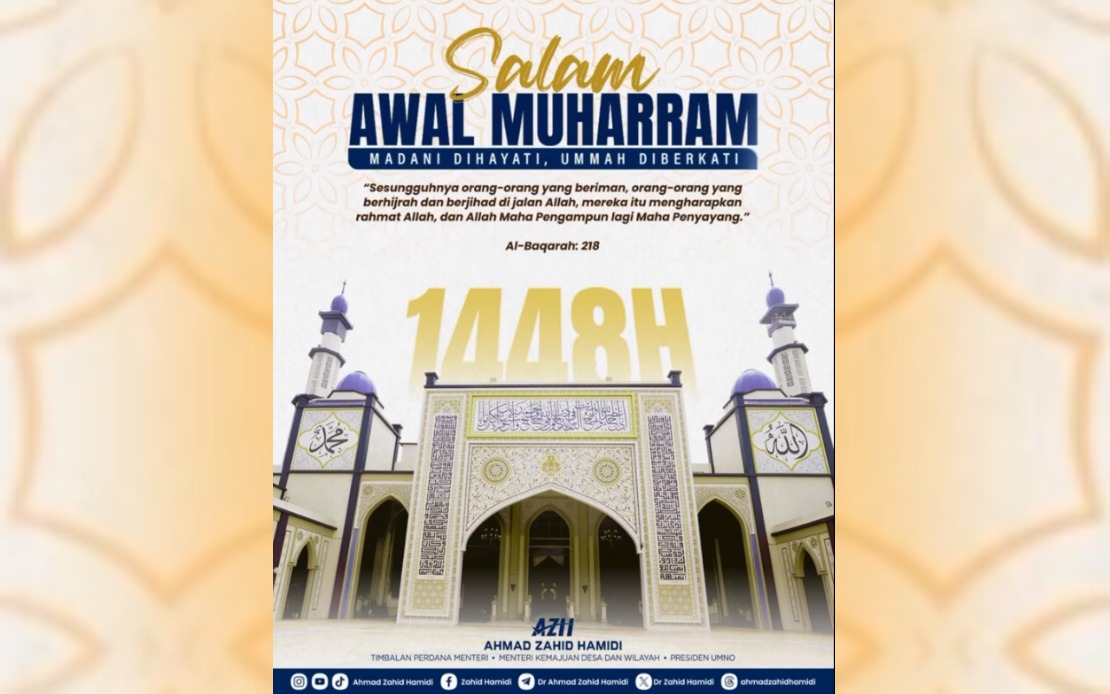
Malaysia's senior government officials have jointly called upon the nation's citizens to harness the spiritual significance of Hijrah—the Islamic concept of migration and transformation—as the Islamic calendar enters the new year of 1448H. The coordinated appeal, delivered on June 16 by Deputy Prime Ministers and multiple Cabinet ministers, positions the occasion as a critical juncture for personal and collective introspection in a period marked by economic uncertainty and social pressures across the region.
Deputy Prime Minister Datuk Seri Dr Ahmad Zahid Hamidi framed Maal Hijrah not as a mere calendar transition but as a philosophical compass for meaningful change. His message emphasised that genuine transformation demands more than rhetoric—it requires sustained commitment, structured discipline and unwavering resolve. By highlighting sacrifice and perseverance as central Islamic virtues, he connected theological concepts to practical governance challenges, suggesting that the principles underpinning the historical migration to Medina remain directly applicable to contemporary Malaysian society navigating constant flux.
The Deputy PM's articulation carries particular weight given Malaysia's current position within Southeast Asia's volatile economic landscape. As regional economies grapple with supply chain fractures and demand volatility, the government's invocation of Hijrah's transformative power suggests an attempt to reframe economic hardship as an opportunity for systemic renewal rather than crisis management. This framing allows policymakers to position difficult reforms as spiritually grounded rather than externally imposed.
Deputy Prime Minister Datuk Seri Fadillah Yusof expanded the conversation toward practical household resilience, directly addressing the cost-of-living pressures that increasingly define Malaysian citizens' daily experiences. His emphasis on prudence, waste reduction and resource conservation deliberately connects Islamic teachings on moderation to immediate economic pressures. By encouraging judicious spending, careful energy use and minimal food waste, he articulates how individual behavioural change aggregates into community-level impact—a critical message when inflation and economic uncertainty dominate public concern.
Fadillah's additional focus on national unity underscores a persistent concern within Malaysia's political establishment: the potential for economic stress to exacerbate communal divisions. His deliberate positioning of togetherness and mutual respect as antidotes to sectional grievance reflects awareness that periods of hardship can activate dormant social fractures. By tethering unity messaging to religious observance, the government attempts to secure buy-in from its predominantly Muslim audience while extending the appeal across Malaysia's diverse population.
Communications Minister Datuk Fahmi Fadzil introduced courage and sincerity as essential Hijrah virtues, suggesting that navigating contemporary challenges requires psychological and moral fortitude alongside material resourcefulness. His framing of the Islamic New Year as a moment for recommitting to integrity particularly resonates given widespread public concern about governance standards and institutional accountability across Malaysia and the broader Southeast Asian region.
Minister in the Prime Minister's Department (Religious Affairs) Zulkifli Hasan elevated the observance beyond secular government messaging by providing specific Islamic guidance on prayer practices and self-reflection rituals. His emphasis on Islah—spiritual self-improvement—grounded the secular appeals in authentic religious practice, ensuring that the government's message aligns with authentic Islamic scholarship rather than appearing instrumentalised. This theological precision strengthens the appeal's credibility within Malaysia's Muslim majority.
The breadth of Cabinet participation—encompassing ministers responsible for agriculture, science, women's affairs, education, defence, trade, health and youth—demonstrates deliberate attempts to universalise the Hijrah message across government domains. Each minister's endorsement suggests that the spirit of transformation and renewal applies not merely to individual Muslims but to every sector of national activity. This comprehensive institutional engagement transforms a religious observance into a whole-of-government reform agenda, though the specific content of such reforms remains largely implicit.
The timing of this coordinated messaging warrants consideration within Malaysia's broader political and economic context. Global supply chain disruptions, energy price volatility and persistent inflation have strained Malaysian households across income levels, creating public dissatisfaction that transcends traditional political divides. By framing economic hardship through a religious and philosophical lens, the government attempts to channel legitimate grievance toward productive introspection rather than reactive blame-shifting. Whether such appeals resonate depends substantially on whether citizens perceive subsequent policy actions as genuinely aligned with articulated values of prudence, unity and integrity.
The emphasis on systemic resilience and adaptability carries particular significance for Southeast Asian readers navigating comparable economic pressures. Malaysia's experience suggests how governments across the region might mobilise cultural and religious resources to encourage population-wide acceptance of difficult adjustments. The Hijrah framework offers a template for reframing austerity and reform as spiritually coherent rather than merely technocratic impositions—a potentially powerful tool during periods when conventional policy messaging faces public scepticism.
For Malaysian policymakers, the challenge lies in translating inspirational rhetoric into institutional practice. Citizens evaluating government messaging regarding unity, integrity and prudence will scrutinise whether subsequent budget allocations, corruption prosecutions and resource distribution decisions align with stated principles. The Hijrah message, powerfully delivered across multiple ministerial voices, will ultimately be judged against the material reality of governance and economic management in the months ahead.

