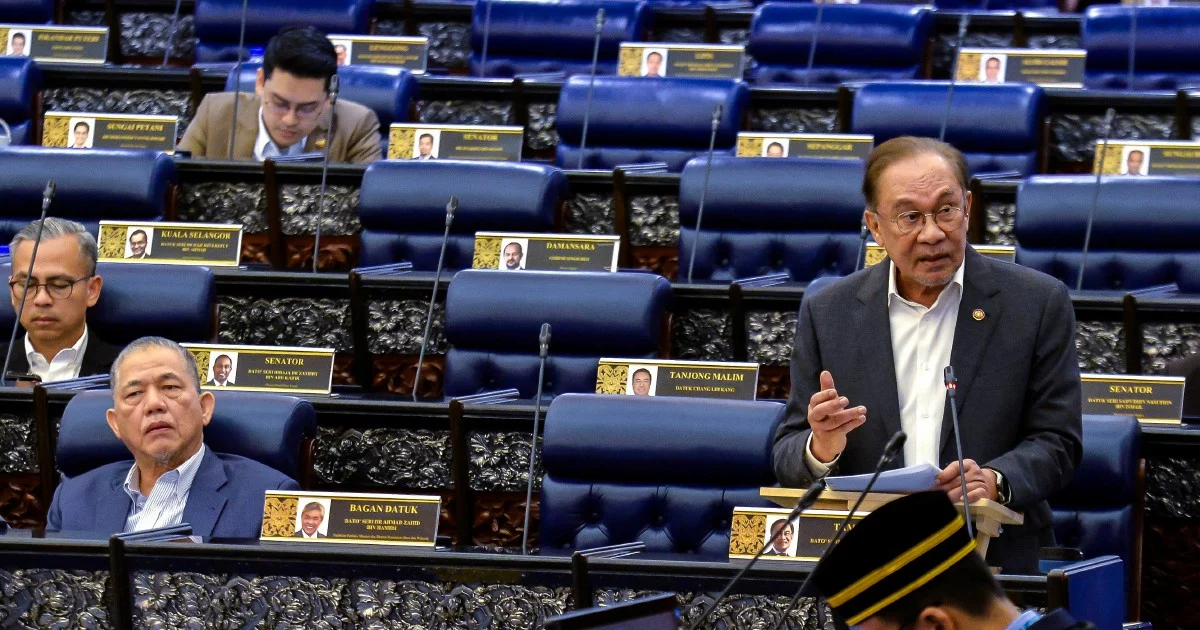
Prime Minister Datuk Seri Anwar Ibrahim announced that Malaysia's household debt has climbed to RM1.73 trillion as of the end of March 2026, representing 84.4 per cent of the nation's gross domestic product. The disclosure underscores mounting pressures on household finances across the country and raises fresh questions about the sustainability of consumer spending patterns that underpin much of the Malaysian economy.
The debt-to-GDP ratio signals an increasingly heavy burden relative to the size of Malaysia's overall economy. With nearly six in every seven ringgit of annual economic output now mirrored in accumulated household liabilities, the figure highlights how deeply indebted Malaysian families have become. This metric matters because it reveals the scale of consumer obligations relative to the nation's productive capacity, affecting everything from interest rate sensitivity to unemployment resilience.
Household debt encompasses mortgages, personal loans, vehicle financing, credit card balances, and other consumer borrowing. The composition of this debt varies significantly across income brackets, with lower-income households typically carrying higher proportions of short-term, higher-cost debt relative to their earnings. Understanding this breakdown is crucial for policymakers assessing which demographic groups face the greatest financial vulnerability as economic conditions evolve.
Malaysia's household debt ratio has been on an upward trajectory for years, reflecting rapid credit expansion in the banking sector and changing consumption patterns. The climb from previous levels indicates that households have increasingly relied on borrowing to finance housing purchases, education, healthcare, and consumption during periods of income uncertainty. This structural shift has reshaped household balance sheets and vulnerability profiles across the nation.
The implications extend beyond individual households to systemic financial stability. Banks and financial institutions that have extended this credit hold substantial exposure to household repayment capacity. Economic shocks affecting employment or income levels could trigger cascading defaults, putting strain on lenders and potentially triggering tighter credit conditions that would further squeeze household finances. The interconnectedness means deteriorating household debt quality could transmit stress throughout the financial system.
Rising household debt also constrains future economic growth potential. As more household income flows toward debt servicing, discretionary spending diminishes, reducing demand for goods and services. This becomes particularly concerning when wage growth lags inflation, as real borrowing capacity shrinks while interest burdens remain fixed. Young Malaysian households, in particular, face stretched affordability metrics in housing markets, forcing deeper reliance on debt to achieve homeownership.
Regional comparisons provide important context. Other Southeast Asian economies monitor similar metrics closely, as household debt levels influence macroeconomic stability and cross-border capital flows. Malaysia's 84.4 per cent ratio positions the nation among the higher-leveraged developing economies, placing it under closer international scrutiny regarding debt sustainability and default risk probabilities.
The central bank and government regulators have deployed various tools to manage household debt risks, including loan-to-value ratios for mortgages, debt service ratio limits for personal loans, and enhanced credit counselling initiatives. These measures aim to prevent excessive leverage while maintaining financial system functionality. However, structural factors driving debt accumulation—including housing inflation, rising education costs, and stagnant wage growth for lower-income groups—continue to exert upward pressure on borrowing.
Malaysian policymakers face a delicate balancing act. Tightening credit access could prevent further debt accumulation but risks choking off credit availability for productive investments and homeownership aspirations. Conversely, permitting rapid credit expansion postpones necessary adjustments while amplifying future instability risks. The optimal path requires targeted interventions addressing high-risk segments while maintaining functional credit markets for legitimate economic activity.
Household debt sustainability also hinges critically on employment stability and income reliability. The acceleration toward automation, artificial intelligence adoption, and economic restructuring creates uncertainty about long-term labour market outcomes, particularly for middle and lower-skilled workers who represent significant portions of the borrowing population. Rising unemployment or income volatility could quickly transform the current debt level from manageable to destabilising.
Looking forward, Malaysia's demographic profile suggests ongoing pressure on household borrowing. Millennials and Generation Z, facing lower real wages and higher housing costs than their parents' generations, will likely accumulate substantial debt burdens during their prime earning years. This intergenerational transfer of debt obligations reshapes financial security expectations and retirement savings patterns.
The Prime Minister's disclosure likely signals heightened government awareness of household debt as an economic concern warranting policy attention. Whether Malaysia can stabilise or gradually reduce this ratio depends on achieving sustainable wage growth, controlling inflation, and perhaps moderating house price appreciation. Without addressing underlying structural imbalances, the trajectory suggests household debt will continue climbing relative to GDP, compounding financial vulnerability across Malaysian families and the broader economic system.

