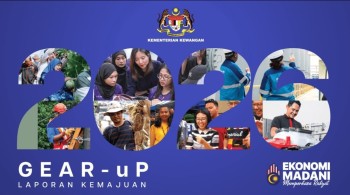
Government-linked investment companies have dramatically escalated their domestic capital deployment this year, committing RM20.3 billion through the Government-Linked Enterprises Activation and Reform Programme (GEAR-uP) in 2025. This represents a substantial increase from RM6.6 billion deployed in 2024, signalling accelerating momentum as the initiative enters its third operational year with expectations carrying through into the first quarter of 2026.
Launched in 2024 under the stewardship of the Ministry of Finance, GEAR-uP represents an ambitious five-year blueprint to mobilise RM120 billion in state-backed capital toward socioeconomic reform and Malaysia's industrial transformation. The programme operates through six major institutional investors: Khazanah Nasional Bhd, the Employees Provident Fund (EPF), Permodalan Nasional Bhd (PNB), Kumpulan Wang Persaraan (Diperbadankan) (KWAP), Lembaga Tabung Angkatan Tentera (LTAT), and Lembaga Tabung Haji (TH). Prime Minister Datuk Seri Anwar Ibrahim, who also serves as finance minister, characterised the programme not as passive capital allocation but as strategically directed national wealth designed to benefit ordinary Malaysians amid an unpredictable global economic environment.
The deployment strategy reflects a deliberate departure from conventional investment philosophy. Rather than allowing capital to circulate with minimal domestic impact, GEAR-uP deliberately channels institutional funds toward infrastructure, digital capabilities, and enterprise development within Malaysia's borders. This approach acknowledges that external volatility—ranging from trade tensions to currency fluctuations—demands domestic resilience. The Prime Minister emphasised that success will ultimately be measured not in aggregate figures deployed, but in how those investments translate into improved living conditions for Malaysian citizens.
Infrastructure expansion constitutes a substantial portion of current commitments. Tenaga Nasional Bhd continues upgrading Malaysia's electrical grid through Regulatory Period 4, with allocations climbing from RM12 billion in 2025 toward RM15 billion by 2027. This trajectory directly supports the nation's renewable energy targets, with government policy aiming for 70 per cent renewable energy capacity by 2050. Meanwhile, Malaysia Airports has committed to an 11-billion-ringgit five-year modernisation programme centred on expanding Kuala Lumpur International Airport's passenger handling capacity beyond 100 million annually. These foundational investments create employment while positioning Malaysia competitively for intra-regional trade and tourism growth.
Data centre development represents an emerging frontier for GEAR-uP capital deployment. KWAP-backed expansion of Google's Selangor facility will generate an additional 320 megawatts of capacity and create approximately 26,500 jobs through 2026 and 2027, complemented by phased development of Empyrion Digital's Johor operations. For Malaysia and Southeast Asia broadly, data centre investment signifies economic participation in the digital economy's foundational infrastructure. These facilities anchor supply chains, attract technology-adjacent employment, and establish Malaysia as a regional digital hub—advantages particularly relevant given intensifying regional competition from Thailand, Vietnam, and Singapore.
Capital markets development underpins longer-term economic transformation envisioned under GEAR-uP. Specialised investment vehicles—Dana Impak, Dana Perintis, Dana Pemacu, and Ekuinas—systematically channel institutional capital toward venture-stage companies, propelling them toward growth and maturity. Khazanah's planned Dana Ciptawan will inject RM200 million specifically targeting Bumiputera enterprises and mid-tier Malaysian firms, addressing historical capital access constraints faced by these segments. Collectively, these instruments create viable pathways for Malaysian companies to scale beyond dependency on foreign capital or investment. The Capital Market Masterplan targets market capitalisation between RM5.8 trillion and RM6.3 trillion by 2030, with this institutional pipeline functioning as the essential delivery mechanism.
Bumiputera wealth creation receives explicit programme focus through multiple channels. Ten Bumiputera-linked companies are targeted for public listing during 2026 and 2027, expanding ownership opportunities among designated communities. Concurrently, the Bumiputera Champions Programme works to scale existing businesses toward competitive positioning. Zakat Wakalah—an innovative Islamic financing instrument—is projected to reach RM100 million by 2026, escalating from RM28 million previously. For Malaysia's Muslim-majority population and Islamic finance sector, these mechanisms demonstrate institutional integration of religious principles with contemporary capital markets, potentially establishing templates applicable across Southeast Asia's Islamic finance ecosystem.
Government-linked companies broadly remain on trajectory toward RM100 billion in additional market value by 2028, with the MY Value Up initiative extending disciplinary value creation practices to Malaysia's 88 largest listed companies. This systemic approach recognises that GEAR-uP's impact extends beyond directly allocated capital; by establishing performance benchmarks across the broader listed company universe, the programme catalyses competitiveness and efficiency throughout Malaysia's corporate landscape. Such discipline creates positive externalities—improved corporate governance, enhanced investor confidence, and stronger competitive positioning relative to regional peers.
Minister of Finance II Datuk Seri Amir Hamzah Azizan articulated the philosophical foundation underlying capital deployment strategy. Capital, by itself, generates no economic benefit; its value materialises only when deployed toward productive employment, creating living wages and career advancement for Malaysian workers. The 2025 portfolio of companies delivered 8.0 per cent total shareholder returns, demonstrating that development objectives and financial performance need not conflict. Measurement extends beyond ringgit figures to encompassing wage levels, graduate employment placement, Bumiputera firm scalability, and domestic supply chain establishment. This integrated performance framework acknowledges that inclusive economic growth requires simultaneous attention to returns and distribution.
The external environment's volatility—characterized by global trade reconfiguration, geopolitical tensions, and currency pressures—provides context for GEAR-uP's urgency and design. Malaysia's ability to maintain economic stability through 2024 reflected earlier structural reforms implemented in 2023, establishing foundations upon which GEAR-uP builds. The programme's direction, established at inception in 2024, deliberately focused on delivery rather than theoretical possibility. Three remaining years promise tangible outcomes: Google's data centre, airline capacity expansion, renewable energy infrastructure, and Bumiputera enterprise listings—all represent initiatives already in motion with concrete timelines and measurable deliverables.
For regional observers, GEAR-uP represents a distinctive approach to state-directed capital deployment combining institutional sophistication with inclusive growth objectives. Unlike historical developmental state models emphasising rapid accumulation regardless of distribution, GEAR-uP explicitly integrates social outcomes alongside financial returns. The programme's success—or failure—will inform broader regional conversations about managing state capital in era of simultaneous demands for economic competitiveness and equitable prosperity. Malaysia's commitment to deploying RM120 billion over five years, with acceleration already evident in 2025 figures, suggests institutional and political commitment to sustained execution despite external uncertainties.

