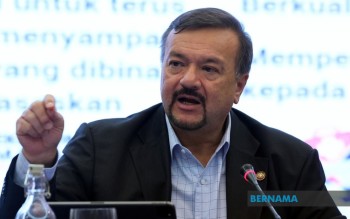
Malaysia's economic performance continues to defy global uncertainty, with the country recording an upward trajectory of growth momentum that signals resilience in an increasingly volatile international environment. Finance Minister II Datuk Seri Amir Hamzah Azizan underscored this resilience at a press conference in Putrajaya, noting that Malaysia's gross domestic product expanded by 5.2 per cent in both 2024 and 2025, before accelerating to 5.4 per cent in the first quarter of this year and an advanced estimate of 5.8 per cent for the second quarter, translating to an average expansion of 5.6 per cent for the first half of 2025.
The sequential strengthening of growth rates throughout the year presents a particularly encouraging narrative for policymakers and investors who have grown accustomed to hearing warnings of imminent slowdowns from international agencies. Amir Hamzah's articulation of these figures emphasised not merely the headline growth numbers, but the underlying stability they represent in a context marked by trade tensions and Middle Eastern conflicts that have disrupted economies across the Asia-Pacific region. For Malaysian readers, this performance carries particular significance as it demonstrates that domestic policy interventions are yielding measurable results rather than remaining theoretical constructs.
The minister credited the momentum to implementation of the MADANI Economy Framework, an overarching economic strategy that has guided Malaysia's approach to development over the past several years. Rather than relying on external demand or commodity cycles, the framework has sought to reorient the economy toward sustainable, inclusive growth driven by strategic domestic investments and structural improvements. This philosophical shift represents a deliberate pivot away from the economy's historical dependency on external markets and global supply chains, making Malaysia less vulnerable to the kind of sudden external shocks that have previously derailed regional growth.
Central to this strategy is the GEAR-uP programme, which commenced in 2024 under the Finance Ministry's stewardship with the ambitious target of channelling RM120 billion in direct domestic investment throughout the 2024-2028 period. This represents one of the largest coordinated domestic investment drives in Malaysian history, reflecting the government's commitment to transforming the economy through targeted capital deployment. The scale of commitment demonstrates that policymakers view long-term structural transformation as more important than short-term fiscal constraints, a stance that contrasts with more cautious approaches adopted elsewhere in the region.
Government-linked investment companies and government-linked companies have emerged as the primary vehicles for executing this vision, functioning as institutional catalysts to mobilise private sector participation and channel foreign expertise into domestic industries. Rather than relying solely on traditional foreign direct investment mechanisms, this approach leverages existing state-owned entities to identify promising sectors and coordinate cross-institutional cooperation that might be difficult for individual private firms to orchestrate independently. The mechanism essentially transforms GLICs and GLCs from peripheral players into strategic anchors of economic transformation, a repositioning that reflects sophisticated understanding of how state capacity can complement rather than substitute for market forces.
Amir Hamzah articulated a particularly nuanced perspective on the relationship between capital inflows and developmental outcomes, noting that securing funding alone remains insufficient without corresponding improvements in productivity, talent acquisition, and technology transfer. This observation addresses a persistent challenge in emerging market economies: the tendency for capital investment to generate headline growth figures without corresponding improvements in per capita income or living standards. By emphasising that the true measure of success lies in whether ordinary Malaysians experience tangible improvements in their economic circumstances, the minister signalled awareness that growth statistics alone cannot sustain political legitimacy or public confidence in economic management.
The geopolitical and trade environment that has surrounded this growth performance adds an additional layer of significance to Malaysia's results. Throughout 2024 and continuing into 2025, global trade tensions have intensified, with major trading nations adopting protectionist measures that have disrupted conventional supply chains and forced companies to reconsider sourcing strategies. Simultaneously, escalating tensions in West Asia have created uncertainty for businesses with exposure to regional logistics and commodity markets. Malaysia, with its extensive maritime trade routes and significant numbers of nationals working in affected regions, faced particular vulnerability to these developments, yet somehow sustained growth rates that many developed economies have struggled to achieve.
This resilience reflects several structural advantages that Malaysia has cultivated over recent decades, including a diversified industrial base that spans electronics, petrochemicals, palm oil processing, and increasingly sophisticated services sectors. Unlike countries heavily dependent on a single commodity or market, Malaysia possesses multiple growth engines that can partially offset weakness in any particular sector. The economy's geographic position as a crucial node in regional supply networks and its reputation for political and macroeconomic stability have also helped attract investors seeking alternatives to established supply chain hubs facing geopolitical risks.
Looking forward, the minister expressed confidence that Malaysia's development trajectory remains broadly aligned with national ambitions to achieve developed-country status within a defined timeframe. This declaration carries implications not merely for Malaysia but for Southeast Asia more broadly, as the region's largest economies have begun competing to establish themselves as alternatives to established developed-nation models. Should Malaysia successfully combine rapid growth with improvements in institutional quality, education systems, and environmental sustainability, the model could prove influential across the region and demonstrate that developing nations need not simply replicate the development pathways of earlier industrialisers.
The emphasis on cooperation from multiple stakeholders reflects recognition that economic transformation ultimately depends on coordination between government, businesses, educational institutions, and civil society. While the MADANI Economy Framework and GEAR-uP programme provide strategic direction and capital, success ultimately requires complementary actions across numerous domains including workforce development, regulatory reform, infrastructure investment, and maintenance of macroeconomic stability. The minister's framing of development as a collective enterprise rather than a government-directed initiative suggests awareness that sustained transformation requires broad-based institutional commitment and alignment of incentives across society.
For Malaysian businesses, particularly mid-sized enterprises that lack direct access to global capital markets or sophisticated international business networks, the growth momentum and explicit government commitment to supporting domestic investment creates windows of opportunity. Companies positioned in sectors targeted by GEAR-uP or supported by GLC partnerships may find easier access to capital, supply chains, and talent than would otherwise be available. The initiative essentially democratises some advantages previously concentrated among large multinational corporations or well-connected family businesses, potentially enabling a broader class of firms to participate in Malaysia's development trajectory.
As Malaysia navigates the remainder of 2025 and prepares for subsequent years, sustaining this growth momentum will require continued policy discipline and adaptation to shifting international conditions. Trade relations with major partners remain fluid, and geopolitical tensions could intensify in ways that directly affect Malaysian interests. Nevertheless, the demonstrated resilience through the first two quarters of the year provides empirical foundation for optimism, suggesting that Malaysia's economic foundations have become sufficiently robust to weather significant external pressures while maintaining forward momentum toward development objectives.

