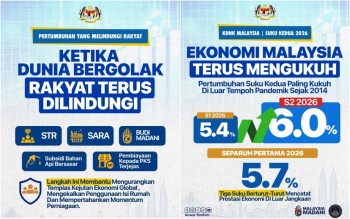
Malaysia's economy demonstrated remarkable resilience in the second quarter of 2026, recording gross domestic product growth of six per cent—a performance that outstripped market forecasts and represented the country's most robust second-quarter expansion outside pandemic-affected years since 2014. Prime Minister Datuk Seri Anwar Ibrahim announced the data, underscoring the achievement as a vindication of the MADANI Government's economic management strategy during a period marked by significant international headwinds.
The expansion arrives at a notably challenging juncture in the global economic calendar. Worldwide economic activity has decelerated substantially, driven by persistent supply chain disruptions originating from geopolitical tensions in West Asia and broader inflationary pressures that have reverberated through emerging markets. Against this backdrop, Malaysia's ability to sustain and indeed accelerate growth signals a divergence from the regional and global trajectory, positioning the country as a relative economic bright spot in a dimming international landscape.
According to Anwar's assessment, the government's multi-pronged approach to insulating ordinary Malaysians from external economic shocks has been instrumental in maintaining domestic consumption patterns and, by extension, supporting overall economic momentum. The administration has deployed several targeted assistance mechanisms, including BUDI MADANI, Sumbangan Tunai Rahmah (STR), and Sumbangan Asas Rahmah (SARA), each designed to cushion households against inflationary pressures that have squeezed living standards across much of the developing world.
Beyond the headline assistance programmes, the Prime Minister indicated that government efforts to stabilise prices and maintain supply chain continuity have operated largely behind public view, comprising administrative coordination and regulatory measures that have prevented the kind of acute supply shocks witnessed elsewhere. This dual approach—combining direct fiscal transfers with supply-side management—offers a template that has gained traction among policymakers seeking to reconcile growth objectives with social protection commitments.
The second-quarter result carries particular significance for Malaysia's medium-term economic narrative. The country has long sought to transition from a commodity-dependent growth model toward a more diversified and resilient economy. Demonstrating strong headline growth during a period when many peers contracted or decelerated substantially suggests that structural shifts in the economy—whether through digitalisation, services expansion, or manufacturing diversification—may be yielding tangible dividends.
However, Anwar was notably candid about the incompleteness of the government's economic agenda. He acknowledged that while the growth figure represented a considerable achievement, sustaining this momentum required continued commitment to broader reforms that extended well beyond cyclical management. The Prime Minister emphasised the necessity of translating macroeconomic gains into meaningful improvements in household incomes, employment quality, and targeted support for populations most vulnerable to economic fluctuations.
This framing reflects an emerging tension within Malaysian economic discourse. Headline growth figures, while impressive to international investors and rating agencies, frequently mask uneven distributional outcomes in which gains concentrate among capital-owning segments while wage-dependent households experience marginal real income growth. Anwar's acknowledgment that additional work remained on this front suggested awareness within government that growth alone, divorced from inclusivity mechanisms, risked generating social friction and political vulnerability.
The emphasis on job quality rather than merely employment numbers further indicates a recalibration of economic priorities. Malaysia's labour market has historically been characterised by high workforce participation rates masked by underemployment, skills mismatches, and wage stagnation in certain sectors. The government's apparent intention to prioritise qualitative employment improvements over quantitative expansion suggests recognition that future growth sustainability depends increasingly on worker productivity and real living standard enhancement rather than simple labour force additions.
For regional observers, Malaysia's Q2 performance carries implications extending beyond national borders. The Southeast Asian region faces collective headwinds from slowing global trade, volatile commodity prices, and capital flow volatility. A sustained demonstration of growth-oriented economic management in Malaysia could either inspire emulation of its policy approaches or, conversely, deepen economic divergence within ASEAN, concentrating investment flows and talent migration toward the stronger-performing economies.
The government's commitment to remaining on a reform trajectory, as Anwar articulated, suggests that policymakers view the current growth phase not as a destination but as a window for structural transformation. This perspective aligns with longer-term national development objectives outlined in various strategic planning documents, where Malaysia has consistently positioned itself as an upper-middle-income economy transitioning toward high-income status.
International economic conditions will substantially determine the sustainability of current momentum. Escalation of West Asian tensions, further supply chain disruptions, or tightening in global financial conditions could rapidly reverse the favourable growth environment. Consequently, while the six per cent second-quarter figure merits celebration, prudent economic stewardship requires simultaneous preparation for less benign scenarios through maintenance of fiscal buffers and continued structural reforms that enhance long-term productivity.
The government's multi-faceted approach—combining targeted assistance, supply management, and growth-oriented structural reform—represents a coherent economic philosophy, though execution remains the critical variable. Success in translating this approach into sustained, inclusive growth would validate the MADANI Government's broader development model, while shortcomings would necessitate strategic reassessment as Malaysia navigates the complex intersection of domestic aspirations and international economic dynamics.

